
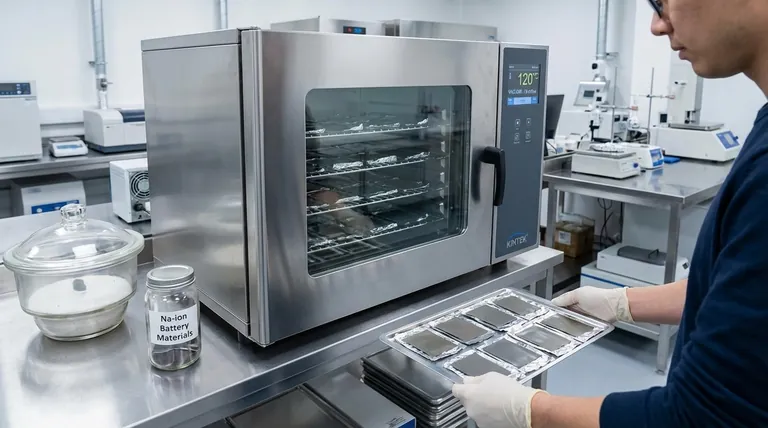
Reliable electrochemical testing of sodium-ion batteries requires pristine electrode conditions. A vacuum drying oven is necessary to perform deep dehydration and thoroughly remove residual organic solvents from coated electrode sheets. Because sodium-ion materials are extremely sensitive to moisture, this step is critical to prevent unwanted chemical reactions that distort test data and degrade battery performance.
The Core Takeaway: The vacuum drying process acts as a final purification step, eliminating trace moisture and solvents that would otherwise cause electrolyte decomposition, corrosion, and unstable Solid Electrolyte Interface (SEI) formation.
The Critical Role of Deep Dehydration
Eliminating Moisture Sensitivity
Sodium-ion battery materials are inherently sensitive to moisture. Even trace amounts of water can alter the chemical structure of the active materials.
Using a vacuum drying oven, often set to temperatures around 120 °C, ensures the thorough removal of physically adsorbed water. This prevents the degradation of materials before the battery is even assembled.
Removing High-Boiling Point Solvents
Electrode slurries often use solvents like N-Methyl-2-pyrrolidone (NMP), which have high boiling points. Evaporating these at standard atmospheric pressure would require excessive heat that could damage the electrode.
The vacuum environment significantly lowers the boiling point of these solvents. This allows for complete evaporation at lower temperatures (typically between 80 °C and 110 °C), ensuring no residual solvent remains to interfere with battery chemistry.
Extracting Trapped Residues
Electrodes contain micropores where moisture and gases can become trapped. Standard drying often fails to reach these internal structures.
Vacuum drying utilizes negative pressure to pull solvent molecules and water vapor out from deep within the electrode structure. This ensures the internal material is just as dry as the surface.
Impact on Electrochemical Performance
Preventing Electrolyte Decomposition
If residual moisture remains in the electrode, it will react with the sodium salt electrolytes once the battery is assembled.
This reaction causes the electrolyte to decompose, often generating gas or acidic byproducts. These byproducts ruin the internal chemistry, leading to poor cycle life and safety hazards.
Ensuring SEI Stability
For a sodium-ion battery to function correctly, a stable Solid Electrolyte Interface (SEI) film must form on the electrode.
Residual water and solvents disrupt this formation. By ensuring a pristine, dry environment, the vacuum oven facilitates the creation of a stable SEI, which is essential for accurate initial coulombic efficiency (ICE) and long-term cycling stability.
Understanding the Trade-offs
Temperature vs. Material Integrity
While deep drying is necessary, the temperature must be carefully controlled.
If the temperature is too high, the binder within the electrode may degrade, or the active material may peel off the current collector. Conversely, temperatures that are too low (even under vacuum) may fail to remove the final traces of NMP.
Vacuum Consistency
The process relies on a consistent vacuum level. Fluctuations in pressure can lead to uneven drying rates.
This uneven evaporation can cause coating cracks or "mud-cracking" on the electrode surface. This physical damage compromises the contact between the active substance and the current collector, skewing impedance measurements.
Making the Right Choice for Your Goal
To ensure your electrochemical testing is valid, tailor your drying process to your specific objectives:
- If your primary focus is Research Accuracy: Ensure deep drying (often 120 °C) to remove every trace of water, as this eliminates variables that could cause side reactions and falsify your electrochemical kinetics data.
- If your primary focus is Electrode Mechanical Stability: utilize a slightly lower temperature (e.g., 70-80 °C) with a strictly controlled vacuum to prevent coating cracks and ensure uniform adhesion to the current collector.
Ultimately, the vacuum drying oven is not just a drying tool; it is a critical instrument for stabilizing the chemical environment of your battery cell.
Summary Table:
| Factor | Impact on Sodium-Ion Electrodes | Importance of Vacuum Drying |
|---|---|---|
| Moisture Content | Causes chemical degradation & side reactions | Ensures deep dehydration of sensitive materials |
| NMP Solvents | Interferes with battery chemistry | Lowers boiling point for complete removal at safe temps |
| Micropores | Trap gases and residual moisture | Negative pressure extracts trapped internal residues |
| SEI Formation | Contaminants lead to unstable SEI films | Provides the pristine surface needed for stable SEI |
| Cycle Life | Electrolyte decomposition reduces lifespan | Prevents acidic byproduct formation to extend life |
Precision Heat Treatment for Advanced Battery Research
Ensure the integrity of your electrochemical data with KINTEK’s high-performance vacuum drying solutions. Backed by expert R&D and manufacturing, we offer a comprehensive range of Muffle, Tube, Rotary, Vacuum, and CVD systems, as well as other lab high-temperature furnaces—all fully customizable to meet the rigorous demands of sodium-ion and lithium-ion battery testing.
Don't let residual moisture compromise your research accuracy. Contact KINTEK today to discover how our specialized equipment provides the consistent vacuum levels and precise temperature control your lab requires.
References
- Junhua Zhou, Mark H. Rümmeli. Titanium Substitution Facilitating Oxygen and Manganese Redox in Sodium Layered Oxide Cathode. DOI: 10.1002/admi.202400190
This article is also based on technical information from Kintek Furnace Knowledge Base .
Related Products
- Vacuum Heat Treat Sintering and Brazing Furnace
- Vacuum Heat Treat Sintering Furnace Molybdenum Wire Vacuum Sintering Furnace
- Dental Porcelain Zirconia Sintering Ceramic Vacuum Press Furnace
- Vacuum Hot Press Furnace Machine for Lamination and Heating
- Vacuum Hot Press Furnace Machine Heated Vacuum Press
People Also Ask
- What is one of the most important uses of vacuum heat treating furnaces in aerospace? Achieve Superior Strength in Aircraft Alloys
- What are the benefits of using vacuum heat treating furnaces for metal alloys? Achieve Superior Metal Properties and Performance
- How does vacuum heat treating affect the grain structure of metal alloys? Achieve Precise Microstructure Control
- What is the temperature of a vacuum furnace brazing? Optimize Your Joint Strength and Cleanliness
- What are the steps involved in a typical vacuum brazing treatment? Master the Process for Strong, Clean Joints







