
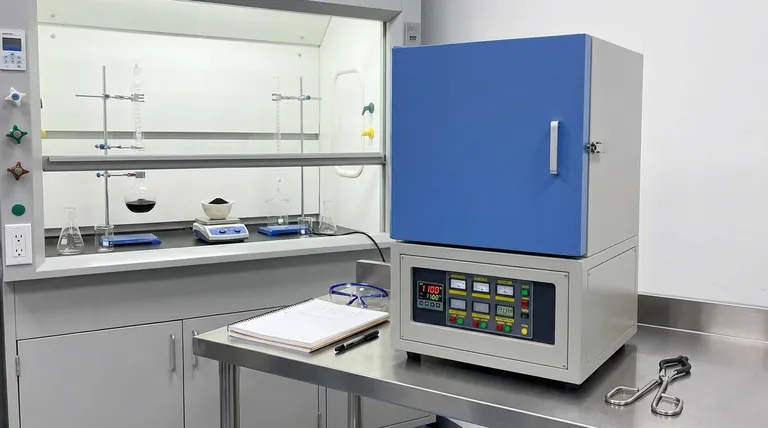
High-precision thermal management is the deciding factor in successfully synthesizing La0.6Sr0.4MxM’1-xO3 perovskites. A programmable high-temperature muffle furnace is necessary to maintain a strict constant temperature of 1100 °C for 6 hours, ensuring the complete conversion of metal oxides into the target rhombohedral crystalline structure. Without this specific programmable control, you cannot guarantee the elimination of impurity phases or the structural stability required for the material's redox capacity.
Core Insight The muffle furnace does not merely heat the material; it creates a specific thermodynamic environment that drives phase purity. By enforcing a rigorous heating rate and a sustained 1100 °C dwell time, the furnace stabilizes the crystal lattice and maximizes the material's performance during chemical cycling.
The Critical Role of Thermodynamics in Phase Formation
Reaching the Energy Threshold
The formation of the La0.6Sr0.4MxM’1-xO3 perovskite phase requires significant thermal energy to overcome the activation barrier for solid-state reactions.
A standard oven is insufficient; the furnace must reliably reach and hold 1100 °C. This high temperature provides the necessary thermodynamics to drive the reaction between raw metal oxides to completion.
Ensuring Crystalline Symmetry
The specific goal of this calcination process is to achieve a rhombohedral symmetry in the crystal structure.
Fluctuations in temperature or insufficient heat can result in amorphous phases or incorrect symmetries. The programmable furnace ensures the thermal field remains stable enough to organize the atomic structure precisely.
Enhancing Redox Capacity
The ultimate performance of this perovskite depends on its ability to undergo reduction and oxidation (redox) cycles.
Proper calcination eliminates structural defects that hamper this process. By securing the phase stability through controlled heating, the material retains its reactivity and durability during repeated chemical cycling.
Why Programmable Control is Essential
Eliminating Impurity Phases
One of the primary functions of the programmable cycle is the total removal of unwanted byproducts.
The furnace must control the heating rate to allow for the complete decomposition of precursors and the removal of volatile impurities. If the temperature ramps up too quickly or fluctuates, impurities may become trapped within the lattice, degrading purity.
Preventing Thermal Shock
Programmable control allows you to set a specific heating rate (ramp rate).
This controlled ascent prevents thermal shock, which can cause cracking or inconsistent grain growth. A gradual, linear increase in temperature ensures that the material heats uniformly throughout the batch.
Understanding the Trade-offs
While high temperatures are required for phase formation, there is a delicate balance that must be maintained.
The Risk of Sintering
While 1100 °C is necessary for this specific perovskite, excessive temperatures or prolonged dwell times beyond the optimal 6 hours can lead to severe sintering.
Sintering causes grains to fuse and pores to collapse, drastically reducing the specific surface area. This reduces the number of active sites available for reaction, counteracting the benefits of high crystallinity.
Balancing Crystallinity and Activity
You are constantly trading off between crystal stability and surface activity.
Higher temperatures generally improve structural stability (crystallinity) but may degrade surface area. Precision control allows you to hit the exact "sweet spot"—in this case, 1100 °C—where the phase is stable, but the material remains active.
Making the Right Choice for Your Goal
To maximize the utility of your muffle furnace for perovskite synthesis, align your programming with your specific material objectives.
- If your primary focus is Phase Purity: Ensure the furnace is programmed for a consistent 1100 °C hold for exactly 6 hours to guarantee the conversion to rhombohedral symmetry.
- If your primary focus is Structural Integrity: strict adherence to a controlled heating rate is required to prevent thermal stress and grain coarsening during the ramp-up phase.
- If your primary focus is Electrochemical Performance: Verify that the temperature uniformity within the chamber is high to eliminate impurity phases that reduce redox capacity.
Precision in your thermal profile is the only way to transform raw oxides into a high-performance, stable perovskite catalyst.
Summary Table:
| Parameter | Target for Perovskite Calcination | Role in Material Performance |
|---|---|---|
| Temperature | 1100 °C | Drives solid-state reaction to reach rhombohedral symmetry |
| Dwell Time | 6 Hours | Ensures complete elimination of impurity phases |
| Control Type | Programmable Ramp Rate | Prevents thermal shock and inconsistent grain growth |
| Goal | Phase Stability | Maximizes redox capacity and chemical cycling durability |
Optimize Your Perovskite Synthesis with KINTEK Precision
Achieving the perfect rhombohedral symmetry in La0.6Sr0.4MxM’1-xO3 requires more than just heat—it requires exact thermal management.
Backed by expert R&D and world-class manufacturing, KINTEK offers a comprehensive range of Muffle, Tube, Rotary, Vacuum, and CVD systems. Our lab high-temperature furnaces provide the programmable precision and temperature uniformity necessary to eliminate impurities and prevent over-sintering. Whether you need a standard solution or a system customizable for your unique research needs, KINTEK is your partner in advanced material science.
Ready to elevate your lab's efficiency and material performance?
References
- Stefano Scognamiglio, Gianluca Landi. Tunable H <sub>2</sub> /Syngas Production by Chemical Looping Reforming of Methane over La <sub>0.6</sub> Sr <sub>0.4</sub> <i>M</i> <sub>x</sub> <i>M’</i> <sub>1‐x</sub> ( <i>M</i> , <i>M’</i> = Fe, Mn, Co)O <sub>3</sub> Perovskites. DOI: 10.1002/cctc.202500554
This article is also based on technical information from Kintek Furnace Knowledge Base .
Related Products
- 1700℃ High Temperature Muffle Oven Furnace for Laboratory
- 1800℃ High Temperature Muffle Oven Furnace for Laboratory
- 1200℃ Muffle Oven Furnace for Laboratory
- 1400℃ Muffle Oven Furnace for Laboratory
- High Temperature Muffle Oven Furnace for Laboratory Debinding and Pre Sintering
People Also Ask
- What is the primary function of a high-temperature laboratory muffle furnace in chemical synthesis? Achieve Precision.
- How does a high-temperature laboratory muffle furnace affect material properties? Transform Anodic Oxide Films Fast
- What role does a muffle furnace play in BCZY712 electrolyte powder production? Achieve Perfect Phase Purity
- How does a muffle furnace impact Ni/MgAl2O4 catalysts? Optimize Stability and Catalytic Performance
- What is the role of a high-temperature muffle furnace in guava leaf carbonization? Master Precise Pyrolysis Control



















