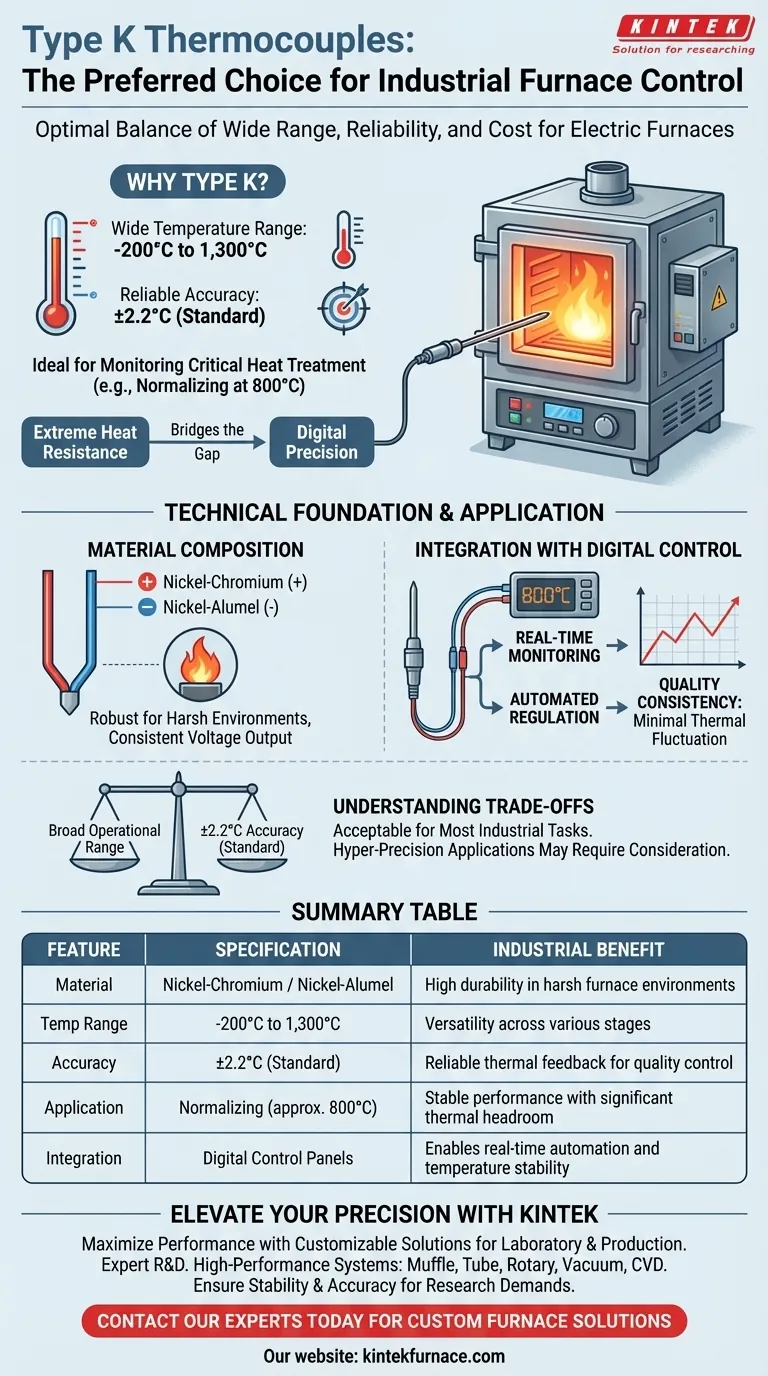
Type K thermocouples are the preferred choice for industrial electric furnace control because they offer an optimal balance of wide temperature range and reliable accuracy. Composed of Nickel-Chromium and Nickel-Alumel, these sensors operate effectively from -200°C to 1,300°C. This specific range, combined with a standard accuracy of ±2.2°C, makes them ideal for monitoring critical heat treatment processes where consistent thermal feedback is mandatory.
By bridging the gap between extreme heat resistance and digital precision, Type K thermocouples allow operators to maintain strict quality control during sensitive normalizing processes at temperatures as high as 800°C.
The Technical Foundation
Material Composition
The reliability of the Type K thermocouple stems from its specific metallurgical construction. It utilizes a Nickel-Chromium positive leg and a Nickel-Alumel negative leg.
This combination is robust enough to withstand the harsh environments found inside industrial electric furnaces while generating a consistent voltage output for measurement.
Broad Operational Range
Industrial furnaces require sensors that do not fail under thermal stress. The Type K offers a measurement spectrum spanning from -200°C to 1,300°C.
This wide versatility ensures that a single sensor type can handle various stages of operation, from cryogenic baselines up to the intense heat required for metal treatment.
Application in Process Control
Optimization for Normalizing
Heat treatment processes, such as normalizing, often require sustained temperatures around 800°C.
The Type K thermocouple operates comfortably within this range, well below its upper limit of 1,300°C. This "headroom" ensures the sensor remains stable and durable even during prolonged heating cycles.
Integration with Digital Control
Modern electric furnaces rely on digital control panels to automate temperature regulation.
Type K sensors provide the necessary electrical feedback to these panels. This integration allows the system to monitor internal conditions in real-time.
Ensuring Quality Consistency
The primary goal of the control system is consistent heat treatment quality.
By providing continuous feedback, the thermocouple allows the digital controller to make immediate adjustments to the heating elements. This minimizes thermal fluctuation and ensures the workload is processed exactly according to specification.
Understanding the Trade-offs
Accuracy Limitations
While highly effective for general industrial use, operators must be aware of the accuracy specifications. The Type K thermocouple typically offers an accuracy of ±2.2°C.
For most normalizing and heat treatment tasks, this tolerance is perfectly acceptable. However, for applications requiring hyper-precision (e.g., fractional degree control), this tolerance band must be accounted for in the quality assurance strategy.
Making the Right Choice for Your Goal
To ensure your furnace control system meets your operational requirements, consider the following:
- If your primary focus is Standard Heat Treatment: Rely on Type K thermocouples for processes like normalizing at 800°C, where the sensor's durability and range provide the best return on investment.
- If your primary focus is Process Stability: Utilize the real-time feedback capabilities of these sensors to drive digital logic, ensuring your furnace reacts instantly to any temperature deviation.
Selecting the Type K thermocouple ensures a robust link between the physical heat of the furnace and the digital precision of your control system.
Summary Table:
| Feature | Specification | Industrial Benefit |
|---|---|---|
| Material | Nickel-Chromium / Nickel-Alumel | High durability in harsh furnace environments |
| Temp Range | -200°C to 1,300°C | Versatility across various heat treatment stages |
| Accuracy | ±2.2°C (Standard) | Reliable thermal feedback for quality control |
| Application | Normalizing (approx. 800°C) | Stable performance with significant thermal headroom |
| Integration | Digital Control Panels | Enables real-time automation and temperature stability |
Elevate Your Heat Treatment Precision with KINTEK
Maximize your furnace performance with temperature control solutions designed for industrial excellence. Backed by expert R&D and world-class manufacturing, KINTEK provides high-performance Muffle, Tube, Rotary, Vacuum, and CVD systems—all fully customizable to meet your unique laboratory or production needs.
Whether you are performing sensitive normalizing at 800°C or high-temperature material synthesis, our systems ensure the stability and accuracy your research demands. Contact our technical experts today to discuss how our customizable high-temp furnaces can optimize your workflow.
Visual Guide
References
- Gustavo Ribeiro Zanini, LUIS CARLOS GERON. PROJETO DE UM FORNO ELÉTRICO INDUSTRIAL PARA TRATAMENTO TÉRMICO TUBOS DE AÇO SA-178 GR A. DOI: 10.52138/citec.v17i01.437
This article is also based on technical information from Kintek Furnace Knowledge Base .
Related Products
- Multi Heating Zones CVD Tube Furnace Machine for Chemical Vapor Deposition Equipment
- High Temperature Muffle Oven Furnace for Laboratory Debinding and Pre Sintering
- Multi Zone Laboratory Quartz Tube Furnace Tubular Furnace
- Vertical Laboratory Quartz Tube Furnace Tubular Furnace
- 1200℃ Muffle Oven Furnace for Laboratory
People Also Ask
- What is the function of a multi-zone tube furnace in CVD synthesis? Master 2D In2Se3 Nanosheet Precision
- What role do multi zone tube furnaces play in new energy research? Unlock Precise Thermal Control for Innovation
- What environmental protection applications utilize multi zone tube furnaces? Unlock Precision in Waste Treatment and Green Tech
- Why are multi zone tube furnaces particularly useful for nanomaterial research? Unlock Precise Thermal Control for Advanced Synthesis
- What temperature-related capabilities make multi zone tube furnaces valuable for research? Unlock Precision Thermal Control