
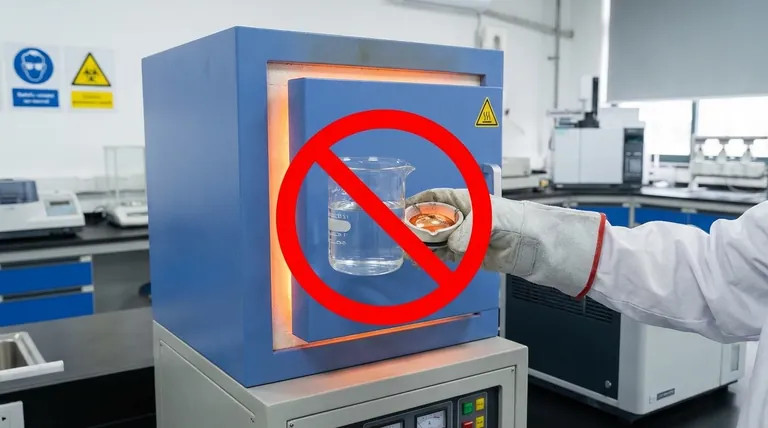
To be clear, you are prohibited from ever introducing any kind of liquids or molten metal directly into the furnace chamber. This is an absolute rule based on fundamental safety principles designed to prevent catastrophic equipment failure and protect personnel from explosive events.
The core principle is not merely about specific substances, but about preventing rapid, uncontrolled thermal and pressure changes. Introducing liquids or molten metal creates conditions for violent reactions that the furnace is not designed to contain.
The Physics Behind the Prohibition
Understanding why these rules exist is critical for maintaining a safe and efficient operation. The restrictions are rooted in preventing two primary types of violent events: flash steam explosions and uncontrolled chemical reactions.
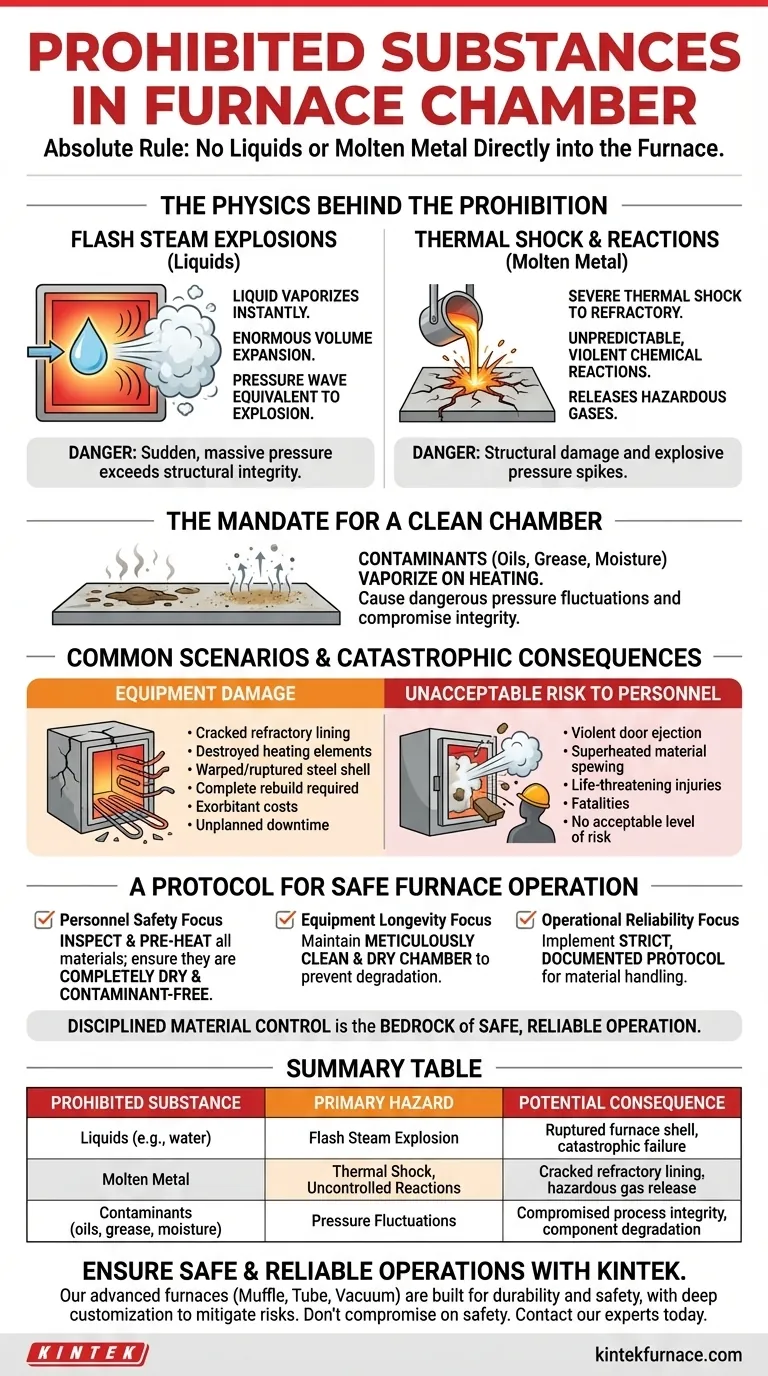
The Danger of Liquids: Flash Steam Explosions
When a liquid, especially water, is introduced into a high-temperature furnace chamber, it does not simply boil—it vaporizes instantly.
This near-instantaneous phase change from liquid to gas is known as a flash steam event. The volume expansion is enormous and incredibly fast, creating a pressure wave equivalent to an explosion.
This sudden, massive increase in internal pressure can easily exceed the structural integrity of the furnace, leading to catastrophic failure.
The Risk of Molten Metal: Thermal Shock and Reactions
Introducing external molten metal can be just as dangerous, though for slightly different reasons.
It can cause severe thermal shock to the furnace refractory lining, leading to cracking and immediate structural damage.
Furthermore, the molten metal can react violently and unpredictably with the furnace atmosphere or any contaminants present on the chamber floor, releasing hazardous gases or causing further explosive pressure spikes.
The Mandate for a Clean Chamber
The requirement to keep the furnace chamber clean at all times is directly related to these principles.
Contaminants like residual oils, grease, or even trapped moisture in dirt and debris can vaporize upon heating. While the effect may be smaller than a direct liquid injection, it can still cause dangerous pressure fluctuations and compromise the integrity of both the equipment and the material being processed.
Common Scenarios and Catastrophic Consequences
Failing to adhere to these rules is not a minor operational misstep; it is a direct cause of severe industrial accidents. Understanding the consequences underscores the importance of the prohibition.
Potential for Equipment Damage
A pressure event can crack the refractory lining, destroy heating elements, and warp or rupture the furnace's steel shell.
The resulting damage often requires a complete furnace rebuild, leading to exorbitant costs and extended, unplanned downtime.
Unacceptable Risk to Personnel
The most critical consequence is the extreme danger to anyone near the furnace.
An explosive event can violently eject the furnace door, spew superheated material across the facility, and cause life-threatening injuries or fatalities. There is no acceptable level of risk when it comes to this hazard.
A Protocol for Safe Furnace Operation
Translating these principles into action requires a disciplined approach to material handling and furnace charging.
- If your primary focus is personnel safety: The absolute rule is to inspect and pre-heat all materials to ensure they are completely dry and free of any contaminants before charging.
- If your primary focus is equipment longevity: Maintaining a meticulously clean and dry furnace chamber is the most effective way to prevent the thermal and pressure shocks that degrade components over time.
- If your primary focus is operational reliability: A strict, documented protocol for material handling prevents the catastrophic accidents that lead to unpredictable and costly downtime.
Ultimately, disciplined material control is the bedrock of safe, reliable, and effective furnace operation.
Summary Table:
| Prohibited Substance | Primary Hazard | Potential Consequence |
|---|---|---|
| Liquids (e.g., water) | Flash Steam Explosion | Ruptured furnace shell, catastrophic failure |
| Molten Metal | Thermal Shock, Uncontrolled Reactions | Cracked refractory lining, hazardous gas release |
| Contaminants (oils, grease, moisture) | Pressure Fluctuations | Compromised process integrity, component degradation |
Ensure your furnace operations are safe and reliable. The risks of improper material handling are too great to ignore. At KINTEK, we leverage our exceptional R&D and in-house manufacturing to provide advanced high-temperature furnace solutions—like our Muffle, Tube, and Vacuum Furnaces—that are built for durability and safety. Our strong deep customization capability allows us to design systems that precisely meet your unique experimental requirements and incorporate safety features to mitigate risks. Don't compromise on safety. Contact our experts today to discuss a furnace solution that protects your personnel and your investment.
Visual Guide
Related Products
- Split Chamber CVD Tube Furnace with Vacuum Station CVD Machine
- Mesh Belt Controlled Atmosphere Furnace Inert Nitrogen Atmosphere Furnace
- 1200℃ Controlled Inert Nitrogen Atmosphere Furnace
- 1700℃ Controlled Inert Nitrogen Atmosphere Furnace
- High Temperature Muffle Oven Furnace for Laboratory Debinding and Pre Sintering
People Also Ask
- What role does a Tube Furnace play in the CVD growth of carbon nanotubes? Achieve High-Purity CNT Synthesis
- How does a CVD tube furnace achieve high purity in gate media preparation? Master Precision Control for Flawless Films
- What are the operational and maintenance requirements for a CVD tube furnace? Ensure Precision for Thin Film Deposition
- What are the advantages of using a CVD tube furnace for preparing gate dielectrics? Achieve High-Quality Thin Films for Transistors
- What future trends are expected in the development of CVD tube furnaces? Discover Smarter, More Versatile Systems



















