
The primary technical justification for using high-purity alumina crucibles in microwave-assisted metal reduction is their combination of low dielectric loss and exceptional high-temperature chemical stability. These properties ensure that microwave energy passes through the vessel to heat the reactants directly, rather than heating the crucible itself, while simultaneously preventing the vessel from reacting with aggressive reduction products.
The critical value of high-purity alumina is its ability to act as a transparent window for microwave energy, facilitating volumetric heating of the sample while resisting contamination from byproducts like tantalum carbide or manganese oxides.
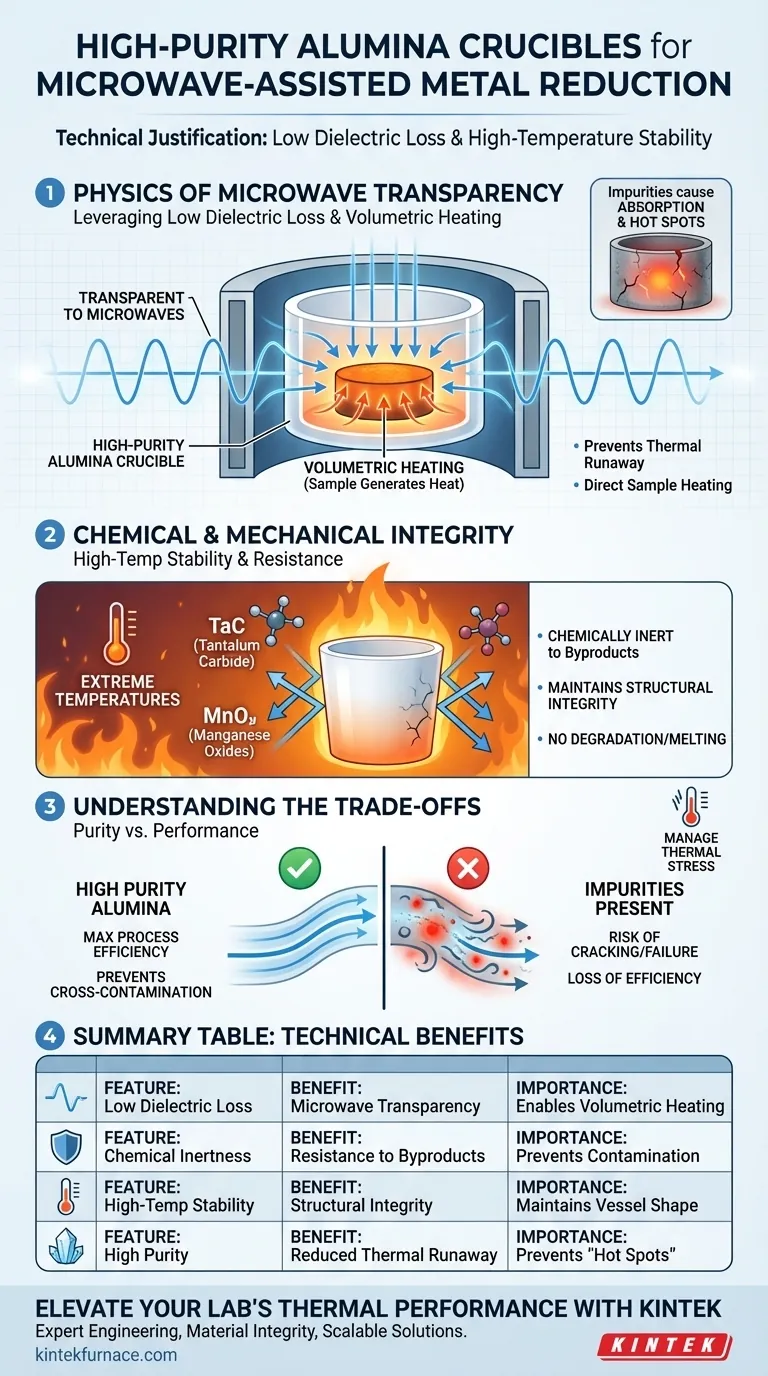
The Physics of Microwave Transparency
Leveraging Low Dielectric Loss
The fundamental requirement for a microwave vessel is low dielectric loss. High-purity alumina is nearly transparent to microwaves, meaning it does not absorb significant energy from the electromagnetic field.
Achieving Volumetric Heating
Because the crucible does not absorb the energy, the microwaves pass directly through the vessel wall to the carbon-containing sample inside.
This allows for volumetric heating, where the sample generates heat internally rather than relying on conduction from the container walls.
Preventing Thermal Runaway
If the crucible were to absorb microwave energy, it would heat up independently of the sample. High-purity alumina prevents this overheating, ensuring the temperature profile is controlled by the reaction kinetics rather than the vessel's properties.
Chemical and Mechanical Integrity
High-Temperature Stability
Metal reduction processes occur at extreme temperatures. High-purity alumina maintains its chemical stability under these rigorous conditions, ensuring the vessel does not degrade or melt during the process.
Resistance to Reduction Products
During the reduction process, aggressive byproducts such as tantalum carbide or manganese oxides are often formed.
Alumina is chemically inert to these specific compounds. This prevents the crucible from reacting with the payload, which preserves the purity of the reduced metal and extends the lifespan of the crucible.
Mechanical Strength
Beyond thermal and chemical properties, the process requires a vessel with substantial mechanical strength. Alumina provides the structural integrity necessary to contain the load without failure under process stress.
Understanding the Trade-offs: Purity vs. Performance
The Risk of Impurities
It is critical to note that these benefits rely strictly on the alumina being high purity.
If impurities are present in the ceramic matrix, the dielectric loss increases. This causes the crucible to begin absorbing microwave energy, leading to "hot spots," potential cracking, and a loss of process efficiency.
Thermal Stress Management
While alumina is strong, it is a ceramic material. The rapid volumetric heating of the sample can create temperature gradients between the hot sample and the cooler crucible wall.
Users must ensure that the mechanical strength of the chosen alumina grade is sufficient to withstand the thermal expansion stresses caused by this rapid internal heating.
Making the Right Choice for Your Goal
To maximize the effectiveness of your microwave-assisted reduction process, align your material selection with your specific technical constraints.
- If your primary focus is Process Efficiency: Prioritize the highest available purity to minimize dielectric loss, ensuring maximum energy transfer directly to the carbon-containing sample.
- If your primary focus is Sample Purity: Rely on alumina’s inertness to prevent cross-contamination, specifically when working with reactive byproducts like tantalum carbide.
High-purity alumina is not just a container; it is an active component of the thermal system that defines the success of microwave-assisted reduction.
Summary Table:
| Feature | Technical Benefit | Importance in Microwave Reduction |
|---|---|---|
| Low Dielectric Loss | Microwave Transparency | Enables volumetric heating by passing energy directly to the sample. |
| Chemical Inertness | Resistance to Byproducts | Prevents contamination from aggressive products like tantalum carbide. |
| High-Temp Stability | Structural Integrity | Maintains vessel shape and performance at extreme process temperatures. |
| High Purity | Reduced Thermal Runaway | Prevents "hot spots" and cracking by minimizing unintended energy absorption. |
Elevate Your Lab's Thermal Performance with KINTEK
Precision in microwave-assisted reduction starts with the right equipment. Backed by expert R&D and manufacturing, KINTEK offers a comprehensive range of Muffle, Tube, Rotary, Vacuum, and CVD systems, along with high-performance laboratory ceramics. Our high-purity solutions are designed to withstand aggressive reduction products while ensuring maximum energy efficiency.
Why choose KINTEK?
- Expert Engineering: Customizable high-temperature furnaces tailored to your unique research needs.
- Material Integrity: High-purity alumina components that prevent contamination and thermal runaway.
- Scalable Solutions: From benchtop lab furnaces to complex CVD systems.
Ready to optimize your metal reduction process? Contact KINTEK today for a consultation and let our experts design the perfect thermal solution for your laboratory.
Visual Guide
References
- Ansan Pokharel, Terence Musho. Microwave-assisted recycling of tantalum and manganese from end-of-life tantalum capacitors. DOI: 10.1038/s41598-025-96574-7
This article is also based on technical information from Kintek Furnace Knowledge Base .
Related Products
- 1400℃ High Temperature Laboratory Tube Furnace with Alumina Tube
- 1700℃ High Temperature Laboratory Tube Furnace with Alumina Tube
- Magnesium Extraction and Purification Condensing Tube Furnace
- Vacuum Induction Melting Furnace
People Also Ask
- How does zone-melting in tube furnaces synthesize bismuth micro-wires? Master Single-Crystal Thermoelectric Growth
- How do high-temperature laboratory tube furnaces ensure environmental stability? Precision Thermal Reduction Tips
- How are high-temperature laboratory tube furnaces applied in long-term vacuum homogenization heat treatments for intermetallic samples?
- How are high-temp tube furnaces used to measure diffusion coefficients per Fick's law? Master Precision Annealing
- How are high-temperature tube furnaces applied in testing ceramic-supported alloy membranes? Insights



