
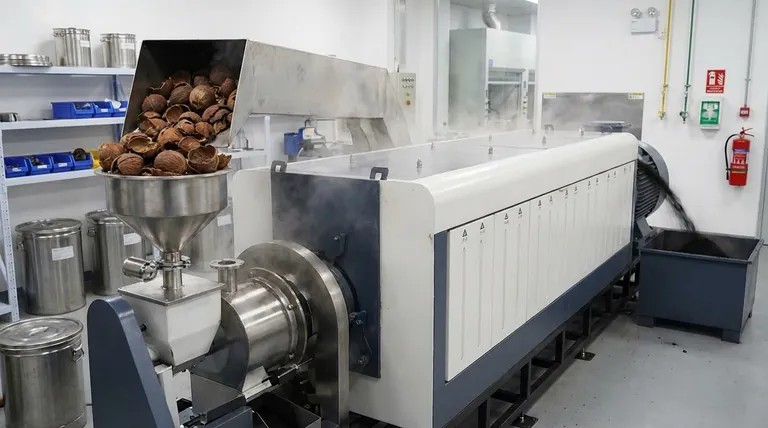
The industrial oven serves as a critical stabilization tool in the pretreatment of oil palm shell. By heating the raw material at exactly 120 °C for a duration of six hours, it effectively removes surface moisture and physically adsorbed water to prepare the biomass for pyrolysis.
Pretreatment in an industrial oven is not merely about drying; it is a structural safeguard. Eliminating moisture at this stage prevents material failure during rapid heating and ensures the chemical precision required for high-quality biochar production.
The Mechanics of Moisture Removal
Targeting Adsorbed Water
The primary function of the industrial oven is to create a controlled thermal environment. Operating at 120 °C, the oven provides sufficient heat to overcome the binding energy of water physically trapped on the shell's surface.
Establishing the Timeline
Effective pretreatment requires consistency, not just heat. The process is maintained for six hours to ensure the heat penetrates the biomass thoroughly.
This duration guarantees that moisture removal is uniform across the entire batch, rather than limited to the outer layers of the shell.
Why Pretreatment Determines Final Quality
Preventing Thermal Shock
If moisture remains trapped inside the oil palm shell, subsequent high-temperature stages can be destructive. Rapid heating causes internal water to vaporize instantly.
The industrial oven mitigates this risk. By removing water beforehand, it prevents the material cracking that occurs when expanding steam forces the biomass structure apart.
Enabling Chemical Precision
Biochar production relies on precise chemical reactions, known as pyrolysis. Water is a variable that can throw off the chemical stoichiometry (the distinct ratio of reactants).
Using the oven to establish a dry baseline ensures that the mass entering the pyrolysis reactor is consistent. This allows for accurate control over the conversion process.
Understanding the Operational Trade-offs
Energy Input vs. Material Yield
Running an industrial oven for six hours represents a significant energy investment. It adds distinct time and cost to the production cycle.
However, this cost is generally outweighed by the reduction in waste. Skipping this step often results in fractured, lower-quality biochar that may be unsuitable for commercial use.
Temperature Specificity
Adhering to the specific 120 °C protocol is essential for this specific pretreatment method.
Lower temperatures (such as the 70 °C often used in general laboratory drying) might not remove strongly adsorbed water within the specific industrial timeframe. Conversely, significantly higher temperatures could trigger premature decomposition before the actual pyrolysis begins.
Making the Right Choice for Your Goal
To maximize the quality of your biochar, you must align your pretreatment protocol with your production objectives.
- If your primary focus is Physical Integrity: Adhere strictly to the 120 °C limit to prevent rapid vaporization and subsequent cracking of the oil palm shell.
- If your primary focus is Process Consistency: Ensure the full six-hour duration is met to stabilize the chemical stoichiometry for the pyrolysis stage.
By treating the industrial oven as a precision instrument rather than a simple dryer, you transform a basic preparatory step into a competitive advantage for your final product.
Summary Table:
| Parameter | Specification | Purpose |
|---|---|---|
| Temperature | 120 °C | Removes surface and physically adsorbed water |
| Duration | 6 Hours | Ensures uniform heat penetration and moisture removal |
| Target Material | Oil Palm Shell | Prepares biomass structure for high-temp pyrolysis |
| Key Outcome | Structural Integrity | Prevents material cracking and chemical inconsistency |
Elevate Your Biochar Production Quality
Maximize your material yield and process precision with KINTEK’s high-performance industrial ovens. Backed by expert R&D and world-class manufacturing, we offer a comprehensive range of Muffle, Tube, Rotary, Vacuum, and CVD systems, all customizable to meet the unique thermal pretreatment needs of your lab or industrial facility.
Don't let moisture compromise your chemical stoichiometry. Contact KINTEK today to discover how our precision heating solutions can optimize your biomass processing and deliver superior biochar results.
Visual Guide

References
- Aik Chong Lua. Conversion of Oil Palm Kernel Shell Wastes into Active Biocarbons by N2 Pyrolysis and CO2 Activation. DOI: 10.3390/cleantechnol7030066
This article is also based on technical information from Kintek Furnace Knowledge Base .
Related Products
- High Temperature Muffle Oven Furnace for Laboratory Debinding and Pre Sintering
- 1200℃ Muffle Oven Furnace for Laboratory
- Dental Porcelain Zirconia Sintering Ceramic Vacuum Press Furnace
- 1400℃ Muffle Oven Furnace for Laboratory
- 1700℃ High Temperature Muffle Oven Furnace for Laboratory
People Also Ask
- What thermal phenomena occur during polymer binder burnout in ceramic green bodies? Lab Furnace Guide
- What role does a high-temperature muffle furnace play in STFO synthesis? Achieve Pure Perovskite Results
- Why is controlled heat treatment in a muffle furnace necessary for calcined clay? Achieve Optimal Pozzolanic Activity
- How does a high-temperature muffle furnace facilitate the formation of LaNbxAl1−xO3+δ perovskite structures? Key Roles
- What role does a high-temperature muffle furnace play in the formation of biochar catalysts? Master Catalyst Synthesis








