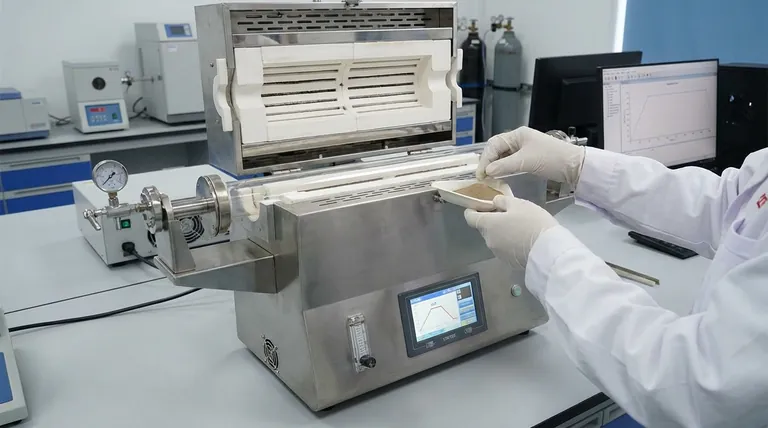
Precise sample loading and distribution are critical in high-temperature carbon dioxide capture experiments to eliminate diffusion resistance within the powder layer. If the sample mass is too large or unevenly distributed, you create a "bed effect," where the results reflect the physical limitations of gas transport through the powder rather than the material's actual chemical reactivity.
To measure the intrinsic kinetic characteristics of a material, you must minimize the physical barrier the powder presents to the gas. Overloading the sample tray creates a thick layer where CO2 diffusion dominates the results, masking the material's true performance capabilities.
The Mechanism of the Bed Effect
Understanding Diffusion Resistance
In laboratory experiments, your goal is to measure how the material reacts with CO2. However, the gas must physically travel through the sample layer to reach individual particles.
If the sample layer is too thick, the gas struggles to penetrate the bottom layers efficiently. This physical barrier is known as diffusion resistance.
Apparent vs. Intrinsic Performance
When diffusion resistance is high, your data becomes misleading. You are no longer measuring the intrinsic kinetic characteristics of the material (how fast it reacts chemically).
Instead, you are measuring diffusion-limited apparent performance. The equipment records a slower reaction rate, not because the chemistry is slow, but because the gas cannot reach the reaction sites quickly enough.
Optimizing Sample Parameters
The Ideal Mass Threshold
To ensure data accuracy, the sample mass must be small enough to allow rapid gas penetration.
The primary reference recommends a specific loading of approximately 20mg. This quantity is typically sufficient to generate a readable signal while remaining thin enough to neglect diffusion resistance.
The Danger of Overloading
There is a specific threshold where data integrity is compromised. If the sample mass exceeds 40mg, the bed effect becomes significant.
At this weight, the powder layer becomes too thick. Any kinetic data derived from samples heavier than 40mg should be viewed with skepticism, as it likely reflects transport limitations rather than true material properties.
Common Pitfalls to Avoid
The Trap of High Signal Strength
Researchers often feel tempted to increase sample mass to get a "stronger" signal or clearer weight change curve.
While a larger mass provides more gross weight change, it introduces significant errors in kinetic calculations. You trade signal amplitude for kinetic accuracy, rendering the rate data invalid.
Uneven Distribution
Even if you use the correct mass (e.g., 20mg), uniform distribution is non-negotiable.
If the powder is clumped on one side of the tray, that specific area will behave like a sample exceeding the 40mg threshold. The sample must be spread evenly to ensure a consistent, thin layer across the entire tray surface.
Making the Right Choice for Your Goal
To ensure your high-temperature CO2 capture data is scientifically valid, adhere to these guidelines:
- If your primary focus is Intrinsic Kinetics: Target a sample mass of approximately 20mg to practically eliminate diffusion resistance.
- If your primary focus is Data Reliability: Strictly avoid exceeding 40mg of sample mass, as this guarantees the presence of a bed effect.
- If your primary focus is Reproducibility: Ensure the sample is distributed uniformly in the tray every time to prevent localized diffusion barriers.
By keeping the sample layer thin and uniform, you ensure your results reflect the true chemistry of the material, not the geometry of the pile.
Summary Table:
| Parameter | Recommended Limit | Impact on Data Accuracy |
|---|---|---|
| Ideal Sample Mass | ~20mg | Minimal diffusion resistance; reflects intrinsic kinetics. |
| Critical Threshold | >40mg | Significant "bed effect"; data reflects physical transport limits. |
| Sample Distribution | Uniformly Thin | Essential to prevent localized gas diffusion barriers. |
| Measurement Goal | Intrinsic Kinetics | Requires thin layers to ensure chemistry-driven results. |
Maximize Your Research Precision with KINTEK
Inaccurate kinetic data can stall breakthrough research. At KINTEK, we understand that high-precision CO2 capture studies require more than just quality samples—they require the right thermal environment.
Backed by expert R&D and manufacturing, KINTEK offers Muffle, Tube, Rotary, Vacuum, and CVD systems, all customizable to meet your unique laboratory needs. Whether you are optimizing sample loading for intrinsic kinetics or scaling up high-temp reactions, our advanced laboratory furnaces provide the stability and control necessary to eliminate variables and ensure reproducible results.
Ready to upgrade your lab's thermal performance? Contact our experts today to find the perfect high-temperature solution for your material science applications.
References
- Iyiade Gbolahan Alalade, V. Collins-Martı́nez. Moderate-Temperature Carbon Capture Using Thermally Pre-Treated Dolomite: A Novel Approach. DOI: 10.3390/c11020037
This article is also based on technical information from Kintek Furnace Knowledge Base .
Related Products
- 1800℃ High Temperature Muffle Oven Furnace for Laboratory
- 1700℃ High Temperature Muffle Oven Furnace for Laboratory
- 1400℃ High Temperature Laboratory Tube Furnace with Alumina Tube
- 1700℃ High Temperature Laboratory Tube Furnace with Alumina Tube
- High Temperature Muffle Oven Furnace for Laboratory Debinding and Pre Sintering
People Also Ask
- What is the primary function of a high-temperature laboratory muffle furnace in chemical synthesis? Achieve Precision.
- How does a high-temperature laboratory muffle furnace affect material properties? Transform Anodic Oxide Films Fast
- What functions does a laboratory muffle furnace perform for AISI 1025 steel post-processing? Precision Thermal Control
- Why is a laboratory high-temperature muffle furnace required for LaNixFe1-xO3 catalysts? Optimize Two-Stage Synthesis
- What role does a muffle furnace play in plant bark mineral analysis? Essential for Precise Dry Ashing & Trace Extraction