
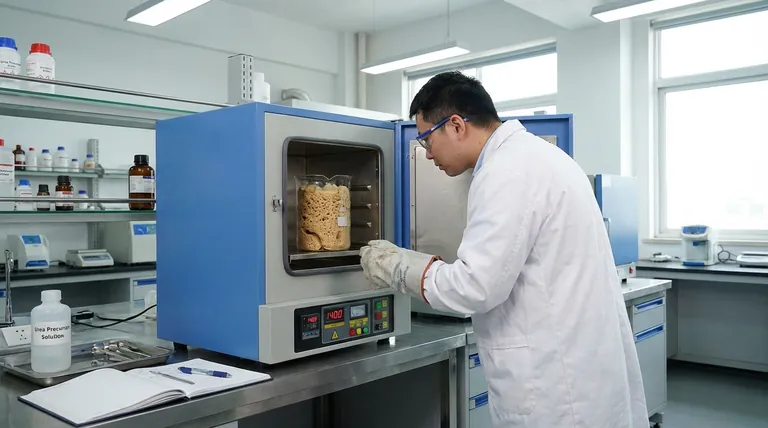
The primary function of a forced air oven in the synthesis of SnmCunOx-t catalyst powders is to facilitate a critical chemical foaming process, not merely to dry the material. By maintaining a precise and stable thermal environment at 140 °C, the oven triggers the decomposition of urea within the precursor solution.
Core Takeaway: In this specific synthesis, the forced air oven acts as a reactor for structural engineering. It drives the thermal decomposition of urea to generate gas, which expands the solution into a porous, semi-finished foam essential for the catalyst's final architecture.
The Mechanics of the Foaming Process
Triggering Chemical Decomposition
The synthesis of SnmCunOx-t relies on a specific chemical trigger: the breakdown of urea.
The forced air oven provides the stable 140 °C environment necessary to initiate this reaction. Unlike simple solvent evaporation, this step causes the urea to decompose thermally, releasing gas bubbles throughout the mixture.
Creating the Porous Architecture
As gas is generated during decomposition, it physically alters the state of the material.
The solution expands significantly, transforming into a porous foam. This process accomplishes preliminary dehydration while simultaneously creating a high-surface-area structure that serves as the "semi-finished" base for the next stage of synthesis.
Preparing for Annealing
The output of this oven phase is not the final product, but a structural precursor.
The porous framework created in the oven ensures that the material is physically prepared for subsequent high-temperature annealing. Without this foaming step, the material would lack the necessary porosity and structural integrity required for the final catalyst.
Distinguishing Foaming from Standard Drying
Reactive Expansion vs. Solvent Removal
It is critical to distinguish this process from the function of a standard laboratory drying oven or vacuum oven.
As noted in general catalyst handling, vacuum drying is typically used to prevent agglomeration or strictly remove moisture at lower temperatures to preserve surface activity.
The Role of Temperature Stability
In contrast, the SnmCunOx-t process uses the forced air oven to drive a structural change via reaction.
While a standard drying oven might operate at 80 °C to slowly fix metal precursors and prevent migration, the forced air oven in this protocol must hit 140 °C to force the expansion of the material through gas generation.
Understanding the Trade-offs
Temperature Sensitivity
The success of this phase relies entirely on thermal precision.
If the temperature drops significantly below 140 °C, the urea will not decompose sufficiently, preventing the formation of the foam structure. Conversely, uncontrolled temperature spikes could lead to inconsistent pore sizes or premature calcination.
The Importance of Air Circulation
The "forced air" component is vital for uniformity.
Static ovens may develop hot or cold spots. In a chemical foaming process, uneven heating would result in heterogeneous expansion, leading to a catalyst with inconsistent structural properties and potentially lower performance.
Making the Right Choice for Your Goal
To select the correct thermal treatment for your catalyst materials, assess your primary objective:
- If your primary focus is creating porous structural frameworks: Use a forced air oven at higher temperatures (e.g., 140 °C) to trigger gas-generating decomposition reactions like those used for SnmCunOx-t.
- If your primary focus is preserving surface activity and preventing agglomeration: Opt for a vacuum drying oven, which removes moisture at lower temperatures without triggering structural decomposition.
The forced air oven is the architect of the catalyst's physical form, turning a liquid precursor into a solid, structured foundation.
Summary Table:
| Process Feature | Forced Air Oven Function (at 140 °C) |
|---|---|
| Core Objective | Chemical foaming and structural engineering via urea decomposition |
| Physical Change | Transformation from liquid precursor to a porous, expanded foam |
| Gas Generation | Releases CO2/NH3 bubbles to create high-surface-area architecture |
| Role of Airflow | Ensures thermal uniformity for consistent material expansion |
| Next Phase Prep | Prepares the semi-finished structure for high-temp annealing |
Elevate Your Catalyst Synthesis with KINTEK Precision
Precise thermal environments are the difference between a failed reaction and a high-performance catalyst. Backed by expert R&D and manufacturing, KINTEK offers a comprehensive range of lab solutions including Muffle, Tube, Rotary, Vacuum, and CVD systems, as well as high-performance forced air ovens.
Whether you are engineering porous foams for SnmCunOx-t or require customizable high-temp furnaces for unique material needs, our equipment ensures the temperature stability and uniformity your research demands.
Ready to optimize your laboratory's thermal processing? Contact us today to find the perfect customizable solution for your workflow!
References
- Cu-Sn Electrocatalyst Prepared with Chemical Foaming and Electroreduction for Electrochemical CO2 Reduction. DOI: 10.3390/catal15050484
This article is also based on technical information from Kintek Furnace Knowledge Base .
Related Products
- 1200℃ Muffle Oven Furnace for Laboratory
- 1400℃ Muffle Oven Furnace for Laboratory
- High Temperature Muffle Oven Furnace for Laboratory Debinding and Pre Sintering
- 1700℃ High Temperature Muffle Oven Furnace for Laboratory
- Laboratory Muffle Oven Furnace with Bottom Lifting
People Also Ask
- What is the primary function of a high-temperature laboratory muffle furnace in chemical synthesis? Achieve Precision.
- How does a high-temperature laboratory muffle furnace affect material properties? Transform Anodic Oxide Films Fast
- How is a laboratory muffle furnace used in 3D-printed PP-CF cross-linking? Achieve Thermal Stability at 150 °C
- What is the role of a laboratory high-temperature muffle furnace in iron analysis? Key to Precise Sample Mineralization
- How is a laboratory high-temperature muffle furnace used to evaluate porous Co-Al materials? Precision Thermal Analysis




