
A high-precision constant temperature drying oven acts as the definitive stabilizer for battery electrodes prior to assembly and testing. Its primary function is to perform "deep drying," a process that systematically eliminates residual solvents and moisture from the electrode slurry without compromising the physical structure of the coating. By maintaining an exact thermal environment, the oven ensures the active material adheres uniformly to the current collector, a prerequisite for generating valid electrochemical data.
The integrity of your electrochemical data relies entirely on the purity of the electrode layer; without the precise removal of solvents and moisture provided by these ovens, performance metrics like cycling stability become unreliable artifacts rather than true measurements.
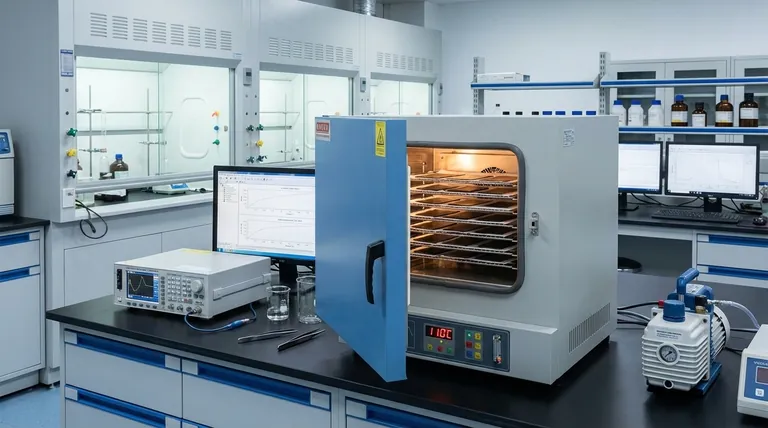
The Physics of Electrode Stabilization
Deep Drying and Solvent Removal
The coating process leaves behind solvents, such as N-methyl-2-pyrrolidone (NMP), within the porous structure of the electrode. A high-precision oven ensures the complete evaporation of these solvents.
If these solvents remain, they interfere with the electrolyte's function. The oven heats the electrode—often between 60°C and 110°C depending on the protocol—to drive these molecules out from the deepest micropores.
Preventing Structural Defects
Rapid or uneven heating can cause the active material to crack or peel away from the current collector. High-precision control ensures a gradual and uniform thermal profile.
This stability prevents the "peeling" effect mentioned in technical literature. It guarantees that the slurry creates a cohesive, mechanically stable layer that can withstand the physical stress of battery assembly.
Moisture Elimination
Beyond solvents, these ovens are critical for removing trace moisture. Water is a contaminant that is detrimental to battery chemistry.
By utilizing sustained heat (often combined with vacuum environments in practice), the oven dehydrates the electrode. This prevents moisture from reacting with the electrolyte or the anode later in the process.
Impact on Electrochemical Testing Accuracy
Guaranteeing Cycling Stability
To measure how well a battery performs over time, the electrode interface must be chemically inert regarding contaminants. Proper drying ensures the formation of a stable Solid Electrolyte Interface (SEI).
If moisture or solvents are present, the SEI becomes unstable, leading to rapid capacity fade. The drying oven removes variables that would otherwise skew cycling stability data.
Enhancing Electrochemical Kinetics
Accurate measurement of reaction rates (kinetics) requires a uniform pathway for ions. Residual solvents block these pathways and increase impedance.
By creating a "clean" electrode structure, the oven ensures that the measurements reflect the true kinetic properties of the active material, rather than the resistance caused by trapped impurities.
Preventing Side Reactions
Moisture trapped in an electrode reacts with organic electrolytes (like sodium or lithium salts) to create hydrofluoric acid or other corrosive byproducts.
Thorough drying mitigates these parasitic side reactions. This protection is vital for ensuring that the current measured during testing is derived solely from the intended electrochemical reaction.
Common Pitfalls to Avoid
The Risk of Temperature Fluctuation
If an oven lacks high precision, temperature spikes can degrade the binder material holding the electrode together.
Conversely, dips in temperature may leave pockets of solvent trapped deep in the coating. Consistency is more critical than intensity; a stable lower temperature is often safer than a fluctuating high temperature.
Over-Reliance on Heat Alone
While temperature is the catalyst, atmospheric control is the vehicle for removal.
Simply heating an electrode in a standard atmosphere may not be enough to degas micropores effectively. In many high-precision contexts, this thermal process is paired with vacuum pressure to facilitate the full extraction of NMP and water.
Making the Right Choice for Your Goal
When configuring your drying protocol, align your settings with your specific testing objectives:
- If your primary focus is Physical Durability: Prioritize gradual temperature ramps to prevent peeling and ensure robust adhesion between the active material and current collector.
- If your primary focus is Electrochemical Precision: prioritize extended drying times (e.g., overnight) to guarantee the absolute removal of trace moisture and NMP, preventing side reactions.
- If your primary focus is SEI Formation: Ensure your drying temperature is sufficient (e.g., 110°C) to fully dehydrate the pore structure, as residual water will chemically destabilize the interface.
A well-dried electrode is the invisible baseline required for every reproducible result in battery research.
Summary Table:
| Function | Benefit for Electrochemical Testing | Impact of Failure |
|---|---|---|
| Deep Solvent Removal | Enhances ion kinetics and reduces impedance. | Residual solvents block pathways and skew data. |
| Moisture Elimination | Prevents parasitic side reactions and HF formation. | Water contamination causes rapid capacity fade. |
| Structural Stabilization | Ensures uniform adhesion and coating integrity. | Cracking or peeling leads to mechanical failure. |
| Thermal Precision | Creates a stable Solid Electrolyte Interface (SEI). | Temperature spikes degrade electrode binders. |
Elevate Your Battery Research with KINTEK Precision
Don't let residual moisture or unstable thermal profiles compromise your electrochemical data. KINTEK provides industry-leading drying and thermal processing solutions tailored for high-stakes laboratory environments.
Backed by expert R&D and world-class manufacturing, we offer:
- Muffle, Tube, and Vacuum Systems for precise atmosphere and moisture control.
- Rotary & CVD Systems for advanced material synthesis.
- Customizable Lab Furnaces designed to meet your specific battery testing protocols.
Ensure your electrodes meet the highest standards of purity and stability. Contact KINTEK today to discuss your customized thermal solution.
Visual Guide

References
- Hyo Yeong Seo, Gi Dae Park. Engineering Porous Carbon Nanotube Microspheres with Nickel Sulfoselenide Nanocrystals for High‐Performance Potassium‐Ion Batteries: Electrochemical Mechanisms and Cycling Stability. DOI: 10.1002/sstr.202500222
This article is also based on technical information from Kintek Furnace Knowledge Base .
Related Products
- High Temperature Muffle Oven Furnace for Laboratory Debinding and Pre Sintering
- 1700℃ High Temperature Muffle Oven Furnace for Laboratory
- 1200℃ Muffle Oven Furnace for Laboratory
- 1400℃ Muffle Oven Furnace for Laboratory
- 1800℃ High Temperature Muffle Oven Furnace for Laboratory
People Also Ask
- What thermal phenomena occur during polymer binder burnout in ceramic green bodies? Lab Furnace Guide
- Why is controlled heat treatment in a muffle furnace necessary for calcined clay? Achieve Optimal Pozzolanic Activity
- What role does a high-temperature muffle furnace play in STFO synthesis? Achieve Pure Perovskite Results
- How does a high-temperature muffle furnace facilitate the formation of LaNbxAl1−xO3+δ perovskite structures? Key Roles
- What role does a high-temperature muffle furnace play in the formation of biochar catalysts? Master Catalyst Synthesis















