
The definitive advantage of using high-purity platinum crucibles is their exceptional chemical inertness, which ensures absolute data integrity during high-temperature analysis. By resisting reaction with the sample and the atmosphere, platinum eliminates external variables that could otherwise compromise the measurement of magnetite oxidation.
Core Takeaway In precision thermal analysis, the sample container must remain chemically "invisible." High-purity platinum achieves this by maintaining constant mass and stability at high temperatures, ensuring that all measured data reflects the behavior of the mineral sample alone, not the vessel holding it.
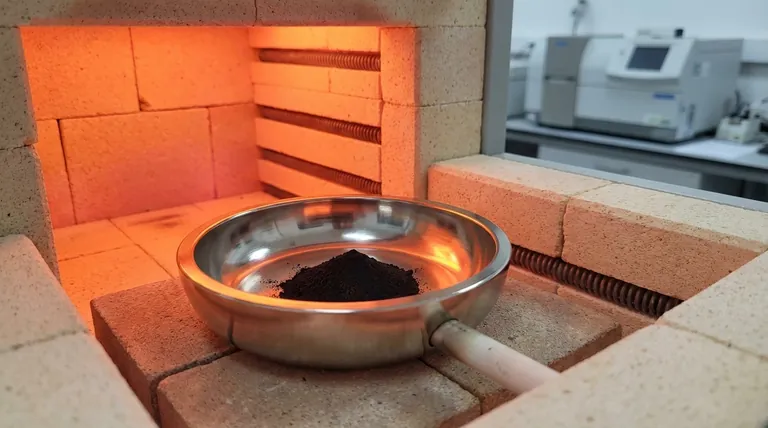
The Critical Importance of Material Inertness
Preventing Sample Contamination
The primary goal during the isothermal oxidation of magnetite is to observe its transformation into hematite without interference.
High-purity platinum possesses exceptional chemical inertness. It does not react with the magnetite starting material or the resulting hematite product, preserving the chemical purity of the sample throughout the experiment.
Eliminating Self-Oxidation
Crucibles made of lesser alloys often react with oxygen when heated, gaining weight and skewing results.
Platinum does not undergo self-oxidation. This characteristic is vital because it guarantees that the crucible itself does not contribute to the weight changes being measured.
Ensuring Data Integrity in High Temperatures
High Refractoriness
The physical stability of the containment vessel is just as critical as its chemical stability.
Platinum exhibits high refractoriness, allowing it to withstand the extreme environments of oxidation experiments. It maintains its structural integrity at temperatures reaching nearly 1100 K.
Protecting TGA Accuracy
Thermogravimetric Analysis (TGA) relies on detecting minute changes in mass to characterize mineral behavior.
Because platinum does not react with the sample or the atmosphere, it does not interfere with TGA data. This ensures the results isolate and reflect only the oxidation behavior of the mineral, rather than artifacts caused by the container.
Understanding the Trade-offs
The Cost of Precision
While platinum offers superior performance, it is a significant investment compared to ceramic or lower-grade alloy alternatives.
This high cost is a necessary trade-off for experiments requiring high precision. However, for rougher, qualitative heating where data noise is acceptable, the expense of high-purity platinum may not be justified.
Making the Right Choice for Your Goal
To ensure your experimental setup aligns with your scientific objectives, consider the following:
- If your primary focus is TGA data accuracy: Choose high-purity platinum to eliminate baseline drift caused by container oxidation.
- If your primary focus is high-temperature stability: Rely on platinum for experiments approaching 1100 K to prevent vessel degradation or softening.
Ultimately, using high-purity platinum transforms the crucible from an experimental variable into a reliable constant, securing the validity of your research.
Summary Table:
| Feature | Platinum Crucible Advantage | Impact on Magnetite Analysis |
|---|---|---|
| Chemical Inertness | Does not react with sample or O2 | Prevents contamination and sample loss |
| Mass Stability | Zero self-oxidation weight gain | Ensures TGA data reflects only mineral changes |
| Refractoriness | Stable up to and beyond 1100 K | Maintains structural integrity under heat |
| Data Integrity | Eliminates baseline drift/noise | High-precision results for mineral behavior |
Elevate Your Thermal Analysis with KINTEK Precision
Don't let container interference compromise your research. Backed by expert R&D and manufacturing, KINTEK offers high-purity laboratory crucibles along with our advanced Muffle, Tube, Vacuum, and CVD systems. Whether you are conducting isothermal oxidation or complex material synthesis, our customizable high-temperature solutions are designed to meet your unique laboratory needs.
Ready to eliminate variables and secure your data? Contact KINTEK today for expert guidance and custom quotes!
Visual Guide

References
- A. Laarich, Kurt N. Wiegel. Effect of Particle Size on Magnetite Oxidation Behavior: A Modeling Approach Incorporating Ultra-Fine Particle Effects. DOI: 10.1007/s11663-025-03640-6
This article is also based on technical information from Kintek Furnace Knowledge Base .
Related Products
People Also Ask
- What are the advantages of using a condensing tube furnace for magnesium extraction? Achieve High Purity and Efficient Metal Recovery
- Why is 800 °C Required for Ln-MoP@C Phosphorization? Unlock Superior Catalyst Engineering
- Why is an industrial monitoring camera necessary for measuring aluminum powder ignition delay in a tube furnace?
- Why is a continuous high-purity nitrogen flow required for Cu/ZIFs? Ensure High-Purity Inert Heat Treatment Results
- How does a tube furnace contribute to the ammonia reduction annealing process for (NiZnMg)MoN catalysts? Optimize Phase Transitions
