
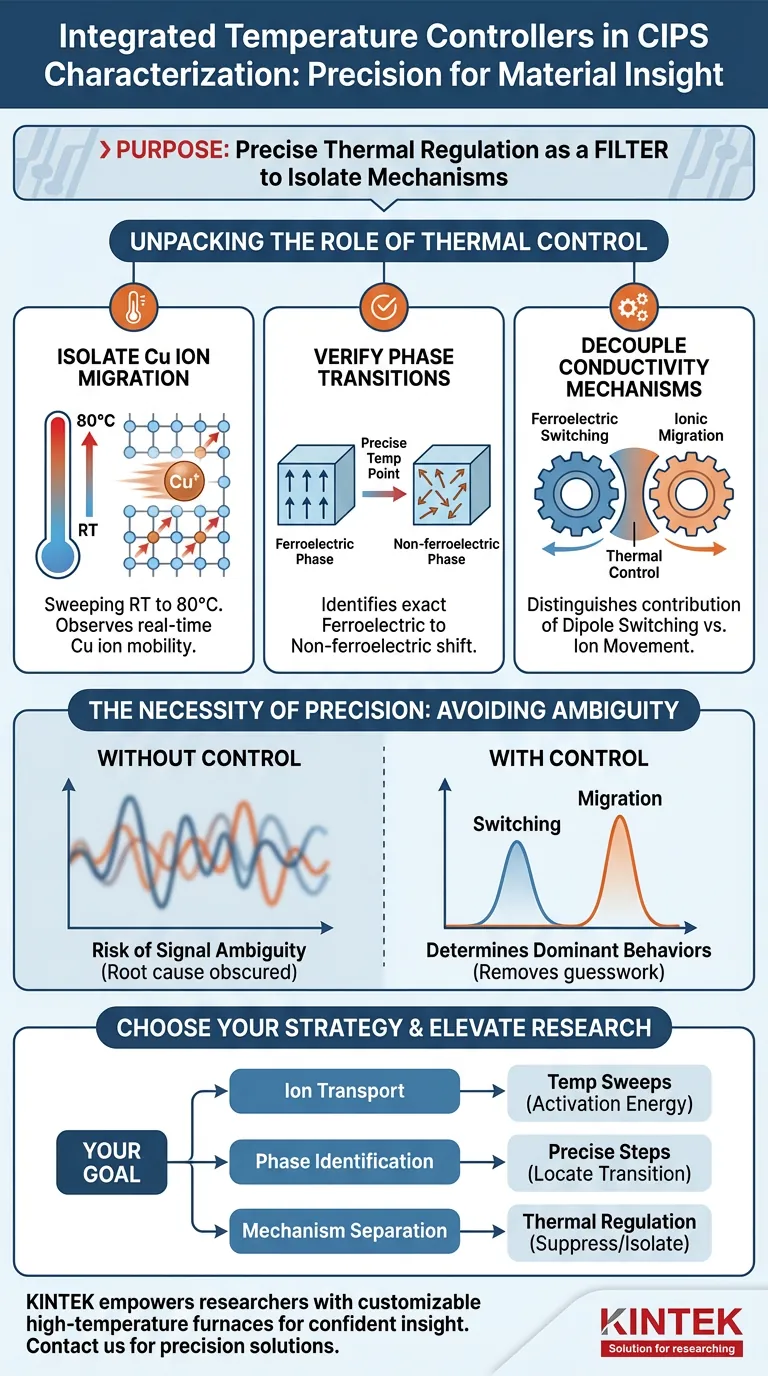
The primary purpose of using integrated temperature controllers during the electrical characterization of CuInP2S6 (CIPS) is to enable precise thermal regulation, which acts as a filter to isolate distinct physical mechanisms. By sweeping temperatures across a specific range—such as from room temperature to 80°C—researchers can directly observe the migration behavior of copper (Cu) ions and distinguish it from other electrical phenomena.
By strictly controlling temperature, researchers can decouple the complex interplay between ferroelectric switching and ionic migration. This thermal precision is the only reliable way to verify phase transitions and quantify how Cu ion movement contributes to the material's total electrical conductivity.
Unpacking the Role of Thermal Control
Isolating Copper Ion Migration
The central challenge in characterizing CIPS is understanding how copper ions move within the lattice.
Integrated temperature controllers allow for real-time observation of this migration. By systematically increasing thermal energy, researchers can track how the mobility of Cu ions changes.
This is typically performed over a defined range, such as room temperature to 80°C.
Verifying Phase Transitions
CIPS is a material that shifts between physical states based on thermal conditions.
It transitions from a ferroelectric phase to a non-ferroelectric phase at specific temperature points.
Precise thermal regulation is critical for identifying exactly when this transition occurs, validating the material's fundamental structural properties.
Decoupling Conductivity Mechanisms
In CIPS, electrical conductivity is not driven by a single force. It is a combination of ferroelectric switching and ion migration.
At a constant temperature, it is difficult to tell which mechanism is responsible for the observed current.
By manipulating the temperature, researchers can distinguish the relative contributions of each mechanism, determining how much of the conductivity is due to the switching of dipoles versus the physical movement of ions.
The Necessity of Precision
The Risk of Signal Ambiguity
Without integrated temperature control, electrical characterization data for CIPS is often ambiguous.
Experimental results may show a change in conductivity, but the root cause remains obscured.
You cannot definitively state whether a signal spike is caused by a ferroelectric switch or a surge in ionic mobility without the context provided by thermal regulation.
Determining Dominant Behaviors
Different mechanisms react differently to heat.
While ferroelectric properties may degrade or vanish at the phase transition point, ionic mobility generally increases with heat.
Controlled heating allows you to see which behavior becomes dominant under specific conditions, removing the guesswork from the analysis.
Making the Right Choice for Your Goal
To get the most out of your CIPS characterization, align your thermal strategy with your specific research objective.
- If your primary focus is Ion Transport: Use temperature sweeps (RT to 80°C) to calculate activation energies and map the mobility pathways of Copper ions.
- If your primary focus is Phase Identification: Use precise thermal steps to locate the exact temperature where the material loses its ferroelectric properties.
- If your primary focus is Mechanism Separation: Use thermal regulation to suppress one mechanism (e.g., ferroelectricity) to study the other (ionic conductivity) in isolation.
Temperature control converts ambiguous electrical signals into definitive material insights.
Summary Table:
| Feature | Purpose in CIPS Characterization | Key Benefit |
|---|---|---|
| Thermal Sweeping | Room Temperature to 80°C sweeps | Isolates Copper (Cu) ion migration behavior |
| Phase Verification | Identifying ferroelectric transition points | Validates material structural transformations |
| Mechanism Decoupling | Separating dipole switching from ion movement | Removes signal ambiguity in conductivity data |
| Activation Energy | Monitoring mobility changes via heat | Quantifies the energy required for ion transport |
Elevate Your Materials Research with KINTEK
Precise thermal regulation is the cornerstone of advanced electrical characterization for complex materials like CuInP2S6. At KINTEK, we empower researchers with cutting-edge laboratory solutions backed by expert R&D and world-class manufacturing.
Whether you need Muffle, Tube, Rotary, Vacuum, or CVD systems, our high-temperature furnaces are fully customizable to meet your unique experimental parameters. Don't let signal ambiguity hinder your insights—leverage our precision-engineered systems to isolate mechanisms and verify phase transitions with confidence.
Ready to optimize your lab's thermal precision? Contact us today to discuss your custom furnace needs with our technical specialists!
Visual Guide
References
- Xingan Jiang, Weiyou Yang. Dual-role ion dynamics in ferroionic CuInP2S6: revealing the transition from ferroelectric to ionic switching mechanisms. DOI: 10.1038/s41467-024-55160-7
This article is also based on technical information from Kintek Furnace Knowledge Base .
Related Products
- 1700℃ Controlled Inert Nitrogen Atmosphere Furnace
- 1200℃ Controlled Inert Nitrogen Atmosphere Furnace
People Also Ask
- Why is thorough binder burnout necessary before sintering advanced ceramics? Ensure Peak Density & Zero Defects
- How does oxygen partial pressure control affect ceramic sintering? Master Defect Chemistry
- How does real-time dilatometric analysis in a controlled-atmosphere furnace optimize PZT ceramic sintering?
- How do controlled-atmosphere furnaces support polymer pyrolysis? Master SiC & Si3N4 Ceramic Conversion
- Why is controlled-atmosphere heating required for functional ceramics and sensors? Master Defect Engineering

