Internal Radiation Baffle (IRB) technology is essential for precisely managing heat flow dynamics within complex furnace environments. By integrating lateral thermal barriers directly into the mold assembly, this technology blocks non-uniform radiation from heaters and mitigates thermal interference caused by the chill plate. The result is a controlled thermal environment that is critical for high-quality directional solidification.
Core Takeaway In complex solidification processes, uneven heat distribution causes structural inconsistencies. IRB technology solves this by physically obstructing erratic heat paths, effectively flattening the liquidus isotherms to ensure a uniform temperature distribution throughout the mold.
The Mechanics of Thermal Control
Managing Non-Uniform Radiation
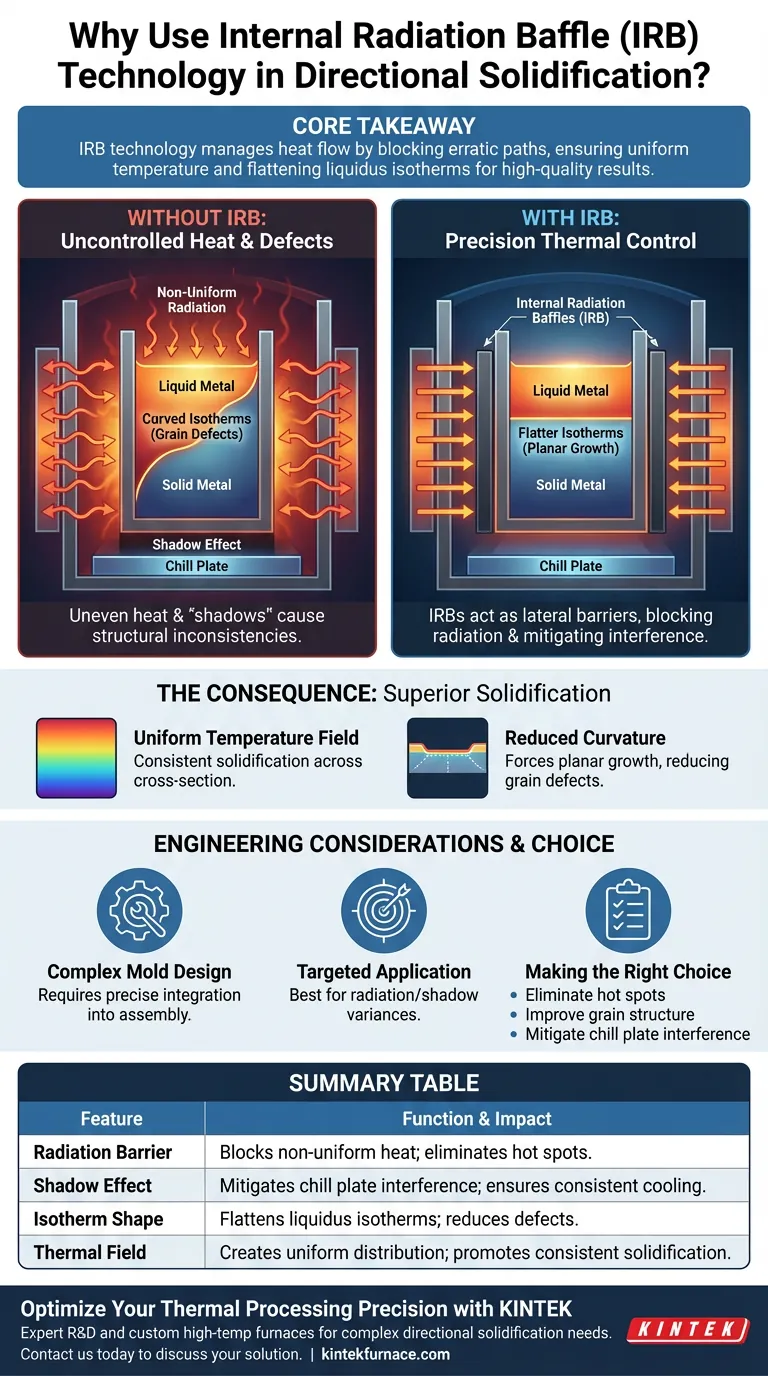
The primary function of an Internal Radiation Baffle is to act as a lateral thermal barrier.
Standard furnace heaters often emit radiation unevenly, creating hot spots or inconsistent thermal gradients. The IRB effectively blocks this non-uniform thermal radiation before it affects the solidifying material.
Mitigating the "Shadow Effect"
In directional solidification, the chill plate—used to draw heat out of the metal—can inadvertently create interference known as the shadow effect.
This phenomenon is particularly problematic in the upper sections of a mold. IRB technology modifies the mold design to reduce this interference, isolating the casting from the disruptive thermal "shadows" cast by the cooling hardware.
The Consequence: Flatter Isotherms
Reducing Curvature
The ultimate goal of using IRBs is to alter the shape of the liquidus isotherms (the boundary between liquid and solid metal).
In a standard setup, these isotherms often exhibit significant curvature, which can lead to grain defects. IRBs significantly reduce this curvature, forcing the solidification front to remain planar.
Uniform Temperature Fields
By blocking external radiation variance and managing the chill plate's influence, IRBs create a uniform temperature field distribution.
This uniformity ensures that the metal solidifies consistently across the entire cross-section of the mold, rather than cooling unevenly from the outside in.
Engineering Considerations
Complexity in Mold Design
While effective, implementing IRB technology requires modifying the standard mold assembly.
Engineers must account for the physical space these baffles occupy and ensure they are positioned correctly to intercept specific heat paths without obstructing necessary mold operations.
Targeted Application
IRBs are a specific solution for radiation and shadow-based thermal variances.
They are most effective when the root cause of the defect is external heat flow interference (from heaters or chill plates). They may not correct issues stemming solely from alloy composition or pour rates.
Making the Right Choice for Your Process
To determine if IRB technology is required for your specific application, consider your thermal objectives:
- If your primary focus is eliminating hot spots: Use IRBs to block non-uniform radiation emitted directly from the furnace heaters.
- If your primary focus is grain structure consistency: Implement IRBs to flatten the curvature of liquidus isotherms, particularly in the upper mold regions.
- If your primary focus is mitigating chill plate interference: Utilize this technology to reduce the shadow effect that distorts the thermal field.
By integrating Internal Radiation Baffles, you transform a variable thermal environment into a precise, uniform field conducive to superior directional solidification.
Summary Table:
| Feature | Function of IRB Technology | Impact on Solidification |
|---|---|---|
| Radiation Barrier | Blocks non-uniform heat from furnace heaters | Eliminates hot spots and thermal variance |
| Shadow Effect | Mitigates interference from the chill plate | Ensures consistent cooling in upper mold regions |
| Isotherm Shape | Flattens the curvature of liquidus isotherms | Reduces grain defects and ensures planar growth |
| Thermal Field | Creates a uniform temperature distribution | Promotes consistent solidification across the cross-section |
Optimize Your Thermal Processing Precision with KINTEK
Achieving perfect grain structure requires more than just high temperatures—it requires absolute thermal control. Backed by expert R&D and manufacturing, KINTEK offers high-performance Muffle, Tube, Rotary, Vacuum, and CVD systems, along with customizable lab high-temp furnaces tailored for your most complex directional solidification needs. Whether you are managing complex mold designs or seeking to eliminate thermal interference, our engineering team is ready to provide the specialized equipment your research demands.
Ready to elevate your material consistency? Contact us today to discuss your custom furnace solution.
Visual Guide
References
- Effect of Temperature Profile Curvature on the Formation of Atypical Inhomogeneity of Dendritic Microstructure Across the Width of a Single Crystal Blade. DOI: 10.1007/s11661-025-07909-y
This article is also based on technical information from Kintek Furnace Knowledge Base .
Related Products
- Laboratory Muffle Oven Furnace with Bottom Lifting
- RF PECVD System Radio Frequency Plasma Enhanced Chemical Vapor Deposition
People Also Ask
- Why is a high-temperature muffle furnace required for FeOx-MOx/TiO2? Engineering High-Performance Nanocomposites
- Why is a high-temperature laboratory muffle furnace essential for the alkali fusion process in zeolite synthesis?
- What function does a muffle furnace perform in Ba0.75Ca0.25TiO3 calcination? Ensure Phase Purity & Synthesis
- What is the importance of the calcination process? Master High-Purity Calcium Phosphate Nanopowder Production
- What are the primary functions of a high-temperature laboratory muffle furnace in the preparation of biosorbent materials?