Knowledge What functions do high-purity graphite crucibles serve in tantalum carbide synthesis? Essential Thermal & Chemical Roles
Author avatar

Tech Team · Kintek Furnace

Updated 2 days ago

What functions do high-purity graphite crucibles serve in tantalum carbide synthesis? Essential Thermal & Chemical Roles


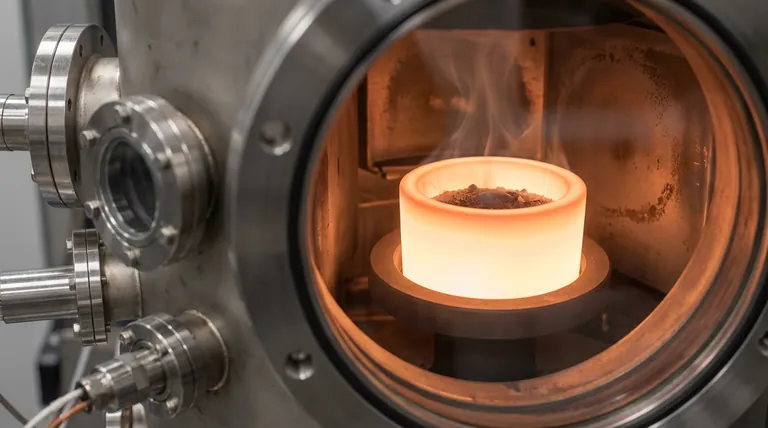
High-purity graphite crucibles function as active thermal and chemical participants in the synthesis process, not merely passive containers. In the vacuum synthesis of tantalum carbide, they serve to securely hold the tantalum powder and carburizing agents while leveraging exceptional thermal conductivity to ensure uniform heating. Crucially, at temperatures exceeding 2000 °C, the crucible itself acts as a supplementary reactant, releasing carbon vapor to aid the carburization process.

Core Takeaway While most crucibles are designed solely to isolate samples, high-purity graphite is selected for its ability to integrate into the reaction kinetics. Its capacity to act as an auxiliary carbon source at extreme temperatures ensures complete carburization, making it indispensable for synthesizing high-quality tantalum carbide.
What functions do high-purity graphite crucibles serve in tantalum carbide synthesis? Essential Thermal & Chemical Roles

The Role of Thermal Management

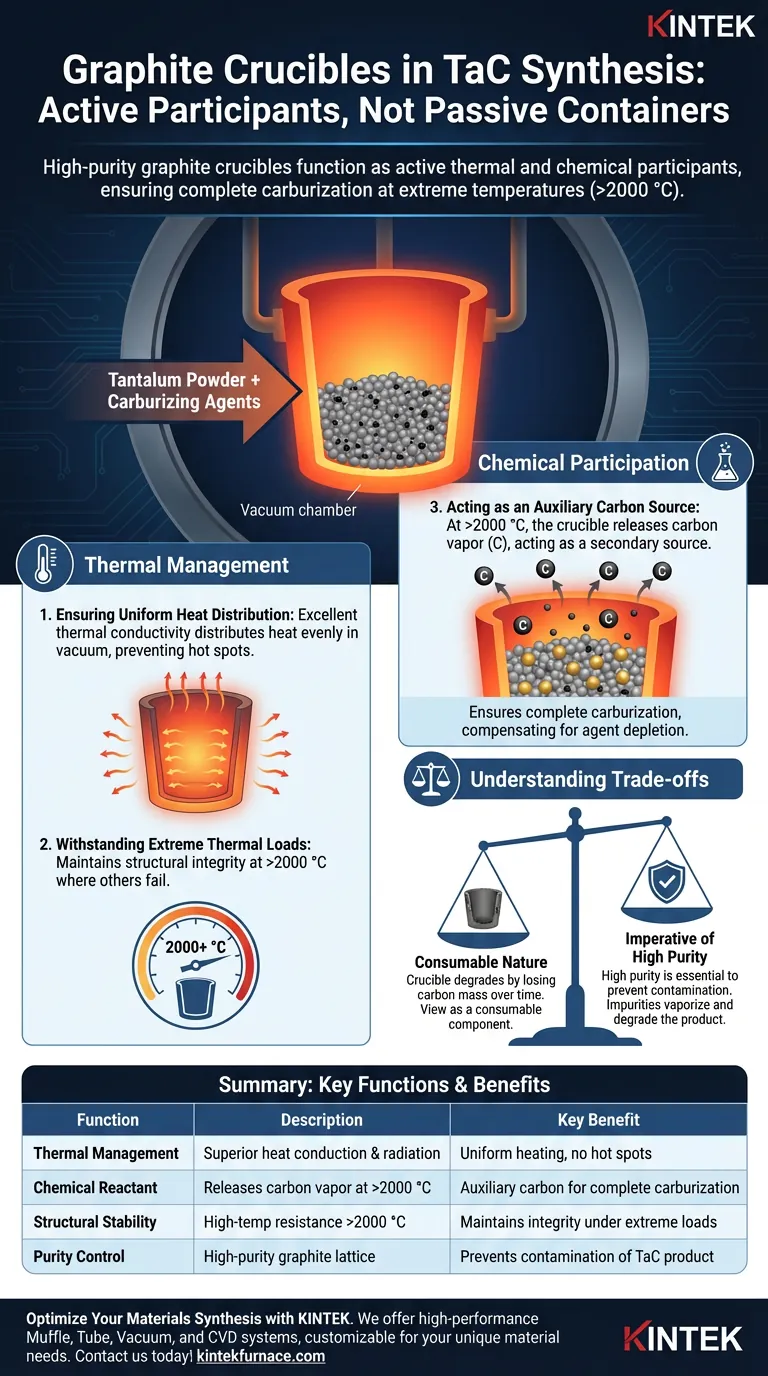
Ensuring Uniform Heat Distribution

In vacuum environments, heat transfer relies heavily on radiation and conduction rather than convection.

High-purity graphite possesses excellent thermal conductivity properties. This allows the crucible to distribute heat evenly across the tantalum powder mixture, preventing hot spots or cold zones that could lead to inconsistent material properties.

Withstanding Extreme Thermal Loads

The synthesis of tantalum carbide requires processing temperatures that can exceed 2000 °C.

Graphite exhibits exceptional high-temperature resistance, maintaining structural integrity where many other materials would melt or fracture. This stability ensures the vessel remains intact throughout the intense heating cycle required to drive the reaction.

Chemical Participation in Synthesis

Acting as an Auxiliary Carbon Source

Perhaps the most distinct function of the graphite crucible in this context is its chemical contribution.

At temperatures surpassing 2000 °C, the graphite material begins to release trace amounts of carbon vapor. This vapor permeates the reaction zone, acting as a secondary source of carbon.

This ensures that the tantalum powder is fully carburized, effectively compensating for any potential depletion of the primary carburizing agents in the mixture.

Understanding the Trade-offs

The Consumable Nature of the Crucible

Because the crucible participates in the reaction by losing carbon mass, it inevitably degrades over time.

Users must view these crucibles as consumable components rather than permanent fixtures. The "auxiliary carbon source" feature means the crucible walls will thin after repeated cycles at extreme temperatures.

The Imperative of High Purity

The "high-purity" specification is not a marketing term; it is a chemical necessity.

Any impurities present in the graphite lattice will vaporize along with the carbon at high temperatures. These impurities can contaminate the tantalum carbide, degrading its mechanical or thermal properties. Therefore, strict adherence to purity standards is required to prevent cross-contamination.

Making the Right Choice for Your Goal

When designing your synthesis process, consider how the crucible interacts with your specific parameters:

  • If your primary focus is stoichiometric precision: Account for the extra carbon provided by the crucible vapor at >2000 °C to prevent over-carburization or to balance the reactant mix.
  • If your primary focus is material purity: Verify the specific impurity trace analysis of the graphite grade, as any non-carbon elements in the crucible will likely migrate into your final product.

Success in tantalum carbide synthesis depends on treating the crucible as a dynamic variable in your chemical equation.

Summary Table:

Function Description Key Benefit
Thermal Management Superior heat conduction and radiation in vacuum. Ensures uniform heating and prevents hot spots.
Chemical Reactant Releases carbon vapor at temperatures >2000 °C. Acts as an auxiliary carbon source for complete carburization.
Structural Stability High-temperature resistance exceeding 2000 °C. Maintains integrity under extreme thermal loads.
Purity Control Use of high-purity graphite lattice. Prevents contamination of the tantalum carbide product.

Optimize Your Materials Synthesis with KINTEK

Precision in high-temperature synthesis requires more than just high-quality components; it requires the right equipment environment. Backed by expert R&D and manufacturing, KINTEK offers high-performance Muffle, Tube, Rotary, Vacuum, and CVD systems, along with specialized lab high-temp furnaces—all customizable for your unique material needs.

Whether you are synthesizing advanced carbides or perfecting thermal cycles, our team provides the technical expertise and robust systems to ensure your success. Contact us today to find the perfect high-temperature solution for your lab!

Visual Guide
What functions do high-purity graphite crucibles serve in tantalum carbide synthesis? Essential Thermal & Chemical Roles Visual Guide

References

  1. Seon-Min Hwang, Dong‐Won Lee. Carburization of Tantalum Metal Powder Using Activated Carbon. DOI: 10.3390/ma18122710

This article is also based on technical information from Kintek Furnace Knowledge Base .

Related Products

People Also Ask

Related Products

Magnesium Extraction and Purification Condensing Tube Furnace

Magnesium Extraction and Purification Condensing Tube Furnace

Magnesium purification tube furnace for high-purity metal production. Achieve ≤10Pa vacuum, dual-zone heating. Ideal for aerospace, electronics, and lab research.

1700℃ High Temperature Muffle Oven Furnace for Laboratory

1700℃ High Temperature Muffle Oven Furnace for Laboratory

KT-17M Muffle Furnace: High-precision 1700°C lab furnace with PID control, energy efficiency, and customizable sizes for industrial & research applications.

1200℃ Split Tube Furnace Laboratory Quartz Tube Furnace with Quartz Tube

1200℃ Split Tube Furnace Laboratory Quartz Tube Furnace with Quartz Tube

Discover KINTEK's 1200℃ Split Tube Furnace with quartz tube for precise high-temperature lab applications. Customizable, durable, and efficient. Get yours now!

1400℃ High Temperature Laboratory Tube Furnace with Quartz and Alumina Tube

1400℃ High Temperature Laboratory Tube Furnace with Quartz and Alumina Tube

KINTEK's Tube Furnace with Alumina Tube: Precision high-temperature processing up to 2000°C for labs. Ideal for material synthesis, CVD, and sintering. Customizable options available.

1400℃ Muffle Oven Furnace for Laboratory

1400℃ Muffle Oven Furnace for Laboratory

KT-14M Muffle Furnace: Precision 1400°C heating with SiC elements, PID control, and energy-efficient design. Ideal for labs.

Laboratory Muffle Oven Furnace with Bottom Lifting

Laboratory Muffle Oven Furnace with Bottom Lifting

Boost lab efficiency with KT-BL Bottom Lifting Furnace: precise 1600℃ control, superior uniformity, and enhanced productivity for material science and R&D.

Laboratory Vacuum Tilt Rotary Tube Furnace Rotating Tube Furnace

Laboratory Vacuum Tilt Rotary Tube Furnace Rotating Tube Furnace

KINTEK Laboratory Rotary Furnace: Precision heating for calcination, drying, sintering. Customizable solutions with vacuum & controlled atmosphere. Enhance research now!

Vacuum Sealed Continuous Working Rotary Tube Furnace Rotating Tube Furnace

Vacuum Sealed Continuous Working Rotary Tube Furnace Rotating Tube Furnace

Precision rotary tube furnace for continuous vacuum processing. Ideal for calcination, sintering, and heat treatment. Customizable up to 1600℃.

High Temperature Muffle Oven Furnace for Laboratory Debinding and Pre Sintering

High Temperature Muffle Oven Furnace for Laboratory Debinding and Pre Sintering

KT-MD Debinding & Pre-Sintering Furnace for ceramics - precise temperature control, energy-efficient design, customizable sizes. Boost your lab efficiency today!

1200℃ Muffle Oven Furnace for Laboratory

1200℃ Muffle Oven Furnace for Laboratory

KINTEK KT-12M Muffle Furnace: Precision 1200°C heating with PID control. Ideal for labs needing rapid, uniform heat. Explore models & customization options.

Multi Zone Laboratory Quartz Tube Furnace Tubular Furnace

Multi Zone Laboratory Quartz Tube Furnace Tubular Furnace

KINTEK Multi-Zone Tube Furnace: Precise 1700℃ heating with 1-10 zones for advanced material research. Customizable, vacuum-ready, and safety-certified.

Mesh Belt Controlled Atmosphere Furnace Inert Nitrogen Atmosphere Furnace

Mesh Belt Controlled Atmosphere Furnace Inert Nitrogen Atmosphere Furnace

KINTEK Mesh Belt Furnace: High-performance controlled atmosphere furnace for sintering, hardening & heat treatment. Customizable, energy-efficient, precise temperature control. Get a quote now!

1700℃ Controlled Inert Nitrogen Atmosphere Furnace

1700℃ Controlled Inert Nitrogen Atmosphere Furnace

KT-17A Controlled Atmosphere Furnace: Precise 1700°C heating with vacuum & gas control. Ideal for sintering, research & material processing. Explore now!

Multi Heating Zones CVD Tube Furnace Machine for Chemical Vapor Deposition Equipment

Multi Heating Zones CVD Tube Furnace Machine for Chemical Vapor Deposition Equipment

KINTEK's Multi-Zone CVD Tube Furnaces offer precision temperature control for advanced thin film deposition. Ideal for research and production, customizable for your lab needs.

Electric Rotary Kiln Continuous Working Small Rotary Furnace Kiln for Pyrolysis Plant Heating

Electric Rotary Kiln Continuous Working Small Rotary Furnace Kiln for Pyrolysis Plant Heating

KINTEK's electric rotary furnaces offer precision heating up to 1100°C for calcination, drying, and pyrolysis. Durable, efficient, and customizable for labs and production. Explore models now!

Electric Rotary Kiln Small Rotary Furnace Biomass Pyrolysis Plant Rotating Furnace

Electric Rotary Kiln Small Rotary Furnace Biomass Pyrolysis Plant Rotating Furnace

KINTEK's Rotary Biomass Pyrolysis Furnace converts biomass to biochar, bio-oil, and syngas efficiently. Customizable for research or production. Get your solution now!

CF KF Flange Vacuum Electrode Feedthrough Lead Sealing Assembly for Vacuum Systems

CF KF Flange Vacuum Electrode Feedthrough Lead Sealing Assembly for Vacuum Systems

Reliable CF/KF flange vacuum electrode feedthrough for high-performance vacuum systems. Ensures superior sealing, conductivity & durability. Customizable options available.

Spark Plasma Sintering SPS Furnace

Spark Plasma Sintering SPS Furnace

Discover KINTEK's advanced Spark Plasma Sintering (SPS) Furnace for rapid, precise material processing. Customizable solutions for research and production.

1400℃ Controlled Inert Nitrogen Atmosphere Furnace

1400℃ Controlled Inert Nitrogen Atmosphere Furnace

KT-14A Controlled Atmosphere Furnace for labs & industry. 1400°C max temp, vacuum sealing, inert gas control. Customizable solutions available.

1200℃ Controlled Inert Nitrogen Atmosphere Furnace

1200℃ Controlled Inert Nitrogen Atmosphere Furnace

KINTEK 1200℃ Controlled Atmosphere Furnace: Precision heating with gas control for labs. Ideal for sintering, annealing, and material research. Customizable sizes available.


Leave Your Message
