Knowledge What role does a laboratory vacuum pump play in a static batch desulfurization evaluation system? Ensure Data Integrity
Author avatar

Tech Team · Kintek Furnace

Updated 2 hours ago

What role does a laboratory vacuum pump play in a static batch desulfurization evaluation system? Ensure Data Integrity


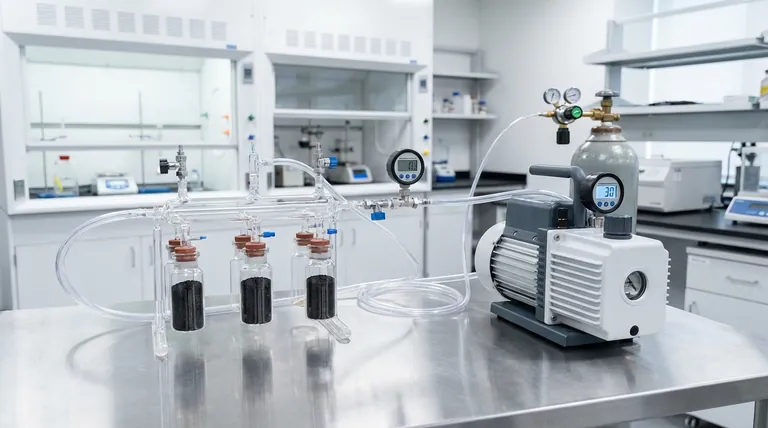
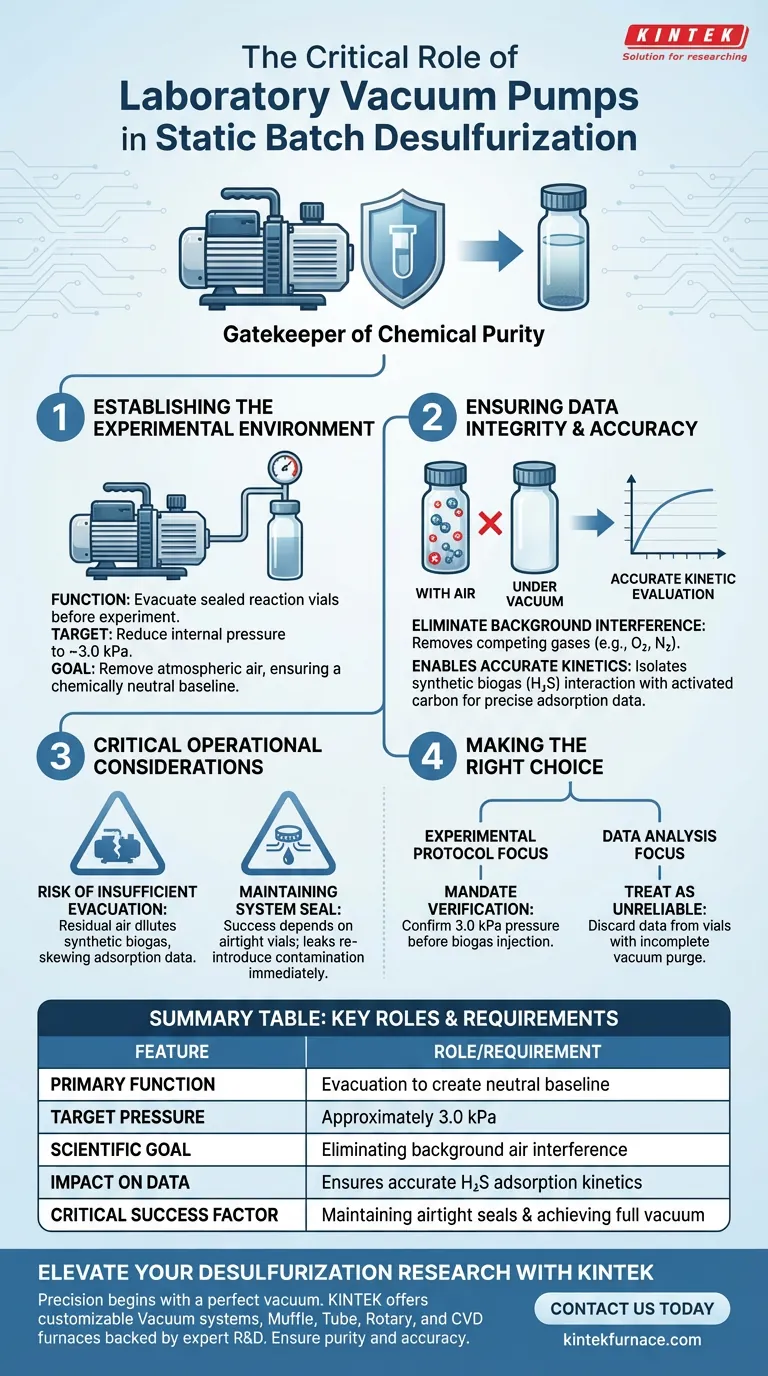
The laboratory vacuum pump serves as a critical preparation tool for establishing a controlled experimental baseline. Its primary function is to evacuate sealed reaction vials before the experiment begins, reducing the internal pressure to approximately 3.0 kPa. This step is mandatory to remove atmospheric air, ensuring that the environment is chemically neutral before the introduction of synthetic biogas.

Accuracy in static batch desulfurization relies on the vacuum pump to eliminate background air interference, ensuring that subsequent measurements of hydrogen sulfide adsorption reflect only the interaction between the biogas and the activated carbon.
What role does a laboratory vacuum pump play in a static batch desulfurization evaluation system? Ensure Data Integrity

Establishing the Experimental Environment

Evacuation of Reaction Vials

The vacuum pump interacts directly with the sealed reaction vials prior to the start of the reaction.

Its objective is to physically extract the existing volume of air trapped within the closed system. This prevents the "starting" atmosphere from being a random variable in the experiment.

Achieving Specific Pressure Targets

The pump must be capable of reducing the internal system pressure to a precise target of approximately 3.0 kPa.

Reaching this specific low-pressure threshold is the indicator that the vial is sufficiently evacuated and ready for the next stage of the process.

Ensuring Data Integrity and Accuracy

Eliminating Background Interference

The primary scientific reason for using the vacuum pump is to remove background air interference.

If atmospheric air remains in the vial, its components (such as nitrogen or oxygen) could compete with the target gases or alter the partial pressures within the system.

Enabling Accurate Kinetic Evaluation

By creating a vacuum, the system ensures that the subsequently injected synthetic biogas is the only gas interacting with the activated carbon.

This isolation allows researchers to accurately evaluate the hydrogen sulfide (H2S) adsorption kinetics. Without this step, kinetic data would be corrupted by the presence of non-target atmospheric gases.

Critical Operational Considerations

The Risk of Insufficient Evacuation

If the vacuum pump fails to reach the 3.0 kPa target, residual air remains in the vial.

This residual air dilutes the synthetic biogas, leading to skewed adsorption data and potentially invalidating the kinetic analysis of the activated carbon.

Maintaining System Seal

The effectiveness of the vacuum pump is entirely dependent on the integrity of the reaction vial seals.

Even a high-performance pump cannot compensate for a leaking vial, which will re-introduce background interference immediately after evacuation stops.

Making the Right Choice for Your Goal

To ensure valid results in your desulfurization evaluation, apply the following based on your specific focus:

  • If your primary focus is Experimental Protocol: Mandate a verification step to confirm internal pressure drops to 3.0 kPa before injecting any synthetic biogas.
  • If your primary focus is Data Analysis: Treat any data collected from vials that did not undergo a complete vacuum purge as unreliable due to atmospheric contamination.

The vacuum pump is not merely a utility; it is the gatekeeper of the experiment's chemical purity.

Summary Table:

Feature Role/Requirement
Primary Function Evacuation of reaction vials to create a neutral baseline
Target Pressure Approximately 3.0 kPa
Scientific Goal Eliminating background air interference (Oxygen/Nitrogen)
Impact on Data Ensures accurate measurement of H2S adsorption kinetics
Critical Success Factor Maintaining airtight system seals and achieving full vacuum

Elevate Your Desulfurization Research with KINTEK

Precision in static batch desulfurization begins with a perfect vacuum. At KINTEK, we understand that background interference can compromise your kinetic data. Backed by expert R&D and manufacturing, KINTEK offers a comprehensive range of lab solutions, including Vacuum systems, Muffle, Tube, Rotary, and CVD furnaces, all customizable to meet your unique experimental needs.

Ready to ensure the purity of your experimental environment? Contact us today to discover how our high-performance laboratory equipment can deliver the accuracy your research demands.

Visual Guide
What role does a laboratory vacuum pump play in a static batch desulfurization evaluation system? Ensure Data Integrity Visual Guide

References

  1. Mayerlin Edith Acunã Montaño, Alesandro Bail. Performance assessment of activated carbon thermally modified with iron in the desulfurization of biogas in a static batch system supported by headspace gas chromatography. DOI: 10.1186/s40543-024-00432-6

This article is also based on technical information from Kintek Furnace Knowledge Base .

Related Products

People Also Ask

Related Products

Vacuum Hot Press Furnace Machine Heated Vacuum Press Tube Furnace

Vacuum Hot Press Furnace Machine Heated Vacuum Press Tube Furnace

Discover KINTEK's advanced Vacuum Tube Hot Press Furnace for precise high-temperature sintering, hot pressing, and material bonding. Customizable solutions for labs.

Laboratory Vacuum Tilt Rotary Tube Furnace Rotating Tube Furnace

Laboratory Vacuum Tilt Rotary Tube Furnace Rotating Tube Furnace

KINTEK Laboratory Rotary Furnace: Precision heating for calcination, drying, sintering. Customizable solutions with vacuum & controlled atmosphere. Enhance research now!

High Pressure Laboratory Vacuum Tube Furnace Quartz Tubular Furnace

High Pressure Laboratory Vacuum Tube Furnace Quartz Tubular Furnace

KINTEK High Pressure Tube Furnace: Precision heating up to 1100°C with 15Mpa pressure control. Ideal for sintering, crystal growth, and lab research. Customizable solutions available.

Vacuum Sealed Continuous Working Rotary Tube Furnace Rotating Tube Furnace

Vacuum Sealed Continuous Working Rotary Tube Furnace Rotating Tube Furnace

Precision rotary tube furnace for continuous vacuum processing. Ideal for calcination, sintering, and heat treatment. Customizable up to 1600℃.

1700℃ High Temperature Laboratory Tube Furnace with Quartz or Alumina Tube

1700℃ High Temperature Laboratory Tube Furnace with Quartz or Alumina Tube

KINTEK's Tube Furnace with Alumina Tube: Precision heating up to 1700°C for material synthesis, CVD, and sintering. Compact, customizable, and vacuum-ready. Explore now!

Vacuum Heat Treat Sintering Furnace Molybdenum Wire Vacuum Sintering Furnace

Vacuum Heat Treat Sintering Furnace Molybdenum Wire Vacuum Sintering Furnace

KINTEK's Vacuum Molybdenum Wire Sintering Furnace excels in high-temperature, high-vacuum processes for sintering, annealing, and material research. Achieve precise 1700°C heating with uniform results. Custom solutions available.

2200 ℃ Graphite Vacuum Heat Treat Furnace

2200 ℃ Graphite Vacuum Heat Treat Furnace

2200℃ Graphite Vacuum Furnace for high-temperature sintering. Precise PID control, 6*10⁻³Pa vacuum, durable graphite heating. Ideal for research & production.

High Temperature Muffle Oven Furnace for Laboratory Debinding and Pre Sintering

High Temperature Muffle Oven Furnace for Laboratory Debinding and Pre Sintering

KT-MD Debinding & Pre-Sintering Furnace for ceramics - precise temperature control, energy-efficient design, customizable sizes. Boost your lab efficiency today!

Stainless Steel Quick Release Vacuum Chain Three Section Clamp

Stainless Steel Quick Release Vacuum Chain Three Section Clamp

Stainless steel quick release vacuum clamps ensure leak-free connections for high vacuum systems. Durable, corrosion-resistant, and easy to install.

Vacuum Heat Treat Sintering and Brazing Furnace

Vacuum Heat Treat Sintering and Brazing Furnace

KINTEK Vacuum Brazing Furnaces deliver precision, clean joints with superior temperature control. Customizable for diverse metals, ideal for aerospace, medical, and thermal applications. Get a quote!

Vacuum Heat Treat Furnace with Ceramic Fiber Liner

Vacuum Heat Treat Furnace with Ceramic Fiber Liner

KINTEK's Vacuum Furnace with Ceramic Fiber Lining offers precise high-temperature processing up to 1700°C, ensuring uniform heat distribution and energy efficiency. Ideal for labs and production.

Laboratory Muffle Oven Furnace with Bottom Lifting

Laboratory Muffle Oven Furnace with Bottom Lifting

Boost lab efficiency with KT-BL Bottom Lifting Furnace: precise 1600℃ control, superior uniformity, and enhanced productivity for material science and R&D.

Vacuum Heat Treat Sintering Furnace with Pressure for Vacuum Sintering

Vacuum Heat Treat Sintering Furnace with Pressure for Vacuum Sintering

KINTEK's Vacuum Pressure Sintering Furnace offers 2100℃ precision for ceramics, metals, and composites. Customizable, high-performance, and contamination-free. Get a quote now!

1400℃ Muffle Oven Furnace for Laboratory

1400℃ Muffle Oven Furnace for Laboratory

KT-14M Muffle Furnace: Precision 1400°C heating with SiC elements, PID control, and energy-efficient design. Ideal for labs.

Vertical Laboratory Quartz Tube Furnace Tubular Furnace

Vertical Laboratory Quartz Tube Furnace Tubular Furnace

Precision KINTEK Vertical Tube Furnace: 1800℃ heating, PID control, customizable for labs. Ideal for CVD, crystal growth & materials testing.

1400℃ High Temperature Laboratory Tube Furnace with Quartz and Alumina Tube

1400℃ High Temperature Laboratory Tube Furnace with Quartz and Alumina Tube

KINTEK's Tube Furnace with Alumina Tube: Precision high-temperature processing up to 2000°C for labs. Ideal for material synthesis, CVD, and sintering. Customizable options available.

Molybdenum Vacuum Heat Treat Furnace

Molybdenum Vacuum Heat Treat Furnace

High-performance molybdenum vacuum furnace for precise 1400°C heat treatment. Ideal for sintering, brazing, and crystal growth. Durable, efficient, and customizable.

Split Chamber CVD Tube Furnace with Vacuum Station CVD Machine

Split Chamber CVD Tube Furnace with Vacuum Station CVD Machine

Split Chamber CVD Tube Furnace with Vacuum Station - High precision 1200°C lab furnace for advanced materials research. Customizable solutions available.

1400℃ Controlled Inert Nitrogen Atmosphere Furnace

1400℃ Controlled Inert Nitrogen Atmosphere Furnace

KT-14A Controlled Atmosphere Furnace for labs & industry. 1400°C max temp, vacuum sealing, inert gas control. Customizable solutions available.

Electric Rotary Kiln Small Rotary Furnace Biomass Pyrolysis Plant Rotating Furnace

Electric Rotary Kiln Small Rotary Furnace Biomass Pyrolysis Plant Rotating Furnace

KINTEK's Rotary Biomass Pyrolysis Furnace converts biomass to biochar, bio-oil, and syngas efficiently. Customizable for research or production. Get your solution now!


Leave Your Message