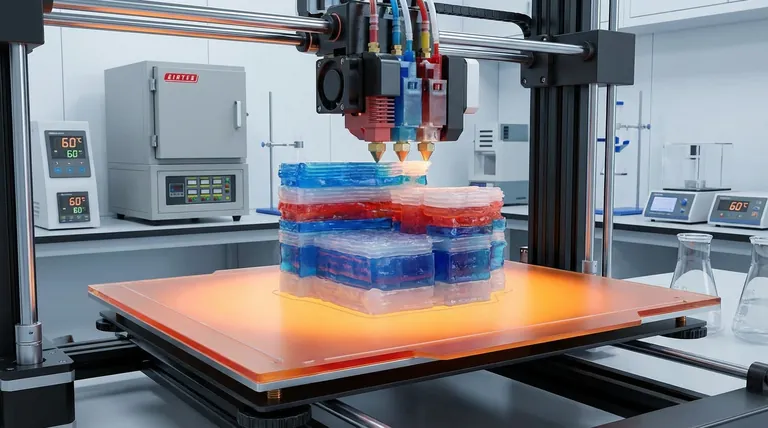
A heating stage acts as a critical stabilizer during the printing process. By maintaining a precise substrate temperature—specifically around 60 °C—it triggers an immediate physical change in inks containing methylcellulose (MC) binders. This rapid "thermal gelation" causes the ink's viscosity to spike the moment it touches the build plate, locking the material in place.
The heating stage is not merely for temperature regulation; it is a mechanism for instantaneous structural reinforcement. By inducing thermal gelation upon contact, it prevents material spreading and enables the accurate stacking necessary for complex 3D structures.
The Mechanism of Thermal Gelation
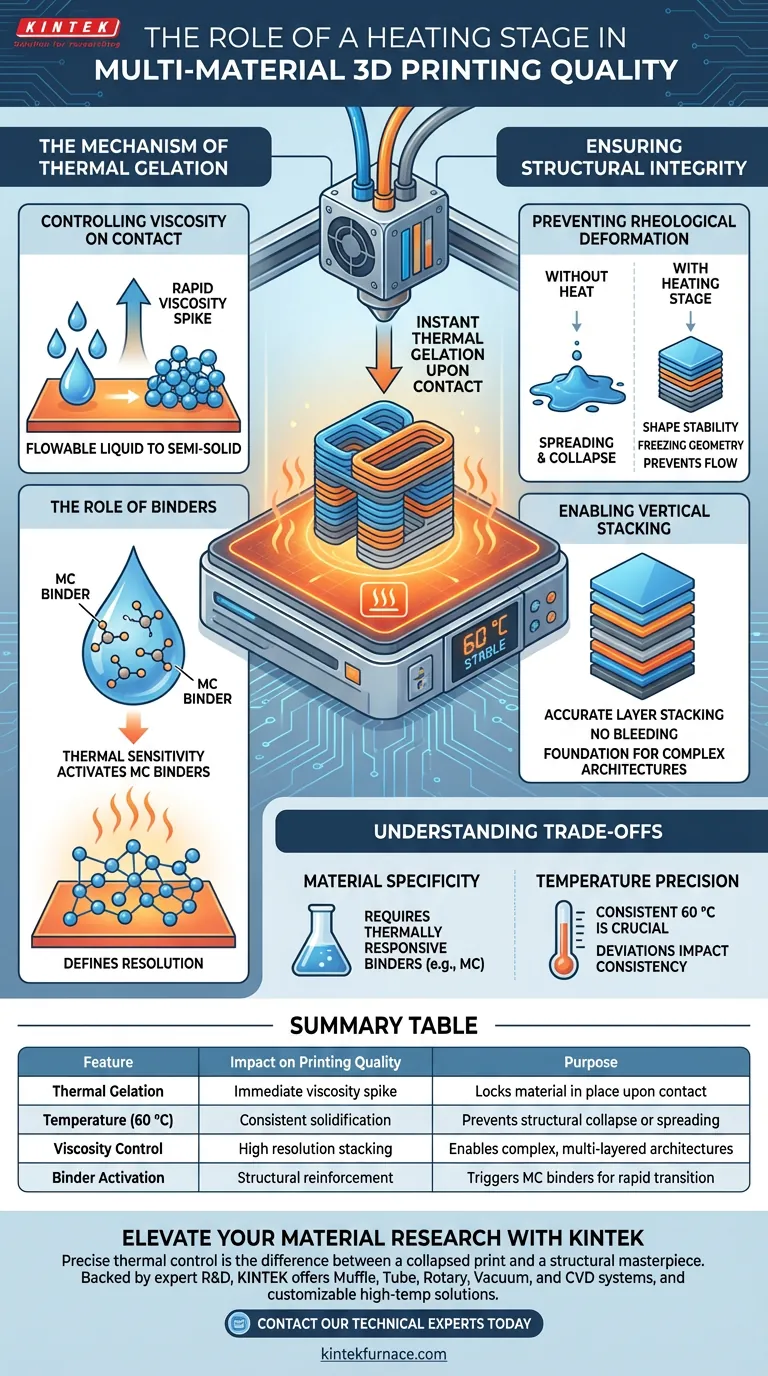
Controlling Viscosity on Contact
The primary function of the heating stage is to manipulate the physical state of the ink in real-time.
When the liquid ink contacts the heated substrate, the thermal energy acts as a catalyst. This causes the viscosity of the material to rise rapidly, transitioning it from a flowable liquid to a semi-solid state almost instantly.
The Role of Binders
This process relies heavily on specific chemical binders within the ink, such as methylcellulose (MC).
These binders are sensitive to thermal changes. The heating stage provides the exact environmental trigger required to activate these binders, initiating the gelation process that defines the print's resolution.
Ensuring Structural Integrity
Preventing Rheological Deformation
Without immediate solidification, liquid inks are susceptible to gravity and surface tension, leading to spreading or structural collapse.
The heating stage ensures shape stability by "freezing" the filament geometry in place. This prevents rheological deformation, where the material flows unwantedly before it sets.
Enabling Vertical Stacking
High-quality multi-material printing requires the ability to layer different materials without them bleeding into one another or collapsing.
By stabilizing each layer immediately, the heating stage allows for the accurate stacking of filaments. This stability is the foundation for building complex, multi-layered 3D architectures with high fidelity.
Understanding the Trade-offs
Material Specificity
It is important to note that this technique is highly material-dependent.
The benefits described here specifically apply to inks formulated with binders like methylcellulose that exhibit thermal gelation. Materials that do not respond to heat in this manner will not benefit from this specific stabilization method.
Temperature Precision
The success of this method relies on maintaining a consistent temperature (approximately 60 °C).
Deviations in substrate temperature can lead to inconsistent gelation. Too cool, and the structure may collapse; too hot, and the material behavior may become unpredictable or dry too quickly.
Making the Right Choice for Your Project
To leverage a heating stage effectively, you must align your hardware capabilities with your material science.
- If your primary focus is complex geometries: Ensure your ink formulation contains thermally responsive binders (like MC) to utilize the heating stage for immediate stabilization.
- If your primary focus is material consistency: Calibrate your heating stage to maintain 60 °C precisely, as fluctuations will directly impact the viscosity and stacking accuracy of your print.
Mastering the thermal environment of the substrate is the key to transforming liquid ink into a precise, self-supporting structure.
Summary Table:
| Feature | Impact on Printing Quality | Purpose |
|---|---|---|
| Thermal Gelation | Immediate viscosity spike | Locks material in place upon contact |
| Temperature (60 °C) | Consistent solidification | Prevents structural collapse or spreading |
| Viscosity Control | High resolution stacking | Enables complex, multi-layered architectures |
| Binder Activation | Structural reinforcement | Triggers MC binders for rapid transition |
Elevate Your Material Research with KINTEK
Precise thermal control is the difference between a collapsed print and a structural masterpiece. Backed by expert R&D and manufacturing, KINTEK offers a comprehensive range of Muffle, Tube, Rotary, Vacuum, and CVD systems, as well as specialized lab high-temp solutions. Whether you are developing advanced ink formulations or complex 3D architectures, our customizable systems are designed to meet your unique research needs.
Ready to stabilize your process? Contact our technical experts today to find the perfect heating solution for your laboratory.
Visual Guide
References
- Highly Stable Low‐Temperature Phosphate Glass as a Platform for Multimaterial 3D Printing of Integrated Functional Microfluidic Devices. DOI: 10.1002/adem.202501603
This article is also based on technical information from Kintek Furnace Knowledge Base .
Related Products
- Multi Heating Zones CVD Tube Furnace Machine for Chemical Vapor Deposition Equipment
- Split Multi Heating Zone Rotary Tube Furnace Rotating Tube Furnace
- Molybdenum Disilicide MoSi2 Thermal Heating Elements for Electric Furnace
- Silicon Carbide SiC Thermal Heating Elements for Electric Furnace
- 2200 ℃ Graphite Vacuum Heat Treat Furnace
People Also Ask
- What is the function of a multi-zone tube furnace in CVD synthesis? Master 2D In2Se3 Nanosheet Precision
- What role do multi zone tube furnaces play in new energy research? Unlock Precise Thermal Control for Innovation
- Why are multi zone tube furnaces particularly useful for nanomaterial research? Unlock Precise Thermal Control for Advanced Synthesis
- What temperature-related capabilities make multi zone tube furnaces valuable for research? Unlock Precision Thermal Control
- What environmental protection applications utilize multi zone tube furnaces? Unlock Precision in Waste Treatment and Green Tech