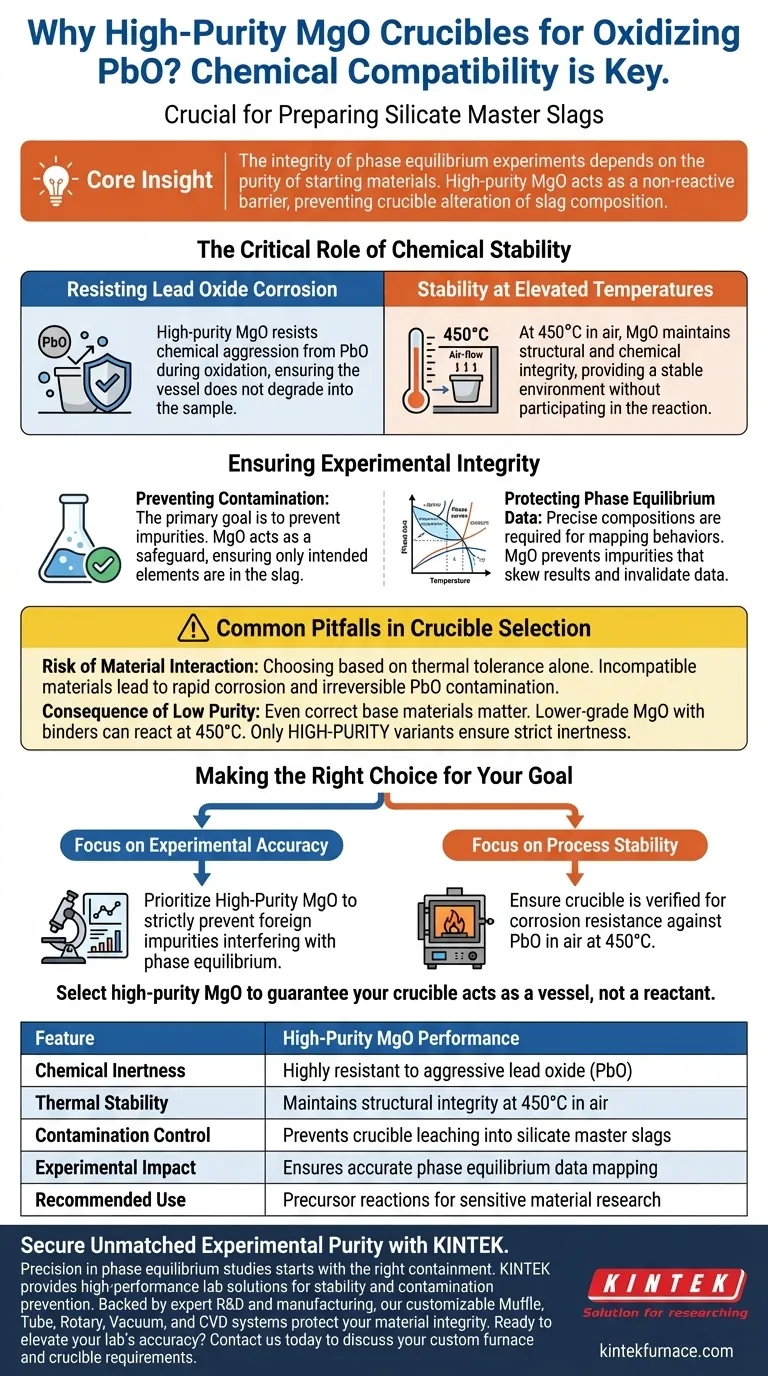
Chemical compatibility is the deciding factor when selecting crucibles for this specific oxidation process. High-purity magnesium oxide (MgO) crucibles are used because they are chemically inert to lead oxide (PbO) in a 450°C air environment, effectively preventing corrosion and ensuring the final silicate master slag remains free of contaminants.
Core Insight: The integrity of phase equilibrium experiments depends entirely on the purity of the starting materials. High-purity MgO is utilized not just for containment, but to act as a non-reactive barrier that prevents the crucible itself from altering the chemical composition of the slag.
The Critical Role of Chemical Stability
Resisting Lead Oxide Corrosion
Lead oxide (PbO) can be chemically aggressive towards many containment materials, particularly during oxidation processes.
High-purity MgO provides excellent chemical compatibility in this context. It effectively resists corrosion caused by contact with lead oxides, ensuring the vessel does not degrade into the sample.
Stability at Elevated Temperatures
The oxidation of PbO for silicate master slags typically occurs in an air environment at 450°C.
Under these specific thermal and atmospheric conditions, magnesium oxide maintains its structural and chemical integrity. It provides a stable environment for the reaction without participating in it.
Ensuring Experimental Integrity
Preventing Contamination
The primary goal of using high-purity MgO is to prevent the introduction of impurities into the master slag.
If a crucible reacts with the melt, elements from the crucible wall leach into the sample. MgO acts as a safeguard, ensuring that the only elements present in the slag are those intended by the researcher.
Protecting Phase Equilibrium Data
The preparation of these slags is often a precursor to phase equilibrium experiments.
These experiments require precise chemical compositions to map material behaviors accurately. Any impurities introduced by a corroding crucible would skew the results, rendering subsequent experimental data invalid.
Common Pitfalls in Crucible Selection
The Risk of Material Interaction
A common oversight in slag preparation is selecting a crucible based solely on thermal tolerance rather than chemical inertness.
Using a crucible material that is not compatible with PbO leads to rapid corrosion. This not only destroys the crucible but irreversibly contaminates the lead oxide sample.
The Consequence of Low Purity
Even when using the correct base material, the purity level is critical.
Lower-grade MgO crucibles may contain binders or impurities that can react at 450°C. Only high-purity variants ensure the strict inertness required for sensitive phase equilibrium studies.
Making the Right Choice for Your Goal
To ensure the success of your master slag preparation, align your material selection with your experimental requirements.
- If your primary focus is experimental accuracy: Prioritize high-purity MgO to strictly prevent the introduction of foreign impurities that interfere with phase equilibrium.
- If your primary focus is process stability: Ensure the crucible material is verified for corrosion resistance specifically against lead oxides in an air environment at 450°C.
Select high-purity MgO to guarantee that your crucible acts as a vessel, not a reactant.
Summary Table:
| Feature | High-Purity MgO Performance |
|---|---|
| Chemical Inertness | Highly resistant to aggressive lead oxide (PbO) |
| Thermal Stability | Maintains structural integrity at 450°C in air |
| Contamination Control | Prevents crucible leaching into silicate master slags |
| Experimental Impact | Ensures accurate phase equilibrium data mapping |
| Recommended Use | Precursor reactions for sensitive material research |
Secure Unmatched Experimental Purity with KINTEK
Precision in phase equilibrium studies starts with the right containment. KINTEK provides the high-performance laboratory solutions required to prevent costly contamination and ensure process stability.
Backed by expert R&D and manufacturing, KINTEK offers a comprehensive range of lab high-temp equipment, including Muffle, Tube, Rotary, Vacuum, and CVD systems, all of which are fully customizable to meet your unique chemical compatibility needs. Whether you are preparing master slags or conducting complex thermal reactions, our equipment is designed to protect your material integrity.
Ready to elevate your lab's accuracy? Contact us today to discuss your custom furnace and crucible requirements with our technical experts.
Visual Guide
References
- Georgii Khartcyzov, Evgueni Jak. Integrated Experimental and Thermodynamic Modelling Study of Phase Equilibria in the PbO-AlO1.5-SiO2 System in Air. DOI: 10.1007/s12540-024-01878-4
This article is also based on technical information from Kintek Furnace Knowledge Base .
Related Products
- Magnesium Extraction and Purification Condensing Tube Furnace
- Vacuum Induction Melting Furnace
- Molybdenum Disilicide MoSi2 Thermal Heating Elements for Electric Furnace
People Also Ask
- What are the advantages of using a condensing tube furnace for magnesium extraction? Achieve High Purity and Efficient Metal Recovery
- What is a tube furnace and what are its primary uses? Essential for Controlled High-Temperature Processes
- What is the purpose of introducing high-purity nitrogen into a tube furnace? Enhance Biomass Torrefaction Efficiency
- How does the atmosphere differ between tube furnaces and box furnaces? Optimize Your Heat Treatment Process
- Why Avoid Particle Coagulation in Ceramic Prep? Prevent Defects in Tube & Vacuum Furnaces