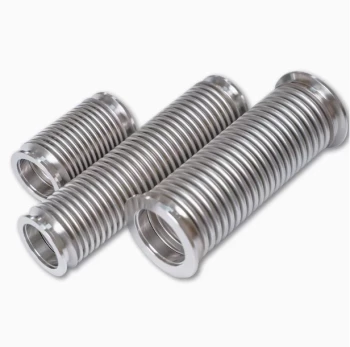
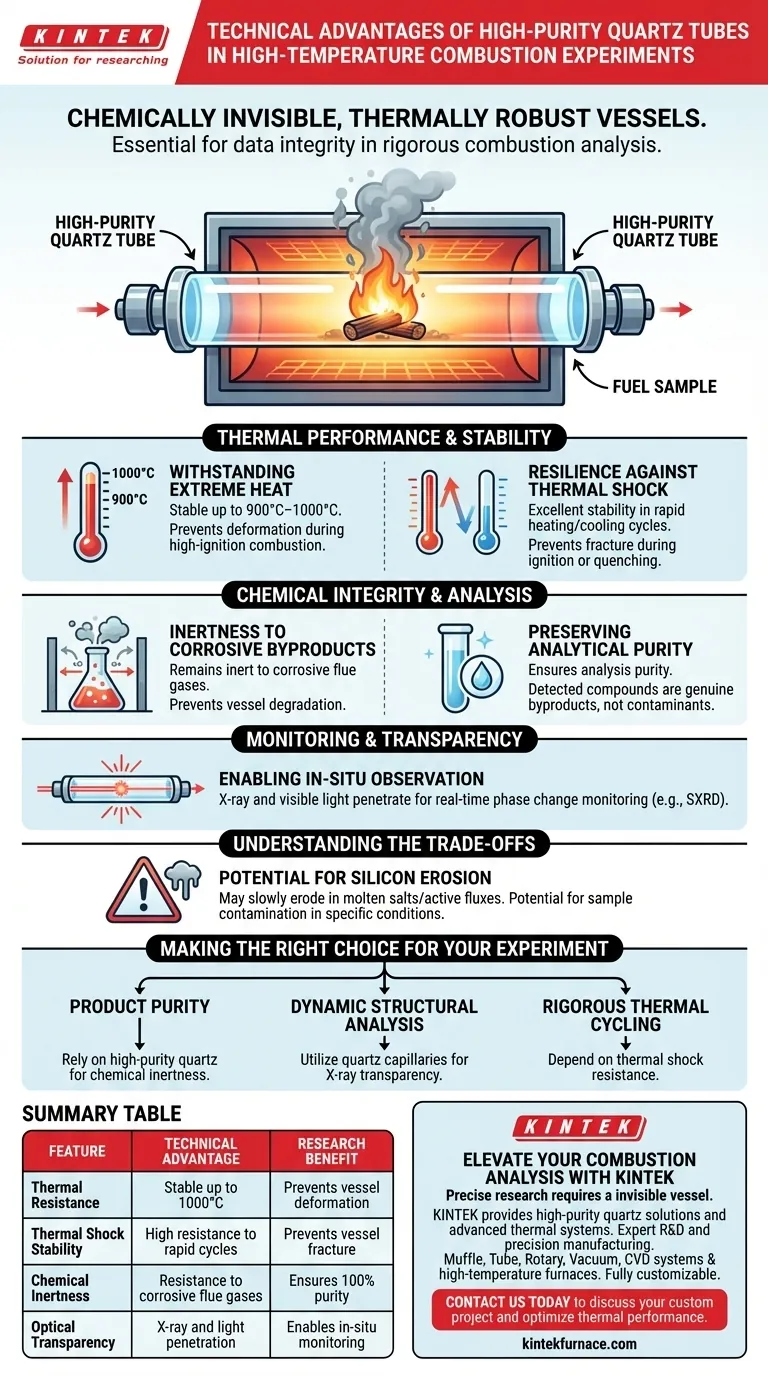
High-purity quartz tubes serve as chemically invisible, thermally robust vessels essential for maintaining data integrity during rigorous combustion analysis. These components provide a critical combination of thermal resistance up to 900°C–1000°C, immunity to thermal shock during rapid temperature changes, and chemical inertness against corrosive flue gases.
The Core Value In high-temperature analysis, the reaction vessel must contain the experiment without participating in it. High-purity quartz ensures that the structural changes or chemical byproducts you measure are from your sample, not degradation or contamination from the tube itself.
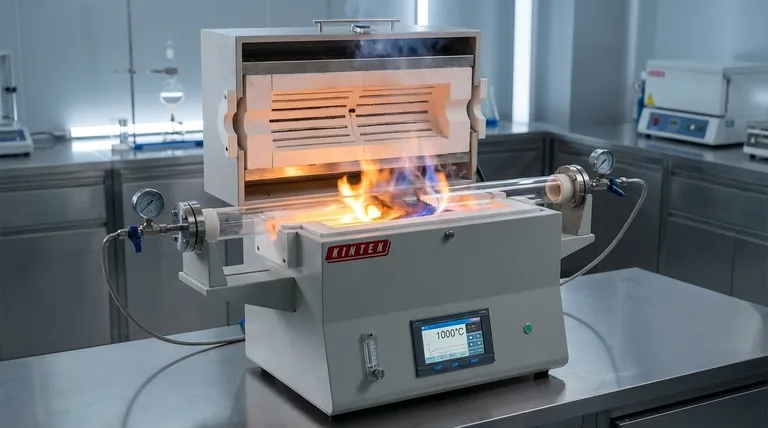
Thermal Performance and Stability
Withstanding Extreme Heat
High-purity quartz offers exceptional thermal resistance, maintaining structural integrity in environments exceeding 900°C.
specialized configurations, such as capillaries used in non-isothermal reduction processes, can remain stable up to 1000°C. This allows for the combustion of fuels that require high ignition temperatures without softening or deforming the vessel.
Resilience Against Thermal Shock
Combustion experiments often involve rapid heating and cooling cycles.
Quartz tubes possess excellent thermal shock stability, meaning they can withstand frequent, drastic temperature fluctuations without fracturing. This durability is critical for preventing catastrophic vessel failure during the ignition or quenching phases of an experiment.
Chemical Integrity and Analysis
Inertness to Corrosive Byproducts
Combustion processes frequently generate corrosive flue gases that react with standard glass or metal vessels.
High-purity quartz remains chemically inert in these environments. It does not react with the corrosive gases produced during fuel combustion, preventing the vessel from degrading or altering the chemical composition of the reaction atmosphere.
Preserving Analytical Purity
The primary goal of combustion experimentation is the accurate analysis of combustion products.
Because the quartz tube resists chemical interaction, it ensures the purity of the analysis. Researchers can be confident that the detected compounds are genuine byproducts of the fuel, rather than contaminants leached from the reaction vessel.
Monitoring and Transparency
Enabling In-Situ Observation
Beyond thermal and chemical properties, high-purity quartz offers superior transparency.
In advanced applications like Synchrotron X-ray Diffraction (SXRD), quartz capillaries allow high-energy beams (e.g., 55 keV) to penetrate the sample. This permits continuous dynamic monitoring of phase changes and structural information in real-time while the sample is under heat.
Understanding the Trade-offs
Potential for Silicon Erosion
While generally inert, quartz is not universally resistant to all chemical environments.
In specific conditions involving molten salts or active fluxes, the inner wall of the quartz tube can slowly erode. While some synthesis techniques intentionally exploit this to use the tube as a silicon source, in a pure combustion experiment, this represents a potential vector for sample contamination if the specific reactants are incompatible with silica.
Making the Right Choice for Your Experiment
Select your reaction vessel based on the specific parameters of your analysis:
- If your primary focus is product purity: Rely on high-purity quartz for its chemical inertness to ensure flue gases remain uncontaminated by the vessel walls.
- If your primary focus is dynamic structural analysis: Utilize quartz capillaries to leverage their X-ray transparency for real-time monitoring of phase changes up to 1000°C.
- If your primary focus is rigorous thermal cycling: Depend on the material's thermal shock resistance to prevent fractures during rapid heating and cooling sequences.
Ultimately, high-purity quartz is the definitive choice when the isolation of the sample environment is as critical as the reaction itself.
Summary Table:
| Feature | Technical Advantage | Research Benefit |
|---|---|---|
| Thermal Resistance | Stable up to 1000°C | Prevents vessel deformation during ignition |
| Thermal Shock Stability | High resistance to rapid cooling/heating | Prevents vessel fracture during quenching |
| Chemical Inertness | Resistance to corrosive flue gases | Ensures 100% purity of combustion byproducts |
| Optical Transparency | X-ray and visible light penetration | Enables in-situ monitoring of phase changes |
Elevate Your Combustion Analysis with KINTEK
Precise research requires a vessel that stays invisible. KINTEK provides high-purity quartz solutions and advanced thermal systems designed to protect your data integrity.
Backed by expert R&D and precision manufacturing, we offer a comprehensive range of Muffle, Tube, Rotary, Vacuum, and CVD systems, as well as other lab high-temperature furnaces. All our systems are fully customizable to meet the unique demands of your experimental setup.
Ready to optimize your lab’s thermal performance? Contact us today to discuss your custom project and see how KINTEK can bring superior reliability to your high-temperature applications.
Visual Guide
References
- Silin Zeng, Baosheng Jin. Experimental study on No<sub>x</sub> emission and nitrogen conversion characteristics of a coal gangue blended with coal washing mixture. DOI: 10.1088/1742-6596/3013/1/012035
This article is also based on technical information from Kintek Furnace Knowledge Base .
Related Products
- High Pressure Laboratory Vacuum Tube Furnace
- Vertical Laboratory Quartz Tube Furnace Tubular Furnace
- 1200℃ Split Tube Furnace Laboratory Quartz Tube Furnace with Quartz Tube
- Magnesium Extraction and Purification Condensing Tube Furnace
- Laboratory Quartz Tube Furnace RTP Heating Tubular Furnace
People Also Ask
- What role does a high vacuum tube furnace play in Co-Al sintering? Master High-Purity Porous Material Synthesis
- What are the different types of tube furnaces available? Find the Perfect Fit for Your Lab's Needs
- What are the main advantages of vacuum tube furnaces in the market? Achieve Purity and Precision in Material Processing
- What is the role of a vacuum tube furnace during the final thermal treatment stage of Fe3O4@CSAC catalysts?
- What conditions does a tube furnace provide for post-ion-implantation? Achieve Precise Microstructural Repair