
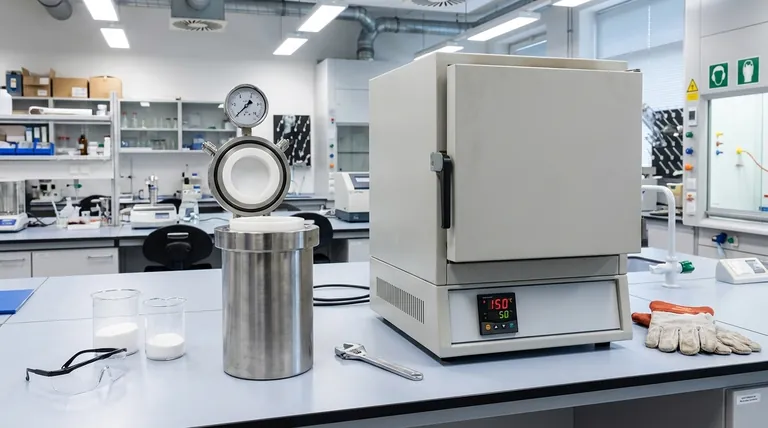
The primary purpose of a stainless steel high-pressure autoclave with a PTFE liner is to create a sealed, chemically inert environment capable of sustaining the extreme conditions required for hydrothermal synthesis. The stainless steel shell provides the necessary structural integrity to withstand high internal pressures, while the inner PTFE liner acts as a protective barrier, preventing the corrosive reaction solution from destroying the steel vessel. This combination allows for the safe, contamination-free growth of specific TiO2 nanostructures, such as nanowires or nanotubes.
Hydrothermal synthesis relies on forcing chemical reactions in a sealed, high-pressure aqueous solution. The autoclave acts as the pressure vessel, while the PTFE liner ensures chemical purity and prevents corrosion, enabling the precise growth of TiO2 nanostructures.
The Mechanics of the Reactor
Containment of High Pressure
The stainless steel outer body serves as the primary pressure vessel. When the reactor is sealed and heated, the internal pressure rises significantly because the solution is prevented from evaporating.
Facilitating Hydrothermal Conditions
This sealed environment allows water to remain in a liquid state at temperatures well above its standard boiling point. These conditions increase the solubility of titanium precursors, which is the mechanism that induces them to grow into specific shapes like nanowires or nanotubes.
The Critical Function of the PTFE Liner
Chemical Inertness and Protection
Hydrothermal synthesis of TiO2 often requires strong alkaline or acidic solutions to dissolve the precursor materials. The Polytetrafluoroethylene (PTFE) liner offers exceptional chemical stability, acting as a shield between these harsh chemicals and the stainless steel body.
Preventing Contamination
If the reaction solution were to touch the steel directly, the vessel would corrode, and metallic ions (like iron) would leach into the solution. The liner ensures a pure reaction environment, guaranteeing that your final TiO2 product is not contaminated by the reactor material itself.
The External Thermal Environment
The Role of the Box Furnace
The autoclave itself acts only as a container; it does not generate heat. It must be placed inside an external heat source, typically an industrial-grade laboratory box furnace.
Ensuring Uniform Crystal Growth
The furnace provides a stable and uniform thermal field, maintaining the system at a constant temperature (e.g., 150 °C) for the required duration. This precise temperature control is a prerequisite for the successful crystallization and structural formation of the nanomaterials.
Understanding Operational Limitations
Temperature Constraints of PTFE
While the stainless steel shell is extremely robust, the PTFE liner limits your maximum operating temperature. You typically cannot exceed temperatures around 200°C–250°C, as the liner will soften, deform, or degrade, potentially compromising the seal.
The Importance of Fill Ratios
Because the liquid expands when heated, you must never fill the autoclave completely. A specific fill ratio (often 60-80%) is required to leave a headspace for vapor and expansion, preventing dangerous pressure spikes that could rupture the safety disk or the vessel itself.
Making the Right Choice for Your Goal
To maximize the quality of your TiO2 synthesis, consider your specific experimental needs:
- If your primary focus is high purity: Ensure your PTFE liner is thoroughly cleaned and free of scratches to prevent cross-contamination from previous runs.
- If your primary focus is specific morphology (e.g., nanotubes): Rely on the external box furnace to maintain the precise, stable temperature required to dictate the crystal structure.
Mastering the interplay between the steel's strength and the liner's chemical resistance is the key to reproducible nanomaterial synthesis.
Summary Table:
| Feature | Component | Function in TiO2 Synthesis |
|---|---|---|
| Pressure Resistance | Stainless Steel Shell | Maintains structural integrity under high-pressure hydrothermal conditions. |
| Chemical Stability | PTFE Liner | Prevents corrosion from harsh acidic/alkaline precursors and ensures purity. |
| Thermal Source | External Box Furnace | Provides a stable thermal field for uniform crystallization and growth. |
| Safety Limit | Temperature/Fill Ratio | Prevents liner degradation (max 200-250°C) and pressure-related ruptures. |
Elevate Your Nanomaterial Research with KINTEK
Precision in hydrothermal synthesis starts with the right equipment. KINTEK provides high-performance laboratory solutions—including Muffle, Tube, Rotary, Vacuum, and CVD systems—designed to work seamlessly with your pressure vessels.
Backed by expert R&D and world-class manufacturing, our high-temperature furnaces are fully customizable to meet the rigorous demands of your TiO2 nanowire or nanotube production. Ensure uniform crystal growth and total chemical purity today.
Contact KINTEK Experts to Customize Your Lab Solution
Visual Guide

References
- Devireddy Sandhya, Vasudeva Rao Veeredhi. An exclusive review on TiO2-based nanofluids with applications to automotive industry. DOI: 10.7862/rm.2025.16
This article is also based on technical information from Kintek Furnace Knowledge Base .
Related Products
- High Pressure Laboratory Vacuum Tube Furnace
- Vertical Laboratory Quartz Tube Furnace Tubular Furnace
- High Temperature Muffle Oven Furnace for Laboratory Debinding and Pre Sintering
- Vacuum Hot Press Furnace Machine Heated Vacuum Press Tube Furnace
- Vacuum Heat Treat Furnace with Ceramic Fiber Liner
People Also Ask
- What role does a high vacuum tube furnace play in Co-Al sintering? Master High-Purity Porous Material Synthesis
- What are the different types of tube furnaces available? Find the Perfect Fit for Your Lab's Needs
- What is the role of a vacuum tube furnace during the final thermal treatment stage of Fe3O4@CSAC catalysts?
- What are the main advantages of vacuum tube furnaces in the market? Achieve Purity and Precision in Material Processing
- Why is a laboratory tube furnace necessary for BiVO4/RGO synthesis? Achieve Precise Nano-Structure Control



















