
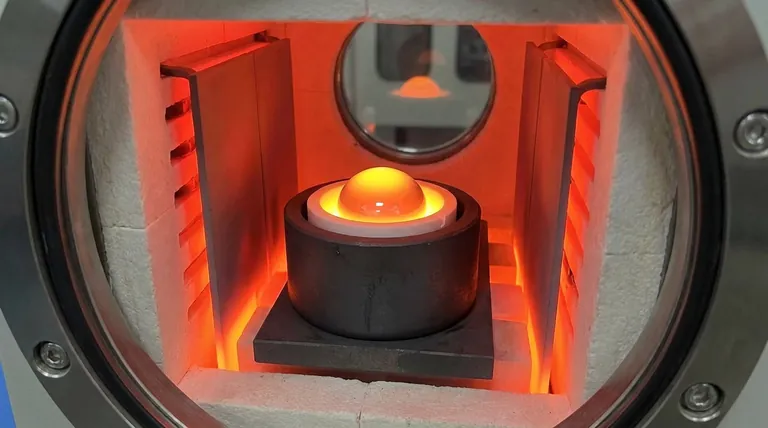
In high-temperature vacuum furnace experiments, the graphite crucible functions primarily as a robust structural carrier and a critical component of the thermal insulation system. It physically supports the alloy specimen and ceramic (Al2O3) shell assembly while simultaneously regulating the thermal environment to ensure consistent experimental conditions.
The graphite crucible is not merely a container; it is an active thermal stabilizer that enables the formation of precise hemispherical alloy droplets by maintaining a uniform temperature field at extremes exceeding 1550°C.
The Role of Structural Support
Acting as the Specimen Carrier
The primary function of the graphite crucible is to serve as the physical carrier for the experimental setup. It holds both the alloy specimen and the Al2O3 shell assembly securely in place.
Stability at Extreme Temperatures
Graphite is selected for its exceptional high-temperature stability. It maintains structural integrity at temperatures of 1550°C to 1600°C, ensuring the experimental geometry remains fixed throughout the heating process.
Thermal Regulation and Uniformity
acting as Thermal Insulation Shielding
Beyond physical support, the crucible acts as part of the furnace's thermal insulation shielding. This role is vital for isolating the experimental zone from fluctuating thermal gradients.
Ensuring a Uniform Temperature Field
By functioning as a thermal shield, the crucible helps generate a highly uniform temperature field around the sample. This uniformity prevents localized hot or cold spots that could skew interaction data.
Facilitating Proper Droplet Formation
The uniform thermal environment enabled by the crucible allows the alloy to melt evenly. This results in the formation of a regular, consistent hemispherical droplet, which is essential for accurate analysis of the alloy-shell interaction.
Understanding the Trade-offs
The Risk of Chemical Interaction
While graphite is thermally stable, it is chemically active in certain environments due to its reductive properties. As noted in supplementary contexts, graphite can act as a reducing agent at high temperatures.
Potential for Sample Contamination
In sensitive experiments, there is a risk that the carbon from the crucible could interact with the alloy or the ceramic shell. You must verify that the "reductive atmosphere" created by the graphite does not introduce unwanted variables into your specific alloy/ceramic interaction study.
Ensuring Experimental Accuracy
To effectively utilize a graphite crucible in your vacuum furnace experiments, consider the following:
- If your primary focus is thermal precision: Rely on the graphite crucible to shield the zone and create the uniform heat required for perfect droplet shape.
- If your primary focus is chemical purity: Monitor the interface for carbon contamination, as the graphite's reductive nature can unintentionally alter the alloy or shell composition.
The graphite crucible is the linchpin of the thermal zone, converting the raw heat of the furnace into a controlled environment suitable for precision measurement.
Summary Table:
| Feature | Function in Interaction Experiments | Benefit to Researcher |
|---|---|---|
| Structural Carrier | Supports alloy specimen and Al2O3 shell | Maintains geometric stability at 1550°C+ |
| Thermal Shielding | Acts as insulation within the furnace | Creates a uniform temperature field for droplets |
| Thermal Stability | Resists deformation at extreme heat | Ensures consistent, repeatable experimental conditions |
| Chemical Nature | Provides a reductive atmosphere | Enables specific interaction studies (requires contamination monitoring) |
Elevate Your Material Research with KINTEK
Precision in high-temperature experiments starts with the right equipment. Backed by expert R&D and world-class manufacturing, KINTEK offers a comprehensive range of Muffle, Tube, Rotary, Vacuum, and CVD systems, all of which can be customized to your specific alloy or ceramic research needs.
Whether you require specialized graphite components or a complete high-temp furnace setup, our team is ready to deliver the reliability your laboratory demands. Contact us today to discuss your unique requirements and see how our tailored solutions can enhance your experimental accuracy.
References
- Guangyao Chen, Chonghe Li. Effect of Kaolin/TiO2 Additions and Contact Temperature on the Interaction between DD6 Alloys and Al2O3 Shells. DOI: 10.3390/met14020164
This article is also based on technical information from Kintek Furnace Knowledge Base .
Related Products
- 2200 ℃ Graphite Vacuum Heat Treat Furnace
- Molybdenum Vacuum Heat Treat Furnace
- 2200 ℃ Tungsten Vacuum Heat Treat and Sintering Furnace
- Vacuum Heat Treat Sintering Furnace Molybdenum Wire Vacuum Sintering Furnace
- 1400℃ High Temperature Laboratory Tube Furnace with Alumina Tube
People Also Ask
- Why are vacuum heat treating furnaces essential for aerospace? Ensure Superior Material Integrity for High-Stakes Applications
- What is the primary application of vacuum heat treating furnaces in aerospace? Enhance Component Performance with Precision
- How does a vacuum heat treating furnace improve the condition of metal alloys? Achieve Superior Metal Performance
- What is the process of vacuum heat treating? Achieve Superior Metallurgical Properties
- How does vacuum heat treating work in terms of temperature and time control? Master Precise Material Transformations



















