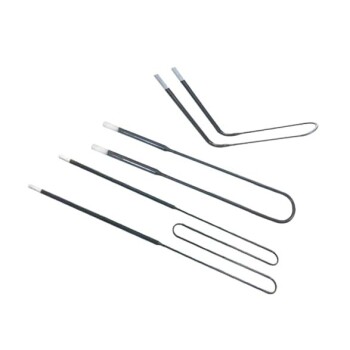
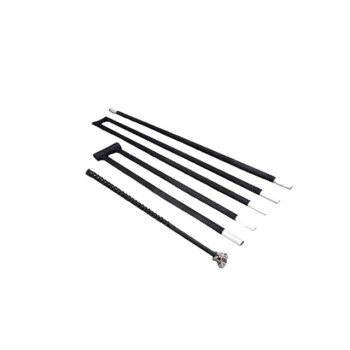
Molybdenum Disilicide (MoSi2) heating elements serve as the critical thermal stabilizer in high-temperature phase equilibrium experiments. Their primary role at 1500 °C is to generate a uniform, continuous temperature field while resisting chemical degradation, ensuring that complex slag systems can reach equilibrium over extended durations without experimental failure.
Core Insight: High-temperature experiments fail when thermal consistency fluctuates or heating elements degrade. MoSi2 elements solve this by forming a self-healing protective layer, allowing them to deliver precise, stable heat in oxidizing atmospheres for long-duration reactions up to 1800 °C.
The Critical Functions of MoSi2 at 1500 °C
Ensuring Thermal Uniformity
Phase equilibrium experiments generally require the entire sample to be held at an exact temperature to determine the precise chemical state of the material.
MoSi2 elements provide a stable, continuous heat source that minimizes temperature gradients within the furnace. This uniformity is non-negotiable for obtaining accurate data in systems such as CaO-Al2O3-VOx slag.
Enabling Extended Reaction Times
Reaching true phase equilibrium is rarely instantaneous; it often requires holding the material at peak temperature for long periods.
These elements are engineered for durability, supporting experiments that last 24 hours or longer. Their ability to run continuously ensures that the reaction is not interrupted by component failure before equilibrium is achieved.
Resistance to Oxidation
At 1500 °C, many standard heating materials would rapidly degrade or oxidize, potentially contaminating the sample or destroying the furnace internals.
MoSi2 elements are chemically distinct because they form a thin, protective silica (SiO2) passivation layer on their surface. This layer acts as a shield, preventing further oxidation and allowing the element to function effectively in air and other oxidizing atmospheres.
Operational Limitations and Trade-offs
While MoSi2 is the superior choice for high-temperature stability, it introduces specific mechanical vulnerabilities that must be managed.
Mechanical Fragility
Despite their thermal robustness, MoSi2 elements are mechanically brittle. They possess low resistance to mechanical shock, making them prone to breakage if the furnace is moved or subjected to vibration while cold.
Electrical Sensitivity
These elements operate within strict electrical parameters. Every MoSi2 element has a maximum current limit; exceeding this threshold can rapidly destroy the element, necessitating precise power control systems in your furnace setup.
Making the Right Choice for Your Goal
When designing your experimental protocol for 1500 °C phase equilibrium studies, apply these principles:
- If your primary focus is Data Accuracy: Rely on MoSi2 for its ability to create a uniform temperature field, which prevents localized cold spots that skew phase diagrams.
- If your primary focus is Process Longevity: Leverage the oxidation resistance of MoSi2 for runs exceeding 24 hours, but ensure the atmosphere remains within the element's compatibility range (air, nitrogen, argon, or vacuum).
- If your primary focus is Maintenance: Benefit from the low-maintenance nature of these elements, but implement strict handling protocols to avoid breakage due to brittleness.
By balancing the chemical resilience of Molybdenum Disilicide against its physical fragility, you ensure the rigorous thermal environment necessary for valid high-temperature research.
Summary Table:
| Feature | Advantage in 1500 °C Experiments |
|---|---|
| Thermal Stability | Maintains uniform temperature fields for accurate phase diagrams |
| Oxidation Resistance | Self-healing SiO2 layer enables long-duration runs in air |
| Durability | Supports continuous operation (24h+) without thermal degradation |
| Operating Range | Rated up to 1800 °C, providing a safe margin for 1500 °C research |
Elevate Your Research Precision with KINTEK
High-temperature phase equilibrium studies demand absolute thermal consistency. KINTEK provides world-class heating solutions backed by expert R&D and precision manufacturing. Whether you require Muffle, Tube, Rotary, Vacuum, or CVD systems, our high-temp furnaces are fully customizable to meet your specific experimental parameters.
Why choose KINTEK?
- Superior MoSi2 element integration for stable 1500 °C+ environments.
- Customizable furnace configurations tailored to unique slag or chemical systems.
- Expert technical support to ensure process longevity and data accuracy.
Don't let thermal fluctuations compromise your data. Contact our technical specialists today to design the perfect high-temperature furnace for your laboratory.
References
- Chengjun Liu, Guojie Huo. The Phase Diagram of a CaO-Al2O3-VOx Slag System under Argon Atmosphere at 1500 °C. DOI: 10.3390/met14010108
This article is also based on technical information from Kintek Furnace Knowledge Base .
Related Products
- Molybdenum Disilicide MoSi2 Thermal Heating Elements for Electric Furnace
- Molybdenum Vacuum Heat Treat Furnace
- Vacuum Heat Treat Sintering Furnace Molybdenum Wire Vacuum Sintering Furnace
- Silicon Carbide SiC Thermal Heating Elements for Electric Furnace
- 1400℃ Muffle Oven Furnace for Laboratory
People Also Ask
- What are the typical application temperatures for molybdenum disilicide (MoSi2) heating elements? Master High-Temp Performance
- What is the primary use of molybdenum disilicide? Ideal for High-Temp Heating Elements
- What are the characteristics of molybdenum disilicide heating elements? Unlock High-Temp Performance
- What are the properties of molybdenum disilicide (MoSi2) that make it suitable for high-temperature applications? Discover Its High-Temp Resilience
- What are the applications of molybdenum disilicide heating elements? Achieve Extreme Heat Stability for Industrial Processes