
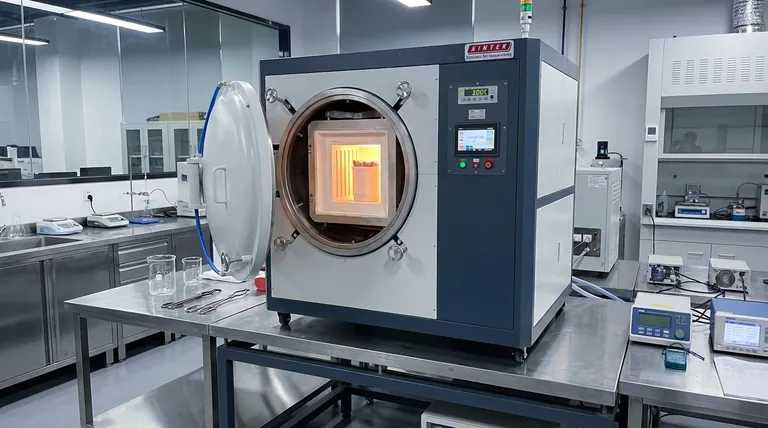
The primary purpose of using a vacuum oven for h-NCM(OH)2 samples is to simulate a pure dehydration process in a strictly controlled environment. By maintaining high vacuum and constant temperature, researchers can partially transform the precursor surface into an active oxide phase (NCMO) without interference from external atmospheric reactants.
By isolating the sample from external variables, this process highlights the direct link between surface reactivity and lithiation kinetics. It provides critical evidence that an unprotected active surface can lead to premature particle fusion.
Creating a Controlled Reaction Environment
Eliminating External Interference
The vacuum oven is essential because it removes air and other gases from the reaction chamber.
This ensures that the dehydration process is driven solely by temperature and pressure, rather than by chemical reactions with atmospheric components.
Simulating Pure Dehydration
The device maintains a constant-temperature environment alongside the high vacuum.
This specific combination forces the removal of water molecules from the h-NCM(OH)2 structure, simulating the dehydration dynamics required for the study.
Transforming the Precursor Surface
Activating the Oxide Phase
The thermal treatment in the vacuum oven causes a chemical change on the surface of the material.
The precursor surface partially transforms from a hydroxide into an active oxide phase (NCMO).
Creating a Testable Surface
This transformation is intentional; it creates a specific surface state that researchers need to evaluate.
The goal is to produce a sample with an "active" surface to measure how it behaves during subsequent processing steps.
Analyzing Lithiation and Fusion Risks
Comparing Surface Reactivity
Once the NCMO phase is formed, researchers use these samples to study lithiation kinetics.
The vacuum-treated samples serve as a baseline to compare how different levels of surface reactivity affect the movement of lithium ions.
Identifying Premature Fusion
The most critical insight gained from this process concerns particle stability.
The research reveals that when the active oxide surface is unprotected, it significantly increases the risk of premature particle fusion.
Understanding the Trade-offs
Simulation vs. Real-world Conditions
While effective for research, this process represents a simulation of dehydration.
It isolates specific variables to study mechanisms, which may differ slightly from the complex interactions found in large-scale commercial calcination processes.
The Risk of Unprotected Surfaces
The process explicitly demonstrates a failure mode: the creation of highly reactive surfaces.
While useful for study, generating these active surfaces highlights the necessity of protective coatings or additives in practical applications to prevent fusion.
Making the Right Choice for Your Research
To apply these findings effectively to your cathode material development, consider the following:
- If your primary focus is fundamental understanding: Use the vacuum oven to isolate surface reactivity and quantify its specific impact on lithiation speeds.
- If your primary focus is process stability: Analyze the degree of particle fusion in vacuum-treated samples to determine the necessity of surface protection strategies.
This method is the definitive way to prove that unprotected active surfaces are a primary driver of structural instability in cathode precursors.
Summary Table:
| Process Objective | Mechanism in Vacuum Oven | Research Outcome |
|---|---|---|
| Dehydration | High vacuum + constant temp | Pure removal of H2O without atmospheric interference |
| Surface Activation | Controlled thermal treatment | Partial transformation from hydroxide to active oxide (NCMO) |
| Kinetic Analysis | Isolated surface reactivity | Baseline for measuring lithiation kinetics |
| Stability Testing | Unprotected surface exposure | Identification of premature particle fusion risks |
Advance Your Cathode Material Innovation with KINTEK
Precise control over vacuum and temperature is the key to unlocking breakthroughs in cathode research and battery performance. KINTEK provides industry-leading Vacuum, CVD, and Muffle systems, backed by expert R&D and manufacturing to meet the most rigorous lab standards.
Whether you are studying surface reactivity or scaling up high-temperature calcination, our systems are fully customizable to your unique research needs. Ensure the stability and quality of your h-NCM materials with our professional-grade high-temperature solutions.
Ready to elevate your research accuracy? Contact KINTEK today for a custom solution!
Visual Guide

References
- Yucheng Wu, Jin Xie. Enabling uniform lithiation in solid-state synthesis by preventing pre-matured surface grain coarsening through grain boundary engineering. DOI: 10.1039/d5sc00271k
This article is also based on technical information from Kintek Furnace Knowledge Base .
Related Products
- Vacuum Heat Treat Sintering and Brazing Furnace
- Vacuum Heat Treat Sintering Furnace Molybdenum Wire Vacuum Sintering Furnace
- Dental Porcelain Zirconia Sintering Ceramic Vacuum Press Furnace
- Vacuum Hot Press Furnace Machine for Lamination and Heating
- Vacuum Hot Press Furnace Machine Heated Vacuum Press
People Also Ask
- How does vacuum heat treating affect the grain structure of metal alloys? Achieve Precise Microstructure Control
- What is one of the most important uses of vacuum heat treating furnaces in aerospace? Achieve Superior Strength in Aircraft Alloys
- What are the benefits of using vacuum heat treating furnaces for metal alloys? Achieve Superior Metal Properties and Performance
- What is the temperature of a vacuum furnace brazing? Optimize Your Joint Strength and Cleanliness
- What are the steps involved in a typical vacuum brazing treatment? Master the Process for Strong, Clean Joints



















