
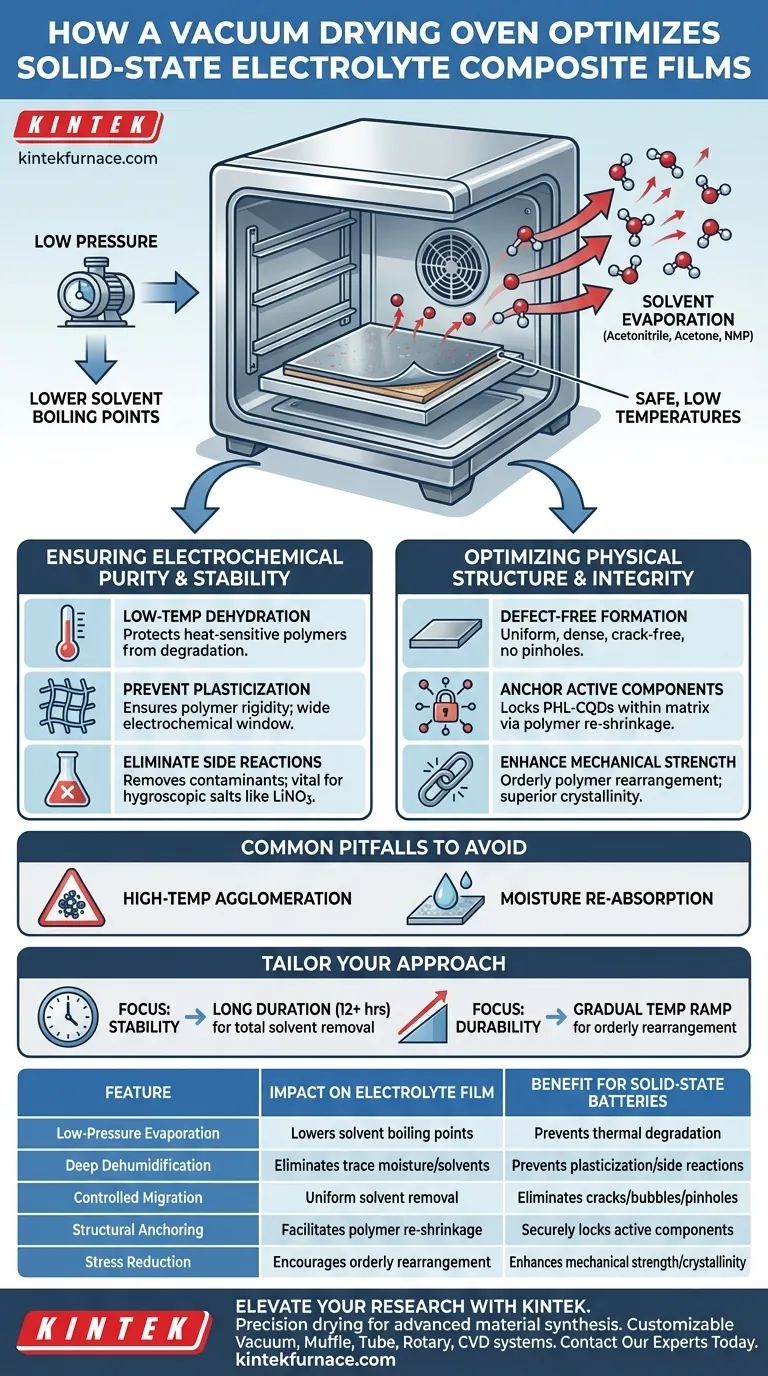
A Vacuum Drying Oven is the critical tool for solidifying composite films by using low pressure to significantly lower solvent boiling points. This facilitates the complete removal of residual organic solvents—such as acetonitrile or acetone—at safe, low temperatures, ensuring the film forms a dense, defect-free structure without thermal damage.
Core Takeaway The vacuum drying process does more than just dry; it actively engineers the film’s microstructure. By enabling low-temperature dehydration, it prevents the formation of voids and cracks while ensuring the chemical purity required to maintain a wide electrochemical window and stable ionic conductivity.
Ensuring Electrochemical Purity and Stability
The Mechanism of Low-Temperature Dehydration
By operating in a vacuum, the oven reduces the ambient pressure, which depresses the boiling point of solvents like water, NMP, and acetonitrile. This allows these solvents to evaporate rapidly at much lower temperatures than would be required under atmospheric conditions. This protects heat-sensitive polymer components from degradation during the drying phase.
Preventing Solvent-Induced Plasticization
Thorough removal of trace solvents is essential to prevent the "plasticization" of the polymer matrix. If solvents remain, they soften the polymer, which can dangerously narrow the electrochemical window. Vacuum drying ensures the polymer remains rigid and chemically stable, guaranteeing reproducible experimental data.
Eliminating Side Reactions
Residual organic solvents are not merely impurities; they are active contaminants that can trigger unwanted side reactions during battery operation. By achieving deep dehumidification and solvent removal, the vacuum oven eliminates these variables. This is particularly vital for films containing hygroscopic salts like Lithium Nitrate (LiNO3), which must be strictly isolated from moisture.
Optimizing Physical Structure and Integrity
Defect-Free Film Formation
Drying at atmospheric pressure often causes solvents to boil violently or evaporate unevenly, leading to surface cracks, bubbles, or pinholes. The vacuum environment promotes a controlled migration of solvents from the film's interior to the surface. This results in a composite film that is uniform, flat, and structurally dense.
Anchoring Active Components
The vacuum drying process drives the re-shrinkage of swollen polymer networks as the solvent exits. This physical contraction plays a functional role: it securely anchors internal components, such as Phloroglucinol-based carbon quantum dots (PHL-CQDs), within the matrix. This "locking" effect prevents active materials from leaching out during the battery's lifecycle.
Enhancing Mechanical Strength
Beyond simple drying, the controlled heat and vacuum environment facilitates the orderly rearrangement of polymer chains. This alignment reduces internal stress within the material. The result is a film with superior crystallinity and mechanical strength, making it more durable under operational stress.
Common Pitfalls to Avoid
Risk of Agglomeration at High Temperatures
While vacuum allows for lower temperatures, applying excessive heat can still damage sensitive components. For films containing metallic nanoparticles, strict temperature control is required to prevent agglomeration or surface oxidation, which would reduce the effective electrochemical active surface area.
Moisture Re-absorption
The benefits of vacuum drying are immediately lost if the sample is exposed to air post-processing. Because solid polymer electrolytes are often hygroscopic, breaking the vacuum without a proper transfer protocol can lead to immediate water absorption. This degrades the film's mechanical integrity and compromises subsequent impedance spectroscopy testing.
Making the Right Choice for Your Goal
To maximize the effectiveness of your vacuum drying process, tailor your approach to your specific performance metrics:
- If your primary focus is Electrochemical Stability: Prioritize long duration drying (e.g., 12+ hours) to ensure the total removal of solvents like acetonitrile, preventing plasticization and side reactions.
- If your primary focus is Structural Durability: Focus on a gradual ramp-up of temperature within the vacuum to promote orderly polymer chain rearrangement and secure anchoring of filler materials.
Ultimately, the vacuum drying oven is not just a drying device, but a structural synthesis tool that defines the density, purity, and longevity of your solid-state electrolyte.
Summary Table:
| Feature | Impact on Electrolyte Film Formation | Benefit for Solid-State Batteries |
|---|---|---|
| Low-Pressure Evaporation | Lowers solvent boiling points (Acetonitrile, NMP) | Prevents thermal degradation of sensitive polymers |
| Deep Dehumidification | Eliminates trace moisture and residual solvents | Prevents plasticization and unwanted side reactions |
| Controlled Migration | Promotes uniform solvent removal from interior to surface | Eliminates cracks, bubbles, and surface pinholes |
| Structural Anchoring | Facilitates polymer network re-shrinkage | Securely locks active components (e.g., PHL-CQDs) |
| Stress Reduction | Encourages orderly rearrangement of polymer chains | Enhances mechanical strength and crystallinity |
Elevate Your Solid-State Battery Research with KINTEK
Precision in the drying stage is the difference between a failing cell and a breakthrough. KINTEK provides high-performance vacuum systems designed specifically for the rigorous demands of advanced material synthesis.
Backed by expert R&D and manufacturing, KINTEK offers Vacuum Drying Ovens, Muffle, Tube, Rotary, and CVD systems, all fully customizable to meet your unique laboratory needs. Whether you are aiming for a wider electrochemical window or superior mechanical durability, our equipment ensures your composite films are dense, pure, and defect-free.
Ready to optimize your electrolyte synthesis? Contact our experts today to find the perfect thermal solution for your lab.
Visual Guide
References
- Jian Ouyang, Zenglin Wang. Tungsten Carbide/Tungsten Oxide Catalysts for Efficient Electrocatalytic Hydrogen Evolution. DOI: 10.3390/molecules30010084
This article is also based on technical information from Kintek Furnace Knowledge Base .
Related Products
- Vacuum Heat Treat Sintering and Brazing Furnace
- Vacuum Heat Treat Sintering Furnace Molybdenum Wire Vacuum Sintering Furnace
- Dental Porcelain Zirconia Sintering Ceramic Vacuum Press Furnace
- Molybdenum Vacuum Heat Treat Furnace
- Vacuum Hot Press Furnace Machine Heated Vacuum Press
People Also Ask
- What are the benefits of using vacuum heat treating furnaces for metal alloys? Achieve Superior Metal Properties and Performance
- What is one of the most important uses of vacuum heat treating furnaces in aerospace? Achieve Superior Strength in Aircraft Alloys
- How does vacuum heat treating affect the grain structure of metal alloys? Achieve Precise Microstructure Control
- What is the temperature of a vacuum furnace brazing? Optimize Your Joint Strength and Cleanliness
- What are the steps involved in a typical vacuum brazing treatment? Master the Process for Strong, Clean Joints












