
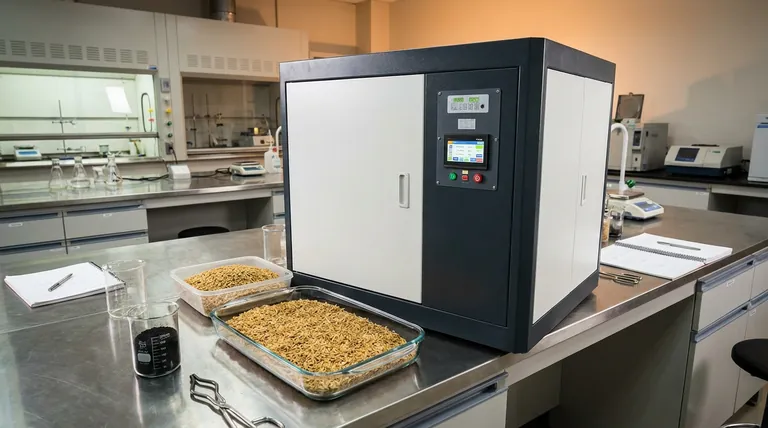
The function of a vacuum drying oven in rice husk carbonization is to ensure chemical stability by removing moisture in an oxygen-deprived environment. Specifically, it subjects the cleaned rice husks to elevated temperatures for extended periods (e.g., 10 hours) to eliminate water content without triggering the oxidative degradation that would occur in a standard atmosphere.
By decoupling heat from oxidation, vacuum drying preserves the fundamental structure of the rice husks. This process guarantees that the starting material remains chemically stable, which is the absolute prerequisite for achieving structural uniformity in the final carbonized product.
Preserving Material Integrity
The primary challenge in preparing biomass like rice husks for carbonization is removing moisture without damaging the organic structure.
Preventing Oxidative Degradation
In a standard oven, heating rice husks to dry them introduces a risk: oxygen in the air reacts with the biomass, potentially causing premature burning or surface oxidation.
A vacuum drying oven mitigates this by evacuating the air chamber. This allows the material to be subjected to high temperatures for long durations—often up to 10 hours—without the presence of oxygen to fuel unwanted chemical reactions.
Ensuring Chemical Stability
The quality of the final carbon product is determined by the quality of the raw material entering the kiln. If the rice husks degrade or oxidize unevenly during the drying phase, the chemical composition changes unpredictably.
Vacuum drying locks in chemical stability prior to activation. It ensures that the only changes occurring to the material are the removal of moisture, rather than the alteration of the carbon structure itself.
Guarantees of Structural Uniformity
Consistency is the ultimate goal of material synthesis. By using a vacuum environment to treat the husks, you ensure that every batch enters the carbonization phase in an identical state.
This preparation step leads to structural uniformity in the resulting carbonized product. It minimizes defects and ensures that the pore structure develops evenly during subsequent high-temperature treatments.
The Vacuum Advantage
While the primary goal is preservation, the mechanism of vacuum drying offers specific physical advantages that standard drying cannot match.
Lowering Vapor Pressure
The vacuum environment significantly lowers the boiling point of water and other volatiles trapped within the husk's matrix.
This allows moisture to evaporate more efficiently, driving water out of the deep pores of the biomass. It ensures a thorough dehydration that surface-level air drying might miss.
Pre-Activation Conditioning
The process effectively "sets the stage" for activation. By removing moisture and preventing oxidation, the oven prepares the husks for extreme thermal processing.
This step ensures that during the actual carbonization, energy is spent on converting the biomass to carbon, rather than wasting energy evaporating residual water or correcting for oxidized defects.
Understanding the Trade-offs
While vacuum drying offers superior quality control, it introduces specific constraints that must be accounted for in your process planning.
Processing Time
This is not a rapid process. The primary methodology requires extended drying durations, often spanning 10 hours or more. This creates a bottleneck compared to rapid-heat air drying methods, reducing overall throughput.
Equipment and Energy Costs
Operating a vacuum pump continuously alongside heating elements consumes significant energy. Furthermore, vacuum drying ovens are more complex and expensive to maintain than standard convection ovens, increasing the capital and operational expenditure of the production line.
Capacity Limitations
Vacuum chambers generally have smaller effective volumes than standard industrial dryers. Scaling this process up for mass production requires careful batch management or investment in larger, industrial-grade vacuum systems.
Making the Right Choice for Your Goal
The decision to use a vacuum drying oven depends on the precision required for your final application.
- If your primary focus is High-Performance Carbon: Use a vacuum drying oven to guarantee the chemical stability and structural uniformity required for advanced applications like filtration or energy storage.
- If your primary focus is Volume and Speed: Evaluate if the slight oxidative degradation from standard air drying is acceptable, as vacuum drying will significantly throttle your production rate.
Ultimately, vacuum drying is the choice for precision; it sacrifices speed to ensure the rice husks remain chemically pure before they ever touch the kiln.
Summary Table:
| Feature | Vacuum Drying Benefit | Impact on Carbonization |
|---|---|---|
| Environment | Oxygen-deprived (evacuated air) | Prevents premature oxidation & burning |
| Moisture Removal | Lowered vapor pressure | Efficient, deep-pore dehydration |
| Material State | Locked chemical stability | Guarantees structural uniformity in final carbon |
| Duration | Extended (up to 10 hours) | Ensures thorough preparation for activation |
| Application | Precision-focused processing | Ideal for high-performance filtration & energy storage |
Optimize Your Carbonization Process with KINTEK
Achieve unmatched material precision and chemical stability in your lab or production line. Backed by expert R&D and world-class manufacturing, KINTEK offers a comprehensive range of Muffle, Tube, Rotary, Vacuum, and CVD systems, all fully customizable to meet your unique high-temperature processing needs. Whether you are developing advanced biomass carbon or high-performance filtration materials, our experts are here to help you select the perfect equipment for your application.
Ready to enhance your lab's efficiency? Contact KINTEK today to discuss your custom furnace solution!
References
- Bakhytzhan Lesbayev, Ayazhan Zhamash. Preparation of Nanoporous Carbon from Rice Husk with Improved Textural Characteristics for Hydrogen Sorption. DOI: 10.3390/jcs8020074
This article is also based on technical information from Kintek Furnace Knowledge Base .
Related Products
- Vacuum Heat Treat Sintering and Brazing Furnace
- Vacuum Heat Treat Sintering Furnace Molybdenum Wire Vacuum Sintering Furnace
- Dental Porcelain Zirconia Sintering Ceramic Vacuum Press Furnace
- Molybdenum Vacuum Heat Treat Furnace
- Vacuum Hot Press Furnace Machine Heated Vacuum Press
People Also Ask
- What are the benefits of using vacuum heat treating furnaces for metal alloys? Achieve Superior Metal Properties and Performance
- How does vacuum heat treating affect the grain structure of metal alloys? Achieve Precise Microstructure Control
- What is one of the most important uses of vacuum heat treating furnaces in aerospace? Achieve Superior Strength in Aircraft Alloys
- What is the temperature of a vacuum furnace brazing? Optimize Your Joint Strength and Cleanliness
- What are the steps involved in a typical vacuum brazing treatment? Master the Process for Strong, Clean Joints












