
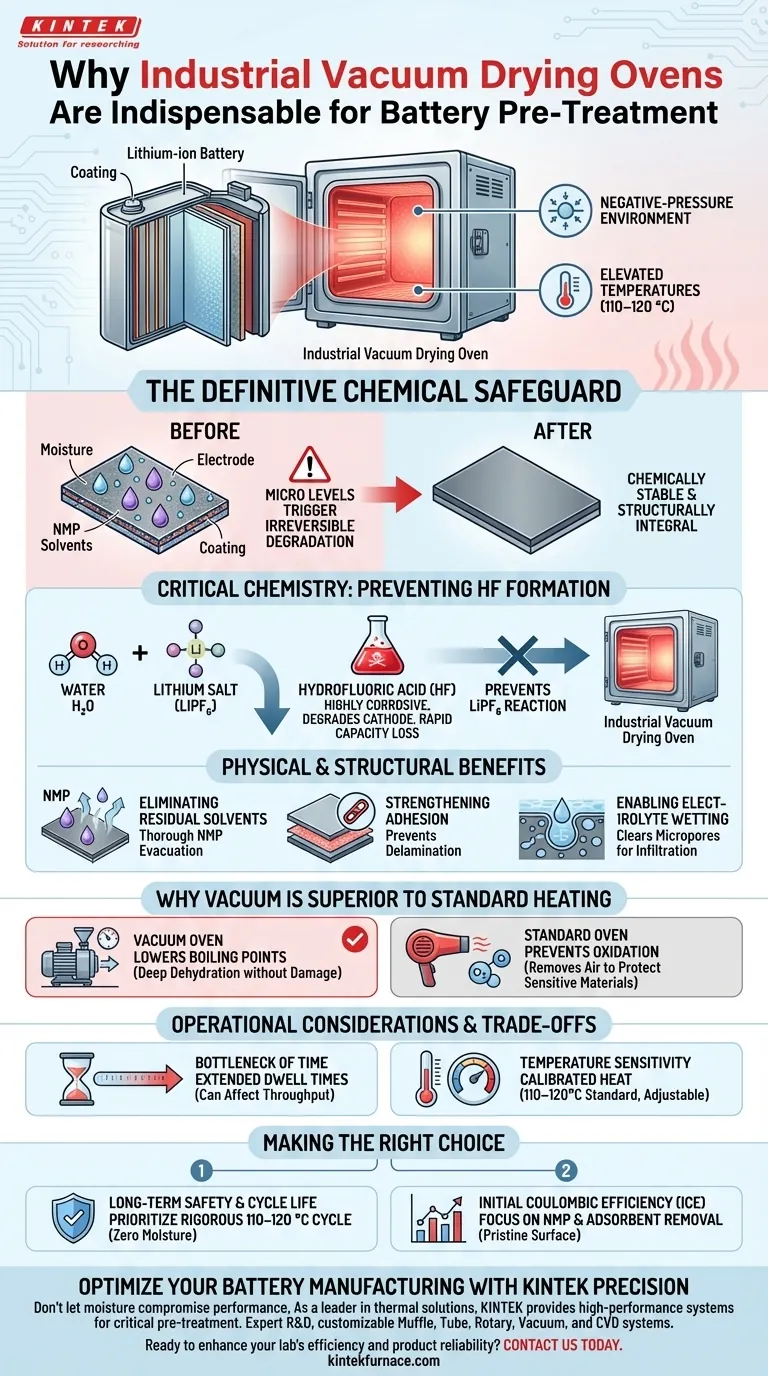
The industrial vacuum drying oven is the definitive safeguard against chemical corruption in battery manufacturing. Its primary function is to utilize a negative-pressure environment at elevated temperatures (typically 110–120 °C) to extract trace moisture and residual solvents like NMP from electrode sheets. This step is indispensable because even microscopic levels of retained water will trigger irreversible chemical degradation once the battery is sealed.
Core Takeaway: The vacuum drying oven is not merely a drying tool; it is a chemical stabilization device. By removing water molecules under vacuum, it prevents moisture from reacting with the electrolyte to produce hydrofluoric acid (HF). This ensures the structural integrity of the electrode and the long-term safety of the battery.
The Critical Chemistry: Preventing HF Formation
The Moisture-Electrolyte Reaction
Moisture is the greatest enemy of lithium-ion battery chemistry. When trace water molecules remain on the electrode, they react with lithium salts in the electrolyte, specifically LiPF6.
The Consequences of Acid Generation
This reaction produces hydrofluoric acid (HF), a highly corrosive byproduct. HF attacks the solid electrolyte interface (SEI) and degrades the cathode materials, leading to rapid capacity loss and potential safety hazards during battery cycling.
Physical and Structural Benefits
Eliminating Residual Solvents
Beyond moisture, the coating process leaves behind solvents such as N-methylpyrrolidone (NMP). The vacuum oven ensures these are thoroughly evacuated.
Strengthening Adhesion
Thorough removal of these volatile components strengthens the physical bond between the active material layer and the current collector. This prevents the electrode material from delaminating during the expansion and contraction cycles of battery use.
Enabling Electrolyte Wetting
Deep drying clears the micropores of the electrode materials. This porosity is essential for allowing the electrolyte to fully infiltrate (wet) the electrode arrays, which significantly reduces interfacial resistance and improves performance.
Why Vacuum is Superior to Standard Heating
Lowering Boiling Points
By operating under negative pressure, the oven lowers the boiling point of water and solvents. This allows for deep dehydration without requiring excessive temperatures that might damage the binder or active materials.
Preventing Oxidation
Standard ovens utilize hot air, which introduces oxygen to the material surface. Vacuum drying removes air from the chamber, preventing the oxidation of sensitive materials (such as fluoride or tin-based precursors) that can occur during conventional heating.
Operational Considerations and Trade-offs
The Bottleneck of Time
Deep dehydration is not instantaneous. To eliminate moisture trapped within the internal structure of the electrode, the process often requires extended dwell times, sometimes lasting overnight. This can create a throughput bottleneck in high-speed manufacturing lines.
Temperature Sensitivity
While 110–120 °C is a common standard, the temperature must be carefully calibrated. Some materials require lower temperatures (e.g., 80 °C) to prevent thermal degradation, while others require higher heat to ensure the purity of the final product.
Making the Right Choice for Your Goal
To maximize the effectiveness of your pre-treatment process, align your oven parameters with your specific performance targets:
- If your primary focus is long-term safety and cycle life: Prioritize a rigorous 110–120 °C cycle to ensure zero moisture remains to trigger HF production and electrolyte decomposition.
- If your primary focus is Initial Coulombic Efficiency (ICE): Focus on the thorough removal of NMP and physical adsorbents to ensure the electrode surface is pristine for optimal solid electrolyte interface (SEI) formation.
The industrial vacuum drying oven effectively transforms a coated electrode from a raw component into a chemically stable system ready for final assembly.
Summary Table:
| Feature | Benefit for Battery Manufacturing |
|---|---|
| Vacuum Environment | Lowers solvent boiling points & prevents oxidation of sensitive materials. |
| Moisture Removal | Prevents LiPF6 reaction and the formation of corrosive hydrofluoric acid (HF). |
| Solvent Evacuation | Thoroughly removes NMP to improve electrode adhesion and conductivity. |
| Enhanced Porosity | Clears micropores for superior electrolyte wetting and lower resistance. |
| Thermal Precision | Calibrated heat (110–120 °C) stabilizes chemicals without damaging binders. |
Optimize Your Battery Manufacturing with KINTEK Precision
Don't let moisture compromise your battery performance and safety. As a leader in laboratory and industrial thermal solutions, KINTEK provides the high-performance vacuum drying systems necessary for critical pre-treatment processes.
Backed by expert R&D and manufacturing, we offer Muffle, Tube, Rotary, Vacuum, and CVD systems, all fully customizable to meet your specific temperature and throughput needs. Whether you are scaling up production or refining R&D, our engineering team ensures your electrodes are chemically stable and ready for assembly.
Ready to enhance your lab's efficiency and product reliability? Contact us today to discuss your custom high-temperature furnace requirements.
Visual Guide
References
- Behnoosh Bornamehr, Volker Presser. High-Performance Lithium-Ion Batteries with High Stability Derived from Titanium-Oxide- and Sulfur-Loaded Carbon Spherogels. DOI: 10.1021/acsami.3c16851
This article is also based on technical information from Kintek Furnace Knowledge Base .
Related Products
- Vacuum Heat Treat Sintering and Brazing Furnace
- Vacuum Heat Treat Sintering Furnace Molybdenum Wire Vacuum Sintering Furnace
- Dental Porcelain Zirconia Sintering Ceramic Vacuum Press Furnace
- Vacuum Hot Press Furnace Machine for Lamination and Heating
People Also Ask
- What is one of the most important uses of vacuum heat treating furnaces in aerospace? Achieve Superior Strength in Aircraft Alloys
- What are the benefits of using vacuum heat treating furnaces for metal alloys? Achieve Superior Metal Properties and Performance
- How does vacuum heat treating affect the grain structure of metal alloys? Achieve Precise Microstructure Control
- What is the temperature of a vacuum furnace brazing? Optimize Your Joint Strength and Cleanliness
- What are the steps involved in a typical vacuum brazing treatment? Master the Process for Strong, Clean Joints



