
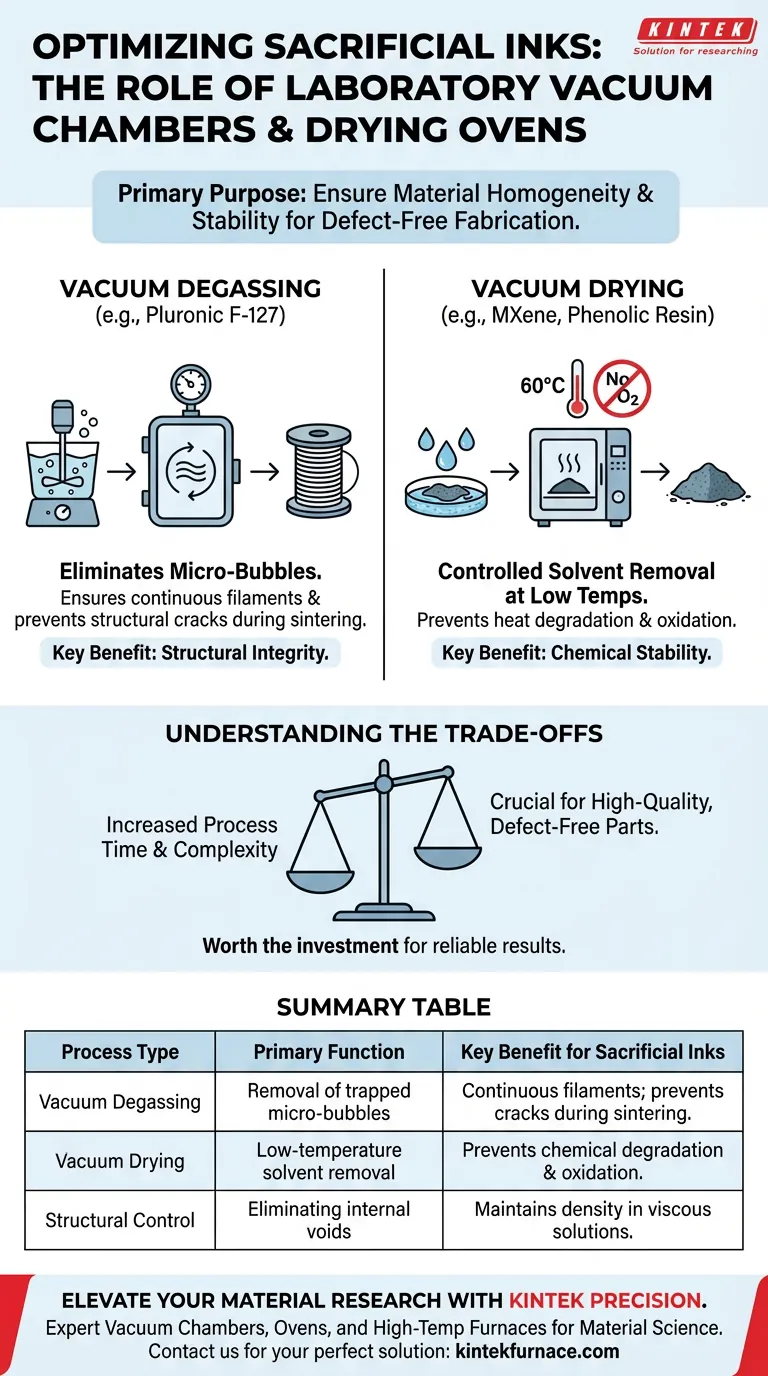
The primary purpose of a laboratory vacuum chamber or vacuum drying oven in this context is ensuring material homogeneity and stability. Specifically, for sacrificial inks like Pluronic F-127, the vacuum chamber is used to degas the solution, removing trapped micro-bubbles introduced during mixing. This ensures the extruded filaments remain continuous and dense, preventing structural failure in the final component.
By creating a void-free and chemically stable material, vacuum processing acts as a critical quality assurance step. It prevents physical defects like cracking during sintering and protects sensitive chemical components from oxidation during drying.
Ensuring Structural Integrity via Degassing
The Problem of Micro-Bubbles
When preparing viscous sacrificial inks, such as those based on Pluronic F-127, the stirring process inevitably traps air within the mixture.
If left untreated, these micro-bubbles compromise the density of the concentrated polymer solution.
Enhancing Filament Continuity
A vacuum chamber removes these trapped gases before the material is loaded into a 3D printer.
This degassing step is vital to ensure that the extruded filaments are continuous.
Without this process, air pockets would cause interruptions in the material flow, resulting in gaps within the printed structure.
Preventing Post-Processing Defects
The benefits of vacuum degassing extend beyond the printing phase into post-processing.
By ensuring a dense, bubble-free ink, you prevent the formation of defects in functional channels.
Furthermore, eliminating these voids is crucial for avoiding structural cracking that can occur during the high-stress sintering process.
Preserving Chemical Stability via Vacuum Drying
Controlled Solvent Removal
In the preparation of complex precursors, such as N-TiO2@NC, a vacuum drying oven is utilized to remove residual solvents.
This allows for effective drying at significantly lower temperatures, such as 60 degrees Celsius.
Lowering the thermal requirement protects the material from heat-induced degradation before it is ready for final processing.
Prevention of Oxidation
Operating in a vacuum environment excludes oxygen and moisture from the drying process.
This is essential for protecting reactive components, such as MXene nanosheets, from oxidation.
It also helps maintain the structural integrity of coatings, such as phenolic resin, ensuring the material is chemically prepared for subsequent high-temperature thermal treatments.
Understanding the Trade-offs
Process Time vs. Material Quality
Utilizing vacuum chambers adds a distinct step to the workflow, increasing the total preparation time for the ink.
However, skipping this step creates a high risk of part rejection due to internal voids that are often invisible until the sintering phase.
Equipment Complexity
Vacuum drying requires precise control over pressure and temperature to prevent rapid boiling of solvents, which could damage the material structure.
While this requires specialized equipment and monitoring, it is the only reliable method to dry oxidation-prone materials without altering their chemical composition.
Making the Right Choice for Your Goal
To apply this to your specific project, determine whether your primary challenge is physical consistency or chemical preservation.
- If your primary focus is printability and physical structure: Prioritize using a vacuum chamber for degassing to remove micro-bubbles and ensure continuous, crack-free filaments.
- If your primary focus is preventing oxidation in sensitive precursors: Prioritize using a vacuum drying oven to remove solvents at low temperatures while excluding oxygen.
Mastering the vacuum environment is the difference between a theoretical ink formulation and a functional, defect-free application.
Summary Table:
| Process Type | Primary Function | Key Benefit for Sacrificial Inks |
|---|---|---|
| Vacuum Degassing | Removal of trapped micro-bubbles | Ensures continuous filaments and prevents cracks during sintering. |
| Vacuum Drying | Low-temperature solvent removal | Prevents chemical degradation and oxidation of sensitive components (e.g., MXenes). |
| Structural Control | Eliminating internal voids | Maintains density in viscous solutions like Pluronic F-127. |
Elevate Your Material Research with KINTEK Precision
Don't let micro-bubbles or oxidation compromise your breakthrough. Backed by expert R&D and manufacturing, KINTEK offers high-performance Vacuum Chambers, Vacuum Drying Ovens, and customizable lab high-temp furnaces designed to meet the rigorous demands of material science.
Whether you are preparing Pluronic F-127 inks or sensitive MXene nanosheets, our systems provide the precise control needed for defect-free results. Contact us today to find the perfect solution for your lab and see how our customizable equipment can optimize your workflow.
Visual Guide
References
- Highly Stable Low‐Temperature Phosphate Glass as a Platform for Multimaterial 3D Printing of Integrated Functional Microfluidic Devices. DOI: 10.1002/adem.202501603
This article is also based on technical information from Kintek Furnace Knowledge Base .
Related Products
- Vacuum Heat Treat Sintering and Brazing Furnace
- Vacuum Heat Treat Sintering Furnace Molybdenum Wire Vacuum Sintering Furnace
- Dental Porcelain Zirconia Sintering Ceramic Vacuum Press Furnace
- Molybdenum Vacuum Heat Treat Furnace
- Vacuum Hot Press Furnace Machine Heated Vacuum Press
People Also Ask
- What are the benefits of using vacuum heat treating furnaces for metal alloys? Achieve Superior Metal Properties and Performance
- How does vacuum heat treating affect the grain structure of metal alloys? Achieve Precise Microstructure Control
- What is one of the most important uses of vacuum heat treating furnaces in aerospace? Achieve Superior Strength in Aircraft Alloys
- What is the temperature of a vacuum furnace brazing? Optimize Your Joint Strength and Cleanliness
- What are the steps involved in a typical vacuum brazing treatment? Master the Process for Strong, Clean Joints












