
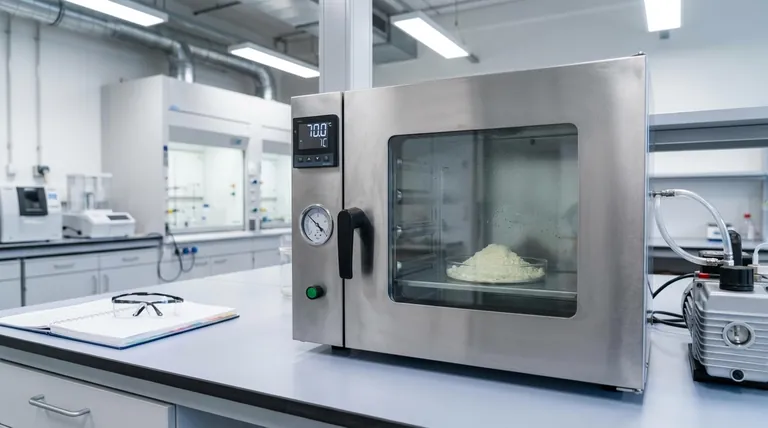
The use of a vacuum drying oven is essential to lower the boiling point of residual solvents trapped within the material. By reducing the ambient pressure, you force solvents like tetrahydrofuran and methanol to volatilize rapidly at just 70 °C, ensuring they are removed from the TF-COF nanopores without requiring destructive high temperatures.
The vacuum environment acts as a critical process enabler, allowing for deep solvent removal at mild thermal conditions. Without this pressure reduction, you face a binary choice between incomplete drying or thermal degradation of your polymer framework.
Preserving Structural Integrity
Overcoming the Nanopore Trap
Synthesized TF-COF contains complex nanopores that trap solvents. At standard atmospheric pressure, solvents like tetrahydrofuran and methanol cling stubbornly to these internal structures.
Simple heat at 70 °C is often insufficient to overcome the capillary forces holding these solvents inside the pores.
The Physics of Pressure Reduction
A vacuum drying oven drastically reduces the ambient pressure surrounding the material.
This physical change lowers the boiling point of the trapped liquids. It allows them to transition into a gas and escape the pores efficiently, even at a relatively cool 70 °C.
Avoiding Thermal Collapse
If you attempted to remove these solvents at atmospheric pressure, you would likely need to raise the temperature significantly.
High temperatures pose a severe risk to the TF-COF, potentially causing structural collapse of the polymer. The vacuum allows you to bypass this risk entirely by substituting pressure for heat.
Ensuring Downstream Success
Protecting the Carbonization Process
Removing solvent residues is not just about drying; it is about chemical purity for the next step.
Any residual organic solvents left in the pores will interfere with the subsequent carbonization process. The vacuum ensures a clean baseline for this critical reaction.
Preventing Oxidation
Standard drying ovens expose materials to heated air, which contains oxygen.
The vacuum environment removes oxygen from the chamber. This prevents unnecessary oxidation or deterioration of the organic-inorganic hybrid structure during the drying phase.
Maintaining Powder Quality
Drying under vacuum helps maintain the physical morphology of the material.
It ensures the result is a loose powder structure rather than a clumped aggregate. This physical state significantly facilitates loading and handling during subsequent pyrolysis steps.
Understanding the Risks of Alternatives
The Danger of Atmospheric Drying
It is a common mistake to assume a standard convection oven at 70 °C yields the same result. It does not.
Without the vacuum, the solvent remains trapped deep within the pores. This leads to "wet" chemistry in later steps, unpredictable carbonization results, and poor material performance.
The Temperature Trap
Attempting to compensate for the lack of vacuum by increasing the temperature is equally dangerous.
While higher heat might drive out the solvent, it frequently degrades the delicate polymer framework before the drying is complete.
Making the Right Choice for Your Goal
To ensure the highest quality synthesis of TF-COF, align your drying protocol with your specific objectives:
- If your primary focus is Structural Stability: Prioritize vacuum drying to keep temperatures low (70 °C) and prevent the polymer framework from collapsing.
- If your primary focus is Carbonization Purity: Rely on the vacuum to extract deep-seated solvents (THF/methanol) that would otherwise contaminate the carbonization reaction.
Vacuum drying is not merely a method of speeding up evaporation; it is the only way to protect the integrity of your TF-COF while ensuring complete solvent removal.
Summary Table:
| Feature | Vacuum Drying (70 °C) | Atmospheric Drying (70 °C) |
|---|---|---|
| Boiling Point | Reduced; rapid solvent escape | Normal; solvents remain trapped |
| Structural Integrity | Preserved; low thermal stress | Risk of thermal degradation if heat is increased |
| Solvent Removal | Deep extraction from nanopores | Incomplete; residual THF/Methanol |
| Oxidation Risk | Minimal (Oxygen-free environment) | Higher (Exposure to heated air) |
| Final Morphology | Loose, high-quality powder | Clumped aggregates |
Elevate Your TF-COF Synthesis with KINTEK Precision
Don't compromise your delicate polymer frameworks with inadequate drying methods. KINTEK provides industry-leading Vacuum, CVD, and high-temperature furnace systems engineered to deliver the precise pressure and temperature control your research demands. Backed by expert R&D and manufacturing, our customizable lab solutions ensure complete solvent removal while protecting the structural integrity of your materials.
Ready to achieve superior carbonization results and structural stability?
Contact KINTEK Today for a Custom Solution
Visual Guide

References
- Linqiang Li, Liwei Mi. Rational design of nitrogen and fluorine co-doped metal-free porous carbons electrocatalysts for highly efficient oxygen reduction and zinc-air batteries. DOI: 10.1007/s43979-024-00117-4
This article is also based on technical information from Kintek Furnace Knowledge Base .
Related Products
- Vacuum Heat Treat Sintering and Brazing Furnace
- Vacuum Heat Treat Sintering Furnace Molybdenum Wire Vacuum Sintering Furnace
- Dental Porcelain Zirconia Sintering Ceramic Vacuum Press Furnace
- Molybdenum Vacuum Heat Treat Furnace
- Vacuum Hot Press Furnace Machine Heated Vacuum Press
People Also Ask
- What are the benefits of using vacuum heat treating furnaces for metal alloys? Achieve Superior Metal Properties and Performance
- How does vacuum heat treating affect the grain structure of metal alloys? Achieve Precise Microstructure Control
- What is one of the most important uses of vacuum heat treating furnaces in aerospace? Achieve Superior Strength in Aircraft Alloys
- What is the temperature of a vacuum furnace brazing? Optimize Your Joint Strength and Cleanliness
- What are the steps involved in a typical vacuum brazing treatment? Master the Process for Strong, Clean Joints












