
At their core, vacuum furnaces are defined by three primary capabilities. These are the ability to create a controlled, oxygen-free environment through a deep vacuum; the power to achieve extremely high and uniform temperatures with precision; and the capacity for fully automated, computer-controlled processes that ensure perfect repeatability.
The defining feature of a vacuum furnace is not simply heat, but absolute control. By removing the atmosphere, you gain unprecedented control over a material's chemistry, structure, and final properties, enabling outcomes that are impossible in any other type of furnace.
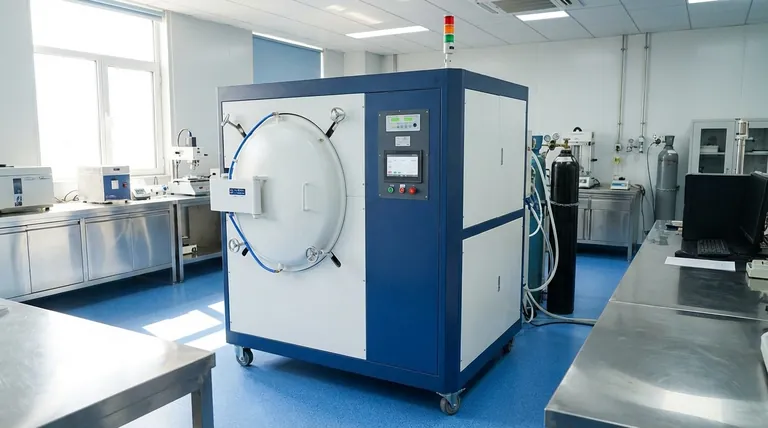
The Core Principle: An Oxygen-Free Environment
The vacuum is the most fundamental feature. By removing air and other gases, the furnace creates an inert environment that prevents unwanted chemical reactions at high temperatures.
Preventing Oxidation and Contamination
At elevated temperatures, most high-performance metals will react with oxygen. This leads to oxidation (rusting), scaling, and decarburization, all of which degrade the material's surface and structural integrity.
A vacuum environment eliminates this risk entirely. This is essential for processing reactive materials like titanium, superalloys, and advanced ceramics, ensuring a clean, bright, and uncompromised surface finish.
Removing By-products for Higher Purity
The vacuum actively pulls contaminants and trapped gases out of the material being processed, a phenomenon known as outgassing.
This process purifies the material by removing unwanted by-products during the heating cycle. The result is a final product with higher density, superior purity, and enhanced mechanical properties.
Unmatched Control Over the Thermal Process
Beyond the vacuum itself, these furnaces provide a level of thermal control that is second to none. This precision allows engineers to dictate the final microstructure of a material.
High and Uniform Temperatures
Vacuum furnaces can operate at extreme temperatures, often ranging from 800°C to over 3,000°C (1,500–5,400°F).
More importantly, they create highly uniform heated zones. This ensures that an entire component, regardless of its geometry, experiences the exact same thermal conditions, leading to consistent and predictable material properties throughout.
Precision Temperature Management
Modern systems offer incredibly precise temperature control, often within a few degrees of the setpoint.
This is managed through sophisticated sensors and computer algorithms, allowing for complex, multi-stage heating cycles to be programmed and executed perfectly every time.
Rapid Cooling (Quenching) Capabilities
Many vacuum furnaces incorporate rapid cooling or quenching systems. After the heating cycle, a high-pressure inert gas can be introduced to cool the part down quickly.
This rapid cooling "locks in" a desired metallurgical structure, which is a critical step for hardening steel or controlling the grain structure in superalloys.
Ensuring Process Integrity and Repeatability
The final set of key features revolves around making the complex process of vacuum heat treatment reliable, safe, and repeatable, especially in industrial settings.
Advanced Automation and Computer Control
Nearly all modern vacuum furnaces are fully automated. Processes are managed by a Programmable Logic Controller (PLC) and computer system.
This electromechanical integration removes human error, guarantees that every part undergoes the exact same treatment cycle, and provides detailed data logging for quality control and certification.
Robust Mechanical Design
These furnaces are built for industrial environments. Key design features include resistance to vibration, excellent corrosion resistance, and materials with high tensile strength. This ensures a long service life and reliable operation.
Integrated Safety Systems
Operating at high temperatures and deep vacuums requires robust safety protocols. Features like over-temperature alarms, water flow sensors for the cooling system, leakage protection, and overvoltage protection are standard. These systems ensure the safety of the operator and the integrity of the equipment.
Understanding the Trade-offs
While powerful, vacuum furnaces are not the solution for every heating application. Understanding their context is key to appreciating their value.
Complexity and Cost
The systems required to create and maintain a high vacuum—including pumps, seals, and chamber construction—make these furnaces significantly more complex and expensive than their atmospheric counterparts, such as a simple box furnace.
Maintenance Requirements
The high-performance components, particularly vacuum pumps and seals, require a rigorous and specialized maintenance schedule to ensure they operate at peak efficiency and prevent costly downtime.
Not Always the Right Tool
For simple heat treatments of non-reactive materials where a bit of surface oxidation is acceptable or can be cleaned off later, a standard atmospheric furnace is often a more practical and cost-effective choice.
Making the Right Choice for Your Application
Selecting the correct furnace type depends entirely on your material and your desired outcome.
- If your primary focus is processing high-performance reactive materials (like superalloys or titanium): The oxygen-free vacuum environment is non-negotiable to prevent catastrophic degradation.
- If your primary focus is achieving maximum material purity and strength: The combination of vacuum outgassing and precise thermal control is your key advantage for creating superior components.
- If your primary focus is industrial-scale, repeatable production: The automation, PLC control, and integrated safety systems are essential for quality assurance and efficient operation.
- If your primary focus is basic heat treatment on non-reactive metals: A simpler and more cost-effective atmospheric box furnace is likely the more appropriate tool.
Ultimately, choosing a vacuum furnace is a decision to invest in absolute control over your material's final form and function.
Summary Table:
| Key Feature | Description |
|---|---|
| Oxygen-Free Environment | Prevents oxidation and contamination for reactive materials like titanium and superalloys. |
| High and Uniform Temperatures | Operates from 800°C to over 3,000°C with even heating for consistent results. |
| Precision Temperature Control | Manages temperatures within a few degrees using sensors and computer algorithms. |
| Rapid Cooling (Quenching) | Uses inert gas to quickly cool materials, locking in desired metallurgical structures. |
| Advanced Automation | PLC and computer systems ensure repeatable processes and detailed data logging. |
| Robust Safety Systems | Includes alarms, sensors, and protection mechanisms for operator and equipment safety. |
Unlock the full potential of your materials with KINTEK's advanced vacuum furnace solutions. Leveraging exceptional R&D and in-house manufacturing, we offer Muffle, Tube, Rotary, Vacuum & Atmosphere Furnaces, and CVD/PECVD Systems tailored to your unique needs. Our deep customization capabilities ensure precise performance for industries handling reactive metals, ceramics, and high-purity applications. Contact us today to discuss how we can enhance your lab's efficiency and outcomes!
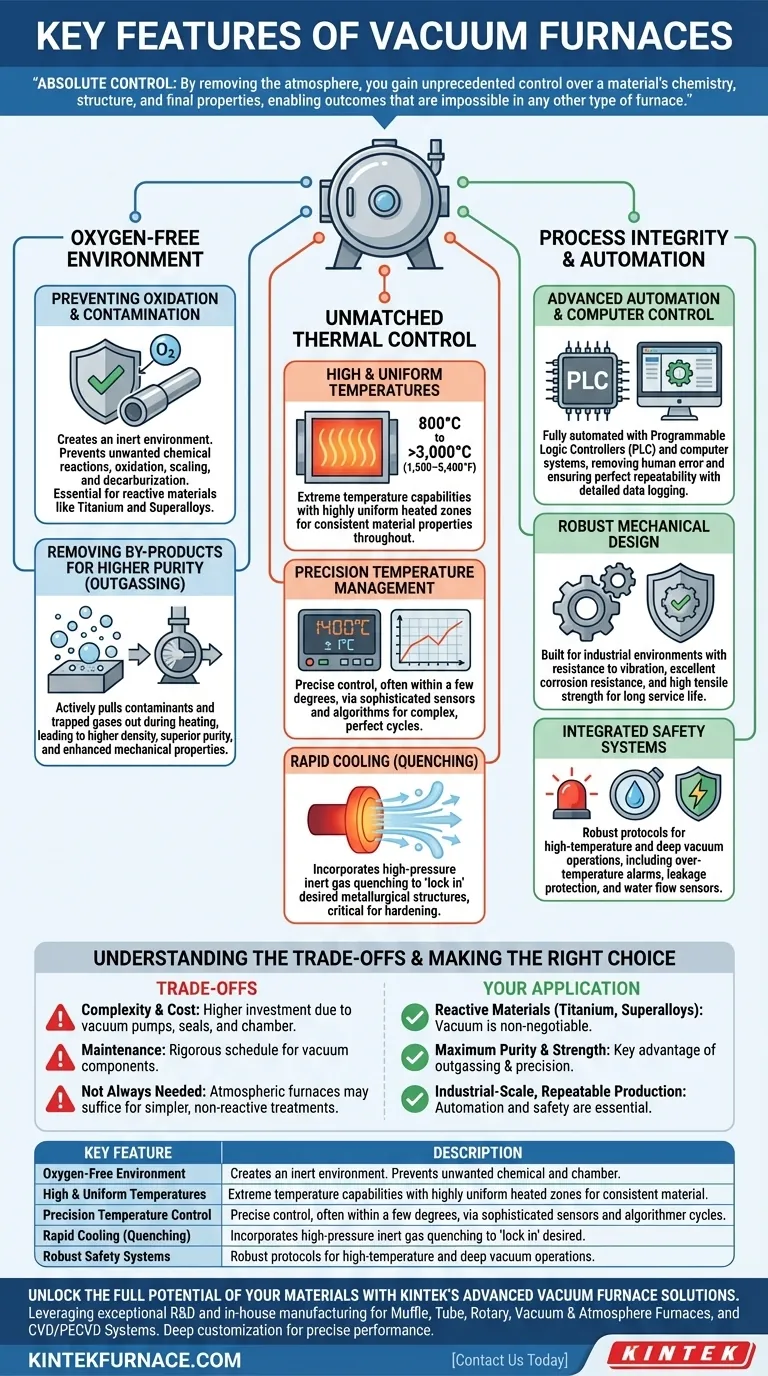
Visual Guide
Related Products
- 600T Vacuum Induction Hot Press Vacuum Heat Treat and Sintering Furnace
- Vacuum Hot Press Furnace Machine Heated Vacuum Press
- 2200 ℃ Tungsten Vacuum Heat Treat and Sintering Furnace
- Vacuum Hot Press Furnace Machine Heated Vacuum Press Tube Furnace
- Vacuum Heat Treat Furnace with Ceramic Fiber Liner
People Also Ask
- Why use Vacuum Hot Press (VHP) for ZnS Ceramics? Achieve Superior IR Transparency and Mechanical Strength
- How does a vacuum hot press sintering furnace mitigate copper sintering swelling? Solve Fe-Cu Expansion Issues
- What are the benefits of using a vacuum hot press sintering furnace for the preparation of SiCw/2024 aluminum matrix composites? Achieve High-Performance Aerospace Materials
- What are the key advantages of vacuum hot press sintering furnaces? Achieve Superior Density and Purity in Materials
- How does the vacuum environment in a vacuum hot press sintering furnace protect chromium-containing ceramics? Find out.



















