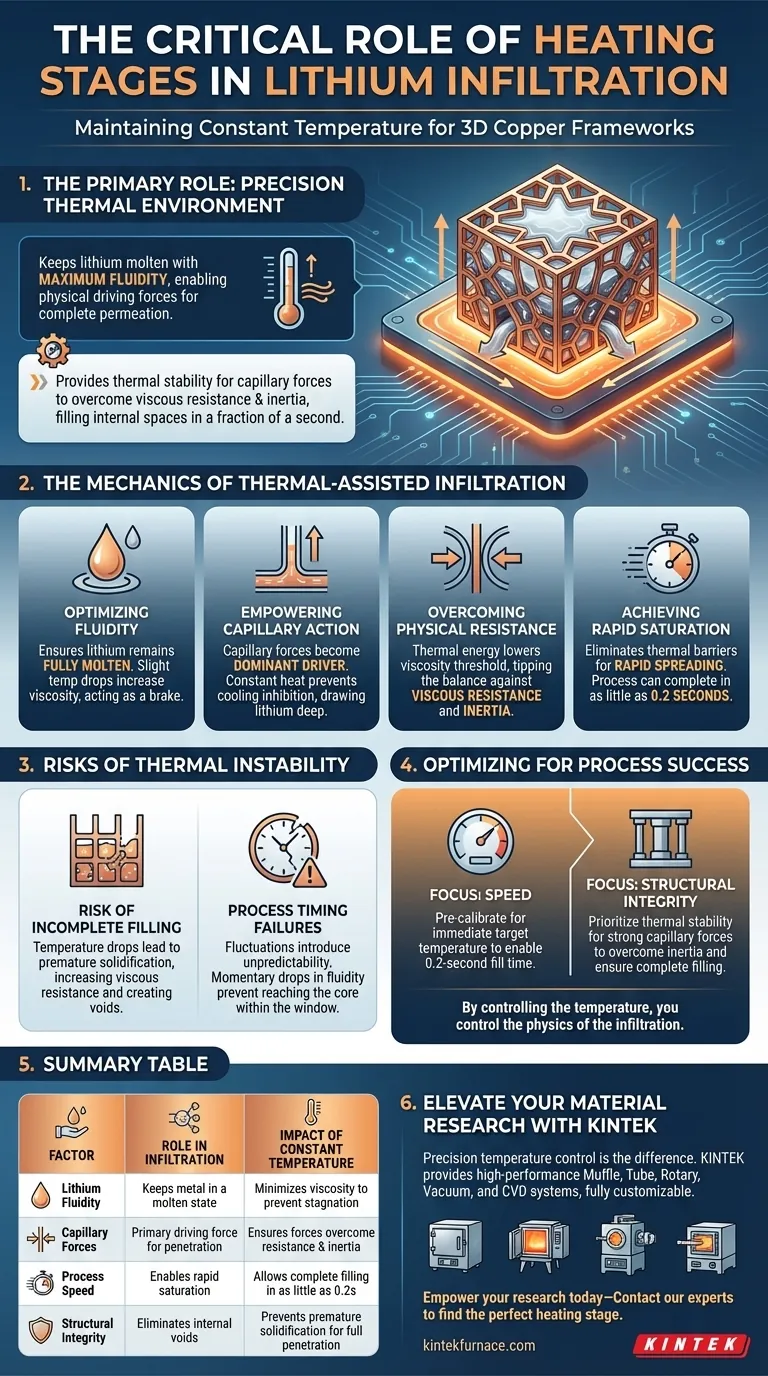
The primary role of the heating stage is to maintain a precise, stable thermal environment that keeps lithium in a molten state with maximum fluidity. This constant temperature is the enabling factor that allows physical driving forces to function correctly, ensuring the lithium permeates the complex geometry of the 3D copper framework without premature solidification.
The heating stage provides the thermal stability necessary for capillary forces to overcome viscous resistance and inertia. This allows molten lithium to completely fill the internal spaces of the framework in a fraction of a second.
The Mechanics of Thermal-Assisted Infiltration
To understand why the heating stage is non-negotiable, one must look at the physical forces at play during the infiltration process. It is a battle between driving forces and resisting forces.
Optimizing Fluidity
The immediate function of the heating stage is to ensure the lithium remains fully molten.
If the temperature drops even slightly below the optimal range, the lithium's viscosity increases. High viscosity acts as a brake on the process, making the metal sluggish and difficult to move through small pores.
Empowering Capillary Action
Under constant temperature conditions, capillary forces become the dominant driver of the process.
These forces naturally pull the liquid into the narrow channels of the copper framework. The heating stage ensures these forces are not inhibited by cooling, allowing them to draw the lithium deep into the structure.
Overcoming Physical Resistance
The infiltration process faces two main opponents: viscous resistance and inertia.
Viscous resistance tries to stop the flow of the liquid, while inertia resists the initial movement. The thermal energy provided by the heating stage lowers the viscosity threshold, tipping the balance in favor of the capillary forces so they can overpower these resistances.
Achieving Rapid Saturation
When the temperature is held constant, the speed of infiltration is drastic.
The primary reference notes that the process can be completed in as little as 0.2 seconds. This rapid spreading is only possible because the constant heat eliminates thermal barriers that would otherwise slow down the flow.
Risks of Thermal Instability
While the heating stage enables the process, understanding the consequences of thermal variation highlights its critical importance.
The Risk of Incomplete Filling
If the heating stage fails to provide a constant temperature, the lithium may cool upon contact with the copper.
This increases viscous resistance immediately. If this resistance exceeds the capillary force, the lithium will stop moving, resulting in a partially filled framework with voids that compromise the final material's performance.
Process Timing Failures
The infiltration window is extremely short.
Any fluctuation in temperature introduces unpredictability into the flow rate. In a process measured in tenths of a second, even a momentary drop in fluidity can prevent the lithium from reaching the core of the framework before the process window closes.
optimizing for Process Success
To ensure a successful lithium infiltration, you must view the heating stage not just as a heater, but as a viscosity control system.
If your primary focus is Speed: Ensure the heating stage is pre-calibrated to maintain the target temperature immediately, enabling the 0.2-second fill time.
If your primary focus is Structural Integrity: Prioritize thermal stability to guarantee that capillary forces remain strong enough to overcome inertia and completely fill all internal spaces.
By controlling the temperature, you control the physics of the infiltration.
Summary Table:
| Factor | Role in Infiltration | Impact of Constant Temperature |
|---|---|---|
| Lithium Fluidity | Keeps metal in a molten state | Minimizes viscosity to prevent flow stagnation |
| Capillary Forces | Primary driving force for penetration | Ensures forces overcome resistance and inertia |
| Process Speed | Enables rapid saturation | Allows complete filling in as little as 0.2 seconds |
| Structural Integrity | Eliminates internal voids | Prevents premature solidification for full penetration |
Elevate Your Material Research with KINTEK
Precision temperature control is the difference between a successful 0.2-second infiltration and a failed experiment. At KINTEK, we understand that your breakthroughs depend on thermal stability. Backed by expert R&D and world-class manufacturing, we provide high-performance Muffle, Tube, Rotary, Vacuum, and CVD systems, all fully customizable to meet your unique laboratory requirements.
Whether you are developing next-generation battery frameworks or advanced alloys, our heating solutions offer the reliability you need to master fluid dynamics and material saturation. Empower your research today—Contact our experts at KINTEK to find the perfect heating stage for your application.
Visual Guide
References
- Inyeong Yang, Sanha Kim. Ultrathin 3D Cu/Li Composite with Enhanced Li Utilization for High Energy Density Li‐Metal Battery Anodes. DOI: 10.1002/smll.202501629
This article is also based on technical information from Kintek Furnace Knowledge Base .
Related Products
- Multi Heating Zones CVD Tube Furnace Machine for Chemical Vapor Deposition Equipment
- Split Multi Heating Zone Rotary Tube Furnace Rotating Tube Furnace
- Molybdenum Disilicide MoSi2 Thermal Heating Elements for Electric Furnace
- Silicon Carbide SiC Thermal Heating Elements for Electric Furnace
- 2200 ℃ Graphite Vacuum Heat Treat Furnace
People Also Ask
- What is the function of a multi-zone tube furnace in CVD synthesis? Master 2D In2Se3 Nanosheet Precision
- Why are multi zone tube furnaces particularly useful for nanomaterial research? Unlock Precise Thermal Control for Advanced Synthesis
- What environmental protection applications utilize multi zone tube furnaces? Unlock Precision in Waste Treatment and Green Tech
- What temperature-related capabilities make multi zone tube furnaces valuable for research? Unlock Precision Thermal Control
- What role do multi zone tube furnaces play in new energy research? Unlock Precise Thermal Control for Innovation