
A high-performance vacuum pumping system is indispensable for ensuring the structural and chemical integrity of industrial alloys during processing. Its immediate function is to generate a low-pressure environment that prevents oxidation and actively removes contaminants, which is the only way to guarantee the material performs as intended after exposure to extreme heat.
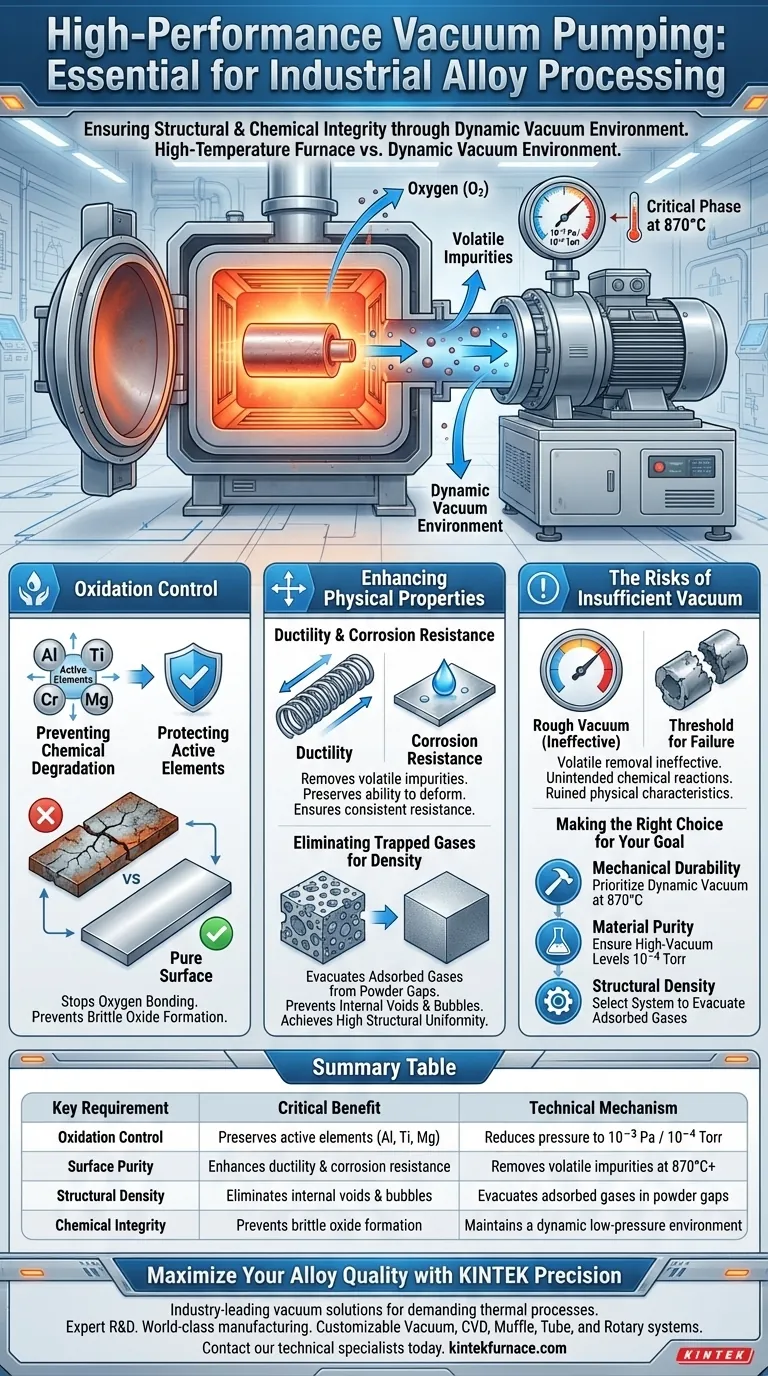
The core function of these systems is to establish a "dynamic vacuum environment." This actively strips away residual oxygen and volatile impurities from the alloy's surface, particularly during critical thermal phases around 870°C. Without this intervention, essential mechanical properties like ductility and corrosion resistance are inevitably compromised.
The Critical Role of Oxidation Control
Preventing Chemical Degradation
The primary threat to alloy integrity during melting and heat treatment is oxygen. When alloys are heated, they become highly reactive.
A high-performance vacuum system reduces the internal pressure to extremely low levels (often between 10^-3 Pa and 10^-4 Torr). This is necessary to stop oxygen from bonding with the metal.
Protecting Active Elements
Many advanced alloys contain "active" elements such as aluminum, titanium, chromium, or magnesium. These elements have a high affinity for oxygen.
Without a vacuum, these components will rapidly oxidize or "burn" at high temperatures. The pumping system ensures these elements remain part of the alloy matrix rather than turning into brittle oxides.
Enhancing Physical Properties
Ensuring Ductility and Corrosion Resistance
The primary reference highlights that the removal of impurities is directly linked to the final performance of the alloy.
By removing volatile impurities from the surface, the vacuum process preserves the alloy's ductility (its ability to deform without breaking). Furthermore, a pure surface is essential for establishing consistent corrosion resistance in the finished part.
Eliminating Trapped Gases for Density
Beyond surface chemistry, vacuum systems address internal structural issues. In processes like powder sintering or hot isostatic pressing, gases can get trapped in the gaps between particles.
The vacuum system evacuates these adsorbed gases and residual air. This prevents the formation of internal bubbles or voids, ensuring the final product achieves high density and structural uniformity.
Understanding the Risks of Insufficient Vacuum
The Threshold for Failure
The requirement for a "high-performance" system is not arbitrary; it is a strict technical threshold. Achieving a rough vacuum is often insufficient for advanced alloys.
If the system fails to reach specific high-vacuum levels (e.g., 10^-4 Torr or better), volatile removal becomes ineffective. This results in unintended chemical reactions, such as the oxidation of sulfur or selenium in semiconductor materials, which ruins the physical characteristics of the product.
Making the Right Choice for Your Goal
The specific requirements of your vacuum system should be dictated by the material properties you value most.
- If your primary focus is Mechanical Durability: Prioritize a system capable of sustaining a dynamic vacuum at 870°C to ensure ductility and corrosion resistance.
- If your primary focus is Material Purity: Ensure the system can reach high-vacuum levels (10^-4 Torr range) to prevent the oxidation of active elements like magnesium or titanium.
- If your primary focus is Structural Density: Select a system designed to evacuate adsorbed gases from powder gaps to prevent internal voids and bubbles.
Reliable alloy performance is impossible without the precise environmental control provided by high-performance vacuum pumping.
Summary Table:
| Key Requirement | Critical Benefit | Technical Mechanism |
|---|---|---|
| Oxidation Control | Preserves active elements (Al, Ti, Mg) | Reduces pressure to 10^-3 Pa / 10^-4 Torr |
| Surface Purity | Enhances ductility & corrosion resistance | Removes volatile impurities at 870°C+ |
| Structural Density | Eliminates internal voids & bubbles | Evacuates adsorbed gases in powder gaps |
| Chemical Integrity | Prevents brittle oxide formation | Maintains a dynamic low-pressure environment |
Maximize Your Alloy Quality with KINTEK Precision
Don't let oxidation or internal voids compromise your critical components. KINTEK provides industry-leading vacuum solutions tailored for the most demanding thermal processes. Backed by expert R&D and world-class manufacturing, we offer a comprehensive range of lab high-temperature furnaces—including Vacuum, CVD, Muffle, Tube, and Rotary systems—all of which are fully customizable to meet your specific pressure and temperature thresholds.
Ensure your materials achieve the structural uniformity and chemical purity they require. Contact our technical specialists today to find the perfect high-performance system for your lab or production line.
Visual Guide
References
- Yu. H. Kvasnytska, K. H. Kvasnytska. Influence of Refractory Elements on Phase–Structural Stability of Heat-Resistant Corrosion-Resistant Alloys for Gas Turbine Blades. DOI: 10.15407/mfint.45.08.0975
This article is also based on technical information from Kintek Furnace Knowledge Base .
Related Products
- Vacuum Induction Melting Furnace
- Vacuum Heat Treat Sintering and Brazing Furnace
- Vacuum Hot Press Furnace Machine for Lamination and Heating
- Vacuum Heat Treat Furnace with Ceramic Fiber Liner
- 2200 ℃ Graphite Vacuum Heat Treat Furnace
People Also Ask
- What are the core functions of the High Vacuum Induction Melting (VIM) furnace? Optimize DD5 Superalloy Purification
- What role does a Vacuum Induction Melting furnace play in the production of high-aluminum nickel-based superalloys?
- Why is a Vacuum Induction Melting furnace (VIM) used for Cu-Zn-Al-Sn alloys? Achieve Precision Composition Control
- What is the role of VIM and directional solidification in aero-engine blade substrates? Engineering Extreme Durability
- What are the technical advantages of using a Vacuum Induction Melting furnace in the development of advanced packaging steel?













