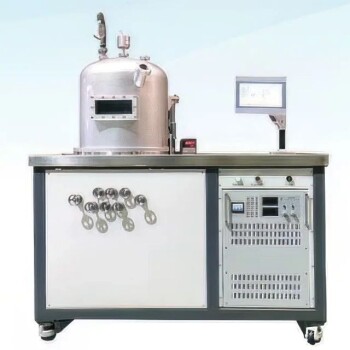
The primary function of a Low-Pressure Chemical Vapor Deposition (LPCVD) system is to act as a high-precision reactor that facilitates the thermal decomposition of chemical precursors into hexagonal boron nitride (hBN) thin films. By maintaining a specific low-pressure and high-temperature environment, the system drives the chemical reaction required to grow uniform layers on a substrate.
Core Takeaway While atmospheric systems can synthesize materials, an LPCVD system provides the critical control over pressure and gas velocity needed for superior film quality and uniform thickness. It is the preferred tool when the goal is producing high-grade, large-area hBN films through precise thermal decomposition.
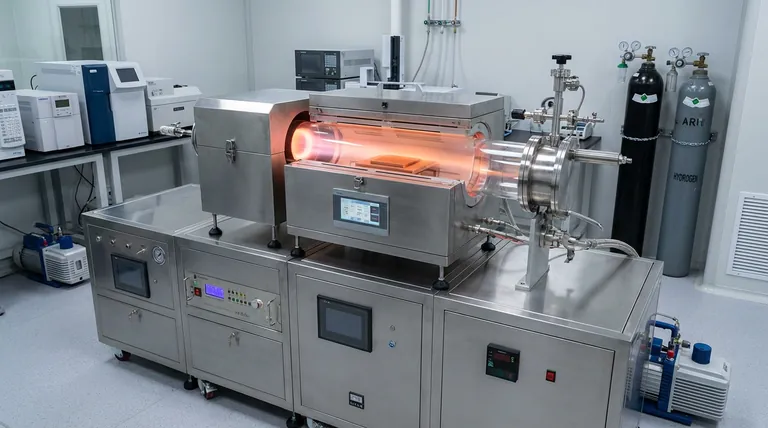
Creating the Optimal Growth Environment
The LPCVD system is designed to overcome the irregularities often found in atmospheric pressure processes. It achieves this by strictly regulating three fundamental parameters: pressure, temperature, and gas flow.
Precise Thermal Regulation
The system maintains a high-temperature environment, typically around 1273 K. This intense heat is necessary to thermally decompose the precursors and initiate the crystallization of hBN.
Precursor Decomposition
The system introduces specific precursors, such as ammonia borane, into the chamber. Under the controlled thermal conditions, these precursors break down and chemically react to form hBN layers.
The Role of the Catalytic Substrate
The reaction does not happen in mid-air; it occurs on the surface of a catalytic substrate, most commonly copper foil. The LPCVD system ensures the decomposed precursor material settles and crystallizes effectively on this metal surface.
The Critical Role of Gas Management
Beyond the precursor, the LPCVD system manages a delicate balance of auxiliary gases. These gases are not just bystanders; they are active participants in ensuring the quality of the final film.
Argon: The Protective Carrier
High-purity argon serves two functions. First, it acts as an inert "shield," keeping the reaction environment clean. Second, it functions as a carrier gas, physically transporting the precursor vapor into the reaction zone.
Hydrogen: The Kinetic Regulator
Hydrogen is essential for the chemical integrity of the process. It is used before growth to anneal the substrate, eliminating surface oxides and increasing grain size for better film structure.
Protection During Cooling
During the growth phase, hydrogen regulates reaction kinetics. Crucially, during the high-temperature cooling stage, hydrogen prevents the oxidation of both the metal electrodes and the newly formed hBN film, preserving the material's quality.
Understanding the Trade-offs
While LPCVD offers superior results, it introduces operational strictness that atmospheric systems may not require. Understanding these dependencies is key to successful synthesis.
Dependence on Vacuum Integrity
Unlike atmospheric systems, LPCVD relies on maintaining a consistent low-pressure vacuum. Any fluctuation in pressure control directly impacts the flow velocity and, consequently, the uniformity of the film thickness.
Complexity of Gas Ratios
Success is highly dependent on the precise interplay between the precursor, Argon, and Hydrogen. As noted, Hydrogen is not merely a buffer; it actively changes the surface chemistry (oxide removal) and reaction kinetics. Incorrect hydrogen ratios can lead to poor grain size or oxidation during cooling.
Making the Right Choice for Your Goal
The LPCVD system is a specialized tool designed for specific outcomes. Here is how to determine if it aligns with your project needs:
- If your primary focus is large-area uniformity: The LPCVD system is essential, as its low-pressure environment offers superior control over thickness compared to atmospheric pressure systems.
- If your primary focus is crystal quality and grain size: You must leverage the system's hydrogen capabilities to anneal the copper substrate properly before growth begins.
- If your primary focus is material purity: Ensure the system maintains a robust flow of high-purity argon to act as a protective inert barrier throughout the process.
Ultimately, the LPCVD system transforms raw chemical precursors into high-value hBN films by trading the simplicity of atmospheric pressure for the precision of a controlled vacuum environment.
Summary Table:
| Feature | Role in hBN Synthesis | Impact on Quality |
|---|---|---|
| Low Pressure | Regulates gas velocity and mean free path | Ensures uniform film thickness over large areas |
| High Temperature | Thermally decomposes precursors (e.g., ammonia borane) | Initiates crystallization and film growth |
| Argon Gas | Inert carrier and protective shield | Maintains purity and transports precursor vapor |
| Hydrogen Gas | Substrate annealing and kinetic regulation | Increases grain size and prevents oxidation during cooling |
| Catalytic Substrate | Copper foil surface reaction | Provides the site for hBN crystallization |
Elevate Your Material Research with KINTEK Precision
Unlock superior film quality with KINTEK’s advanced deposition technology. Backed by expert R&D and manufacturing, KINTEK offers high-performance Muffle, Tube, Rotary, Vacuum, and CVD systems—all fully customizable to meet the rigorous demands of hBN synthesis and other lab high-temp applications. Whether you need precise vacuum integrity or specialized gas management for your research, our team is ready to deliver the exact solution for your unique needs.
Ready to optimize your synthesis process? Contact us today to discuss your project requirements!
References
- Sibo Wang, Zhanguo Chen. Transfer-Free Analog and Digital Flexible Memristors Based on Boron Nitride Films. DOI: 10.3390/nano14040327
This article is also based on technical information from Kintek Furnace Knowledge Base .
Related Products
- RF PECVD System Radio Frequency Plasma Enhanced Chemical Vapor Deposition
- Cylindrical Resonator MPCVD Machine System for Lab Diamond Growth
- Inclined Rotary Plasma Enhanced Chemical Deposition PECVD Tube Furnace Machine
- Slide PECVD Tube Furnace with Liquid Gasifier PECVD Machine
- 915MHz MPCVD Diamond Machine Microwave Plasma Chemical Vapor Deposition System Reactor
People Also Ask
- What is RF in PECVD? A Critical Control for Plasma Deposition
- What is the role of RF power in PECVD and how does the RF-PECVD process work? Master Thin Film Deposition Control
- What are the applications of plasma enhanced chemical vapor deposition? Key Uses in Electronics, Optics & Materials
- What are the key advantages of PECVD technology? Achieve Low-Temperature, High-Quality Thin Film Deposition
- How are deposition rates and film properties controlled in PECVD? Master Key Parameters for Optimal Thin Films