
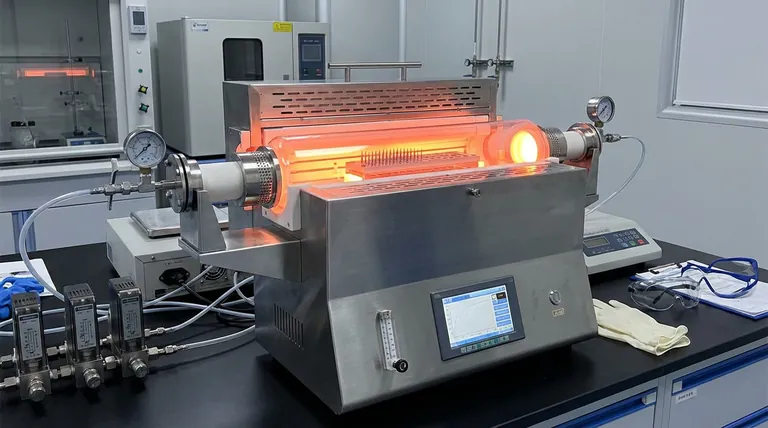
The primary role of a horizontal oxidation furnace is to provide a controlled, high-temperature environment specifically designed to grow a dense, thermally stable silicon dioxide (SiO2) layer on silicon micro-tips. By maintaining an oxygen-rich atmosphere at 1080 °C, the furnace facilitates an in-situ thermal oxidation process that creates a barrier far superior to naturally occurring oxides.
Core Takeaway While native oxides are too thin and unstable for extreme conditions, a horizontal oxidation furnace enables the engineering of a precise 20–50 nm thick SiO2 layer. This specific thickness and density are required to prevent diffusion and reaction during high-temperature, atomic-level studies.
The Mechanism of Thermal Oxidation
High-Temperature Environment
The furnace functions by generating and sustaining a specific temperature of 1080 °C.
At this temperature, the kinetic energy is sufficient to drive the reaction between silicon and oxygen efficiently. This allows for the intentional growth of oxide rather than simple surface passivation.
In-Situ Layer Growth
The process occurs in-situ, meaning the oxide creates a cohesive interface directly with the silicon micro-tip.
This results in a dense silicon dioxide (SiO2) layer. The furnace environment ensures the layer is uniform and structurally sound, which is essential for acting as a diffusion barrier.
Why Native Oxide is Insufficient
The Thickness Limitation
Without a furnace, silicon naturally forms a "native" oxide layer. However, this layer is typically only 2 nm thick.
The horizontal oxidation furnace allows researchers to increase this thickness significantly. It provides the control necessary to achieve a target thickness between 20 and 50 nm.
Thermal Instability
The thin nature of native oxide makes it chemically and mechanically weak under stress.
Native oxide films generally fail when subjected to temperatures above 400 °C. This makes them unsuitable for experiments requiring high thermal resilience.
Understanding the Trade-offs
The Necessity of Controlled Thickness
A common pitfall in preparing silicon micro-tips is underestimating the diffusion risks at high temperatures.
Relying on thinner oxides or lower-temperature processing can lead to barrier failure. The furnace is specifically used to exceed the "critical mass" of protection that native oxides cannot provide.
Stability vs. Reactivity
The goal of using this furnace is to create a barrier that is chemically inert regarding the underlying silicon.
By growing the layer to 20–50 nm, the furnace ensures the barrier remains robust against diffusion and reaction. This stability is the defining requirement for successful high-temperature atomic-level studies.
Making the Right Choice for Your Goal
To ensure the success of your silicon micro-tip preparation, assess your thermal requirements against the capabilities of the oxide layer.
- If your primary focus is high-temperature stability: You must utilize the horizontal oxidation furnace to grow a thermal oxide layer, as native oxides will fail above 400 °C.
- If your primary focus is atomic-level diffusion studies: You require the furnace to achieve a precise thickness of 20–50 nm to act as a robust reaction barrier.
By leveraging the high-temperature capabilities of a horizontal oxidation furnace, you transform a fragile silicon surface into a stable platform for advanced research.
Summary Table:
| Feature | Native Oxide Layer | Furnace-Grown Thermal Oxide |
|---|---|---|
| Thickness | ~2 nm | 20 – 50 nm |
| Thermal Stability | Fails above 400 °C | Stable at 1080 °C+ |
| Barrier Density | Low/Porous | High/Dense |
| Application | Surface Passivation | High-Temp Atomic Studies |
Elevate Your Semiconductor Research with KINTEK
Precise thermal oxidation is the cornerstone of reliable diffusion barrier fabrication. Backed by expert R&D and manufacturing, KINTEK offers high-performance Muffle, Tube, Rotary, Vacuum, and CVD systems, along with specialized horizontal furnace solutions. Whether you are preparing silicon micro-tips or conducting advanced material synthesis, our lab high-temp furnaces are fully customizable to meet your unique research needs.
Ready to achieve superior layer uniformity and thermal stability? Contact our specialists today to find the perfect furnace solution for your laboratory.
References
- E. Akbarnejad, Alfred Ludwig. Enabling High‐Temperature Atomic‐Scale Investigations with Combinatorial Processing Platforms Using Improved Thermal SiO<sub>2</sub> Diffusion and Reaction Barriers. DOI: 10.1002/admi.202400138
This article is also based on technical information from Kintek Furnace Knowledge Base .
Related Products
- Mesh Belt Controlled Atmosphere Furnace Inert Nitrogen Atmosphere Furnace
- 1200℃ Controlled Inert Nitrogen Atmosphere Furnace
- Controlled Inert Nitrogen Hydrogen Atmosphere Furnace
- Custom Made Versatile CVD Tube Furnace Chemical Vapor Deposition CVD Equipment Machine
- 1700℃ Controlled Inert Nitrogen Atmosphere Furnace
People Also Ask
- How is a controlled atmosphere furnace used in material research? Achieve Precise Material Synthesis and Heat Treatment
- What are the two main purposes of controlled atmosphere conditions in furnaces? Protect or Transform Materials for Peak Performance
- How does a controlled atmosphere furnace improve product quality and consistency? Master Precise Heat Treatment for Superior Results
- What types of gases can a controlled atmosphere furnace handle? Master Inert and Reactive Gases for Your Lab
- What types of furnaces have controlled atmosphere furnaces largely replaced? Boost Metallurgical Precision & Safety



















