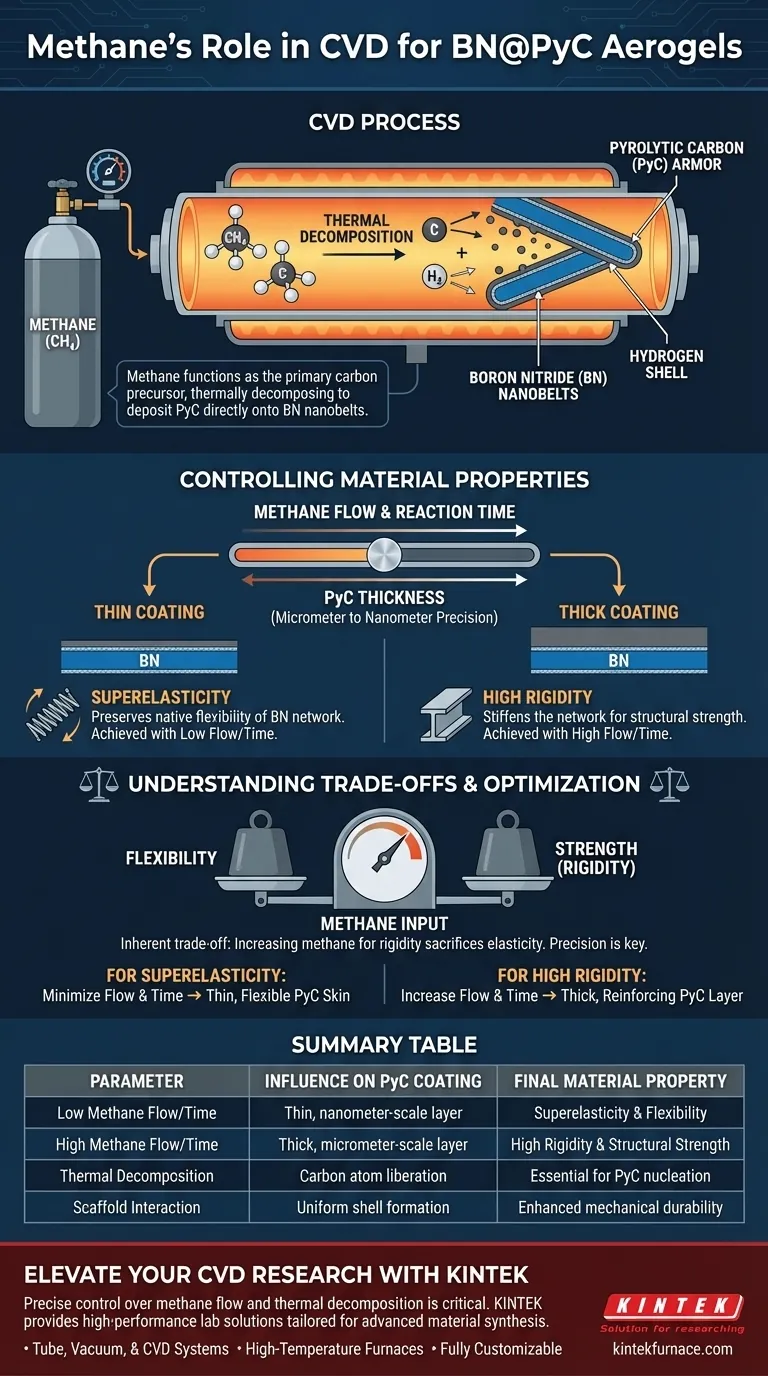
In the Chemical Vapor Deposition (CVD) process for BN@PyC aerogels, methane functions as the primary carbon precursor. It is introduced into a high-temperature tube furnace where it undergoes thermal decomposition, releasing carbon atoms that deposit as pyrolytic carbon (PyC) directly onto the surfaces of boron nitride (BN) nanobelts.
Methane acts as the tunable "armor" source for the aerogel structure. By regulating its flow and reaction time, you directly control the thickness of the carbon coating, allowing you to program the material’s mechanical properties from superelastic to highly rigid.
The Mechanism of Deposition
Thermal Decomposition
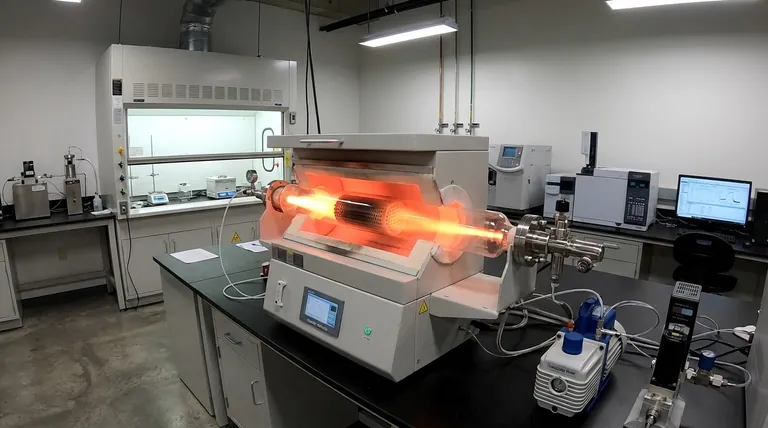
Inside the reaction chamber, the high thermal energy causes the methane gas to break down chemically. This decomposition is the critical first step, liberating carbon from the gaseous state so it is available for solid-state deposition.
Creating the PyC Armor
The released carbon does not float aimlessly; it nucleates and grows on the boron nitride (BN) scaffold. This forms a continuous shell of pyrolytic carbon (PyC) around the nanobelts, effectively jacketing the underlying ceramic structure.
Controlling Material Properties
Precision at the Nano-Scale
The interaction between the methane supply and the aerogel is highly controllable. By adjusting the methane flow rate and the reaction time, you can dictate the thickness of the deposited PyC layer with micrometer or nanometer precision.
Transitioning Mechanical States
This control over thickness is the key to determining the final physical behavior of the aerogel. The methane-derived coating drives a mechanical transition in the material.
A thinner coating preserves the native superelasticity of the BN network. A thicker coating, achieved through higher flow or longer exposure, stiffens the network, resulting in high rigidity.
Understanding the Trade-offs
The Sensitivity of Process Parameters
While methane allows for property tuning, the relationship between flow rate and final rigidity is sensitive. A lack of precision in controlling the gas source can lead to unintentional mechanical properties.
Balancing Flexibility and Strength
There is an inherent trade-off dictated by the methane input. Increasing the methane flow to maximize structural strength (rigidity) inherently sacrifices the aerogel's elasticity. You cannot maximize both properties simultaneously; the methane parameters forces a choice between flexibility and stiffness.
Optimizing the Coating Process
To achieve the specific mechanical performance required for your application, focus on manipulating the methane exposure variables.
- If your primary focus is Superelasticity: Minimize the methane flow rate and reaction time to create a nanometer-scale, flexible PyC skin.
- If your primary focus is High Rigidity: Increase the methane flow rate and extend the reaction time to build a thicker, micrometer-scale reinforcing layer.
The function of methane is ultimately to serve as the dial that sets the mechanical identity of your final aerogel product.
Summary Table:
| Parameter | Influence on PyC Coating | Final Material Property |
|---|---|---|
| Low Methane Flow/Time | Thin, nanometer-scale layer | Superelasticity & Flexibility |
| High Methane Flow/Time | Thick, micrometer-scale layer | High Rigidity & Structural Strength |
| Thermal Decomposition | Carbon atom liberation | Essential for PyC nucleation |
| Scaffold Interaction | Uniform shell formation | Enhanced mechanical durability |
Elevate Your CVD Research with KINTEK
Precise control over methane flow and thermal decomposition is critical for engineering the next generation of BN@PyC aerogels. KINTEK provides high-performance lab solutions tailored for advanced material synthesis. Backed by expert R&D and precision manufacturing, we offer a comprehensive range of Tube, Vacuum, and CVD systems, as well as high-temperature furnaces—all fully customizable to meet your unique research requirements.
Ready to achieve nanometer-scale precision in your deposition process? Contact us today to find the perfect furnace solution for your lab!
Visual Guide
References
- Meng Lan, Qiangang Fu. Armoring Boron Nitride with Pyrolytic Carbon Layers for Tunable Rigidity and Flexibility. DOI: 10.1002/advs.202504649
This article is also based on technical information from Kintek Furnace Knowledge Base .
Related Products
- Custom Made Versatile CVD Tube Furnace Chemical Vapor Deposition CVD Equipment Machine
- RF PECVD System Radio Frequency Plasma Enhanced Chemical Vapor Deposition
- Multi Heating Zones CVD Tube Furnace Machine for Chemical Vapor Deposition Equipment
- MPCVD Machine System Reactor Bell-jar Resonator for Lab and Diamond Growth
- Cylindrical Resonator MPCVD Machine System for Lab Diamond Growth
People Also Ask
- Why are CVD tube furnace sintering systems indispensable for 2D material research and production? Unlock Atomic-Scale Precision
- What is a CVD tube furnace and what is its primary function? Discover Precision Thin-Film Deposition
- How does CVD tube furnace sintering enhance graphene growth? Achieve Superior Crystallinity and High Electron Mobility
- Which industries and research fields benefit from CVD tube furnace sintering systems for 2D materials? Unlock Next-Gen Tech Innovations
- How can integrating CVD tube furnaces with other technologies benefit device fabrication? Unlock Advanced Hybrid Processes