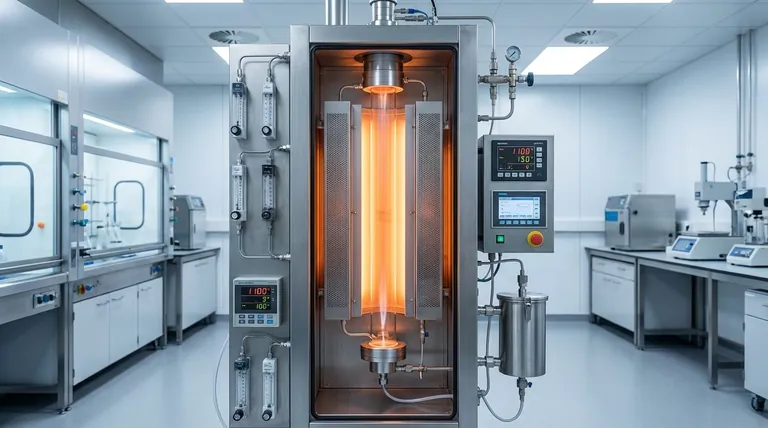
The primary role of a vertical tube Floating Catalytic Chemical Vapor Deposition (FCCVD) system is to function as a continuous-flow reactor for the high-volume synthesis of single-walled carbon nanotubes (SWCNTs). By maintaining a reaction environment typically at 1100 °C, the system vaporizes injected liquid carbon sources and catalysts, allowing nanotubes to nucleate and grow in a suspended state before being transported by gas for collection.
Core Takeaway Unlike static methods that grow materials on a fixed plate, the vertical FCCVD system leverages gravity and advanced airflow to enable the continuous, floating growth of nanotubes. This specific configuration is essential for producing SWCNTs with high crystallinity and small bundle diameters.
The Mechanics of Synthesis
Creating the Reaction Environment
The foundation of the FCCVD system is its ability to generate and sustain high temperatures.
For SWCNT synthesis, the furnace chamber is typically maintained at 1100 °C. This extreme heat is required to thermally crack the carbon source and activate the catalyst.
The Injection Process
The system does not rely on pre-placed substrates. Instead, it utilizes an injection method.
Liquid carbon sources, catalyst precursors, and growth promoters are introduced directly into the furnace chamber.
Nucleation in Suspension
Once inside the heated zone, the precursors vaporize and decompose.
Carbon atoms attach to free-floating catalyst particles. This facilitates the nucleation and growth of the nanotubes directly in the gas phase.
Strategic Advantages of the Vertical Configuration
Advanced Airflow Control
The vertical orientation of the tube is not arbitrary; it is designed to optimize aerodynamics.
Advanced airflow mechanisms manage the movement of the reacting gases. This ensures the uniform distribution of heat and reactants, which is critical for consistent quality.
Continuous Production Flow
Because the catalyst is floating rather than fixed, the process is not limited by the surface area of a wafer.
The system produces SWCNTs continuously. A carrier gas transports the formed nanotubes out of the hot zone for collection, enabling a streamlined manufacturing workflow.
Quality of Output
The specific combination of floating catalysts and vertical flow impacts the material properties.
This method is noted for producing SWCNTs with small bundle diameters. Furthermore, the controlled environment yields nanotubes with high crystallinity, indicating a low defect density.
Understanding the Trade-offs
Process Sensitivity
While the FCCVD system enables continuous production, it introduces significant complexity in process control.
The "floating" nature of the reaction means that temperature, flow rate, and precursor ratios must be perfectly synchronized. Unlike substrate-based CVD where the catalyst is fixed, here the catalyst is moving, making the residence time in the hot zone a critical variable to manage.
Making the Right Choice for Your Goal
To maximize the effectiveness of a vertical FCCVD system, align your operational parameters with your specific output requirements:
- If your primary focus is Structural Integrity: Prioritize precise thermal maintenance at 1100 °C to ensure complete cracking and high crystallinity of the nanotubes.
- If your primary focus is Production Scalability: Focus on optimizing the carrier gas velocity to ensure efficient transport and continuous collection without clogging the vertical tube.
Mastering the airflow and thermal profile of the vertical tube is the key to transitioning from batch processing to continuous, high-quality nanotube production.
Summary Table:
| Feature | Specification/Detail |
|---|---|
| Primary Function | Continuous-flow reactor for high-volume SWCNT synthesis |
| Operating Temp | Typically 1100 °C (for thermal cracking and catalyst activation) |
| Growth State | Suspended/Floating (Gas phase nucleation) |
| Configuration | Vertical tube (Optimizes gravity and aerodynamics) |
| Key Output Qualities | High crystallinity, small bundle diameters, low defect density |
| Carrier Gas Role | Transporting formed nanotubes for collection |
Optimize Your Nanomaterial Synthesis with KINTEK
Transition from batch processing to continuous, high-quality production with our precision-engineered thermal solutions. Backed by expert R&D and world-class manufacturing, KINTEK offers specialized CVD systems, Muffle, Tube, Rotary, and Vacuum furnaces—all fully customizable to meet the rigorous demands of your SWCNT research or industrial scale-up.
Ready to achieve superior crystallinity and throughput?
Contact KINTEK today to discuss your unique furnace needs.
Visual Guide

References
- Junyu Pan, Zhong Yang. Phosphorous waterborne polyurethanes/single-walled carbon nanotube composites as flame retardant building materials and their application in architectural design. DOI: 10.1039/d5ra05374a
This article is also based on technical information from Kintek Furnace Knowledge Base .
Related Products
- Custom Made Versatile CVD Tube Furnace Chemical Vapor Deposition CVD Equipment Machine
- Slide PECVD Tube Furnace with Liquid Gasifier PECVD Machine
- Multi Heating Zones CVD Tube Furnace Machine for Chemical Vapor Deposition Equipment
- Inclined Rotary Plasma Enhanced Chemical Deposition PECVD Tube Furnace Machine
- HFCVD Machine System Equipment for Drawing Die Nano Diamond Coating
People Also Ask
- What is a CVD tube furnace and what is its primary function? Discover Precision Thin-Film Deposition
- Why are CVD tube furnace sintering systems indispensable for 2D material research and production? Unlock Atomic-Scale Precision
- Which industries and research fields benefit from CVD tube furnace sintering systems for 2D materials? Unlock Next-Gen Tech Innovations
- How does CVD tube furnace sintering enhance graphene growth? Achieve Superior Crystallinity and High Electron Mobility
- How might AI and machine learning enhance CVD tube furnace processes? Boost Quality, Speed, and Safety