
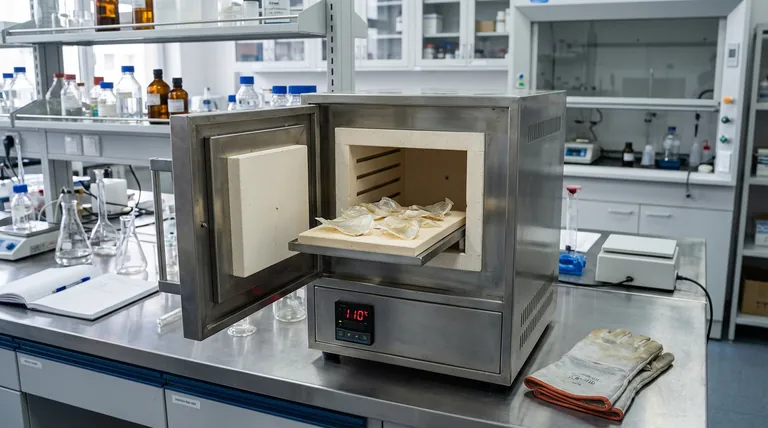
The primary function of a laboratory oven in this process is to execute constant temperature drying of washed white bass scales at 110°C. This critical dehydration step evaporates moisture and eliminates physically adsorbed water, transforming the raw scales into a stable precursor suitable for high-temperature processing.
By effectively removing moisture, the laboratory oven safeguards the material's structural integrity. It prevents the rapid expansion of water into steam during later stages, which would otherwise cause physical damage to the activated carbon structure.
The Objectives of Dehydration
Removing Adsorbed Moisture
After the initial washing phase, white bass scales retain significant amounts of water. The laboratory oven provides a controlled environment to evaporate this physically adsorbed water. By maintaining a constant temperature, the oven ensures that the drying process is uniform and thorough.
Reducing Environmental Humidity
Beyond simply drying the surface, the oven stabilizes the raw material against environmental factors. It reduces the impact of ambient humidity on the scales. This results in a consistently dry raw material that serves as a reliable baseline for the rest of the experiment.
Why Pre-Drying is Critical
Preventing Violent Vaporization
The most important role of the oven is protecting the material during the subsequent carbonization phase. If wet scales are introduced directly into a high-temperature furnace, the trapped water will vaporize instantly. This violent vaporization creates internal pressure that can shatter or distort the delicate structure of the material.
Preserving Product Structure
By ensuring the input material is completely dry, you mitigate the risk of structural collapse. The oven acts as a stabilizing stage, ensuring that the pore structure of the potential activated carbon is not compromised by steam expansion before it is even formed.
Understanding the Trade-offs
Temperature Specificity
It is vital to adhere to the specific protocol for the material in question. While other biomass precursors (such as banana peels) may require multi-stage drying at temperatures ranging from 40°C to 200°C for different chemical fixations, white bass scales specifically require 110°C.
The Risk of Incorrect Heating
Deviating from the 110°C standard presents risks. A lower temperature may fail to remove all adsorbed water, leading to the vaporization issues described above. Conversely, excessively high temperatures during this drying phase could trigger premature decomposition before the controlled carbonization stage begins.
Making the Right Choice for Your Goal
To ensure high-quality activated carbon production, apply the oven stages with precision:
- If your primary focus is Structural Integrity: Ensure the drying cycle at 110°C is complete to prevent steam-induced micro-fractures during carbonization.
- If your primary focus is Process Consistency: Standardize the drying duration to ensure every batch enters the furnace with the exact same moisture content (near zero).
Proper dehydration is the essential preparatory step that defines the stability and quality of your final activated carbon product.
Summary Table:
| Stage | Temperature | Primary Objective | Risk of Failure |
|---|---|---|---|
| Dehydration | 110°C | Remove physically adsorbed water | Steam-induced structural damage |
| Stabilization | Constant | Neutralize environmental humidity | Inconsistent carbonization results |
| Pre-heating | Controlled | Prevent violent vaporization | Internal pressure and micro-fractures |
Maximize Your Lab’s Precision with KINTEK
High-quality activated carbon begins with precise thermal processing. Whether you are performing critical dehydration at 110°C or high-temperature carbonization, KINTEK provides the specialized equipment needed for excellence.
Backed by expert R&D and manufacturing, we offer a comprehensive range of Muffle, Tube, Rotary, Vacuum, and CVD systems, all fully customizable to meet your unique research requirements. Don't compromise your material’s structural integrity with inconsistent heating.
Ready to elevate your material science? Contact KINTEK experts today to find the perfect thermal solution for your laboratory.
References
- Jolantje Latupeirissa, Muliana Muliana. CHARACTERISATION OF ACTIVATED CARBON FROM WHITE SNAPPER SCALES (Lates calcarife) WASTE. DOI: 10.30872/jkm.v21i2.1292
This article is also based on technical information from Kintek Furnace Knowledge Base .
Related Products
- Laboratory Muffle Oven Furnace with Bottom Lifting
- 1200℃ Muffle Oven Furnace for Laboratory
- 1400℃ Muffle Oven Furnace for Laboratory
- 1800℃ High Temperature Muffle Oven Furnace for Laboratory
- 1700℃ High Temperature Muffle Oven Furnace for Laboratory
People Also Ask
- Why is a high-temperature muffle furnace required for FeOx-MOx/TiO2? Engineering High-Performance Nanocomposites
- What is the importance of the calcination process? Master High-Purity Calcium Phosphate Nanopowder Production
- What function does a muffle furnace perform in Ba0.75Ca0.25TiO3 calcination? Ensure Phase Purity & Synthesis
- Why is a high-temperature laboratory muffle furnace essential for the alkali fusion process in zeolite synthesis?
- What are the primary functions of a high-temperature laboratory muffle furnace in the preparation of biosorbent materials?



















