
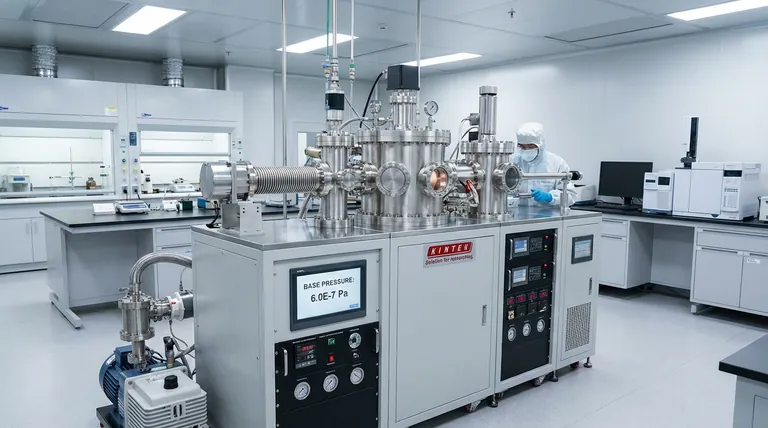
The base vacuum level determines the chemical purity and structural success of your thin film. For Ru50Mo50(0001) alloys, achieving an ultra-low base pressure (approximately 6 x 10^-7 Pa) is critical to minimize residual gases, specifically oxygen and water vapor. Without this deep vacuum, these gases react with the metal atoms during deposition, preventing the formation of a pure metallic alloy.
The base pressure is not merely an operational setting; it is the primary safeguard against oxidation. Maintaining a high vacuum environment is the only way to ensure the growth of high-purity, epitaxial films with the atomically sharp interfaces required for non-equilibrium alloys.
Eliminating the Source of Contamination
The Threat of Residual Gases
The primary obstacle to high-quality sputtering is the presence of residual gases in the chamber.
Even in a sealed environment, trace amounts of oxygen and water vapor remain.
If the base pressure is not sufficiently low (e.g., above 6 x 10^-7 Pa), these gases are incorporated into the film as impurities.
Preventing Metal Oxidation
Ruthenium (Ru) and Molybdenum (Mo) are susceptible to reacting with residual oxygen.
During the co-sputtering process, these metals are in a highly energetic state, increasing their reactivity.
A strict high-vacuum environment is essential to prevent the oxidation of these metals, ensuring the final product remains a metallic alloy rather than a metal oxide.
Achieving Structural Perfection
Enabling Epitaxial Growth
The designation Ru50Mo50(0001) implies a specific crystal orientation (epitaxy).
Purity is a prerequisite for epitaxy; foreign atoms (like oxygen) disrupt the crystal lattice structure.
By eliminating contaminants, the system allows the metal atoms to arrange themselves perfectly, facilitating high-purity epitaxial growth.
Ensuring Sharp Interfaces
For advanced thin films, the boundary between layers (the interface) determines performance.
Contaminants can cause blurring or diffusion at these boundaries.
A low base pressure ensures that the deposited layers have sharp interfaces, preserving the distinct properties of the alloy.
The Risks of Insufficient Vacuum
Compromising Alloy Composition
If the vacuum level is compromised, you lose control over the stoichiometry of the film.
Instead of a 50:50 metallic ratio, you introduce a third variable: oxygen content.
This fundamentally alters the material properties, often rendering the "non-equilibrium" phase unstable or impossible to form.
The Trade-off: Time vs. Quality
Achieving 6 x 10^-7 Pa requires longer pump-down times, which affects process throughput.
However, attempting to speed up the process by accepting a higher base pressure is a false economy.
The result will be a contaminated film that fails to meet the structural and chemical requirements of the Ru50Mo50(0001) specification.
Making the Right Choice for Your Goal
To ensure the successful preparation of Ru50Mo50(0001) films, adhere to the following guidelines:
- If your primary focus is Chemical Purity: You must drive the base pressure down to at least 6 x 10^-7 Pa to eliminate the risk of Ru and Mo oxidation.
- If your primary focus is Structural Quality: Prioritize the removal of water vapor and oxygen to prevent lattice defects and ensure sharp, epitaxial interfaces.
Strict adherence to vacuum protocols is the foundation upon which high-quality non-equilibrium alloys are built.
Summary Table:
| Factor | Requirement | Impact on Ru50Mo50(0001) Film |
|---|---|---|
| Base Pressure | ≤ 6 x 10^-7 Pa | Prevents oxidation and ensures metallic purity |
| Residual Gases | Oxygen & Water Vapor | Minimized to avoid lattice defects and contamination |
| Growth Mode | Epitaxial | High vacuum enables precise (0001) crystal orientation |
| Interface Quality | Atomically Sharp | Low pressure prevents diffusion and blurring at boundaries |
Elevate Your Thin Film Precision with KINTEK
High-purity Ru50Mo50(0001) alloys demand uncompromising vacuum environments. At KINTEK, we understand that structural perfection starts with the right equipment. Backed by expert R&D and world-class manufacturing, we provide high-performance Magnetron Sputtering systems, Vacuum furnaces, and CVD systems tailored for researchers who cannot afford to compromise on film stoichiometry or epitaxial quality.
Whether you need a specialized high-temp furnace or a customizable deposition system, our team is ready to support your unique material requirements. Contact us today to discuss your custom lab solution and ensure your next project achieves the vacuum integrity it deserves.
References
- Ke Tang, Seiji Mitani. Enhanced orbital torque efficiency in nonequilibrium Ru50Mo50(0001) alloy epitaxial thin films. DOI: 10.1063/5.0195775
This article is also based on technical information from Kintek Furnace Knowledge Base .
Related Products
- Cylindrical Resonator MPCVD Machine System for Lab Diamond Growth
- MPCVD Machine System Reactor Bell-jar Resonator for Lab and Diamond Growth
People Also Ask
- How does MPCVD achieve stable temperature control during diamond growth? Master Precise Thermal Management
- What are the essential components of an MPCVD reactor system? Build a Pristine Environment for High-Purity Materials
- How does pressure affect the MPCVD growth process? Master Plasma Control for Superior Film Quality
- How do carbon-containing groups contribute to diamond growth in the MPCVD method? Unlock High-Quality Diamond Synthesis
- What factors influence the quality of diamond deposition in the MPCVD method? Master the Critical Parameters for High-Quality Diamond Growth

