Knowledge Why is a slow heating rate utilized for rice husk biochar? Optimize Pore Structure and Adsorption Performance
Author avatar

Tech Team · Kintek Furnace

Updated 2 days ago

Why is a slow heating rate utilized for rice husk biochar? Optimize Pore Structure and Adsorption Performance


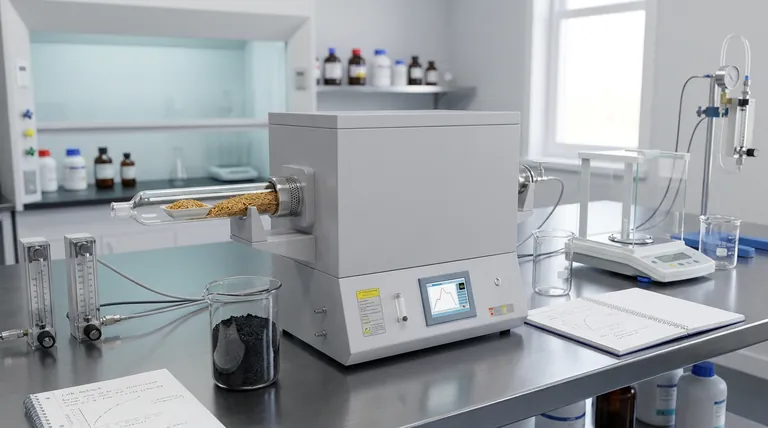
The primary utility of a slow heating rate of 5 °C per minute is to ensure the controlled and stable release of volatile components from the rice husk biomass. By moderating the thermal progression, this specific rate prevents the sudden pressure buildup that leads to the collapse of pore structures. This preservation of physical integrity is essential for creating a biochar capable of effective filtration and adsorption.

By prioritizing a gradual thermal ramp, you sacrifice processing speed to gain structural stability and precise chemical tuning. This method is the difference between a generic charred material and a high-efficiency adsorbent capable of targeting specific contaminants.
Why is a slow heating rate utilized for rice husk biochar? Optimize Pore Structure and Adsorption Performance

Preserving Physical Structure

Preventing Pore Collapse

When biomass is heated rapidly, volatile gases expand explosively within the material. This internal pressure can shatter the delicate micro-structure of the rice husk. A slow heating rate of 5 °C per minute allows these gases to escape gently, keeping the porous framework intact.

Avoiding Excessive Sintering

Rapid temperature increases often lead to sintering, a process where particles fuse together due to heat. Sintering reduces the overall surface area and closes off pores. The controlled 5 °C per minute rate mitigates this risk, maintaining the high surface area necessary for biochar performance.

Optimizing Chemical Properties

Regulating Aromatization

The heating curve directly influences the degree of aromatization, which refers to the formation of stable carbon ring structures. A slow ramp allows for a more ordered rearrangement of carbon atoms. This structural stability is crucial for the longevity and durability of the final biochar product.

Distributing Surface Functional Groups

Beyond the physical skeleton, the biochar's surface chemistry is defined by its functional groups. These groups act as "hooks" for chemical interactions. The slow heating rate allows for the precise regulation and distribution of these groups, optimizing the material's chemical reactivity.

The Impact on Adsorption Efficiency

Targeting Specific Contaminants

The ultimate goal of preserving pores and tuning chemistry is to maximize adsorption capacity. The primary reference highlights that this specific heating protocol optimizes the biochar for adsorbing contaminants like tetracycline.

maximizing Efficiency

By preventing structural collapse and tuning surface chemistry, the biochar becomes a more efficient filter. The slow heating ensures that the maximum number of active sites remain available to capture pollutants.

Understanding the Trade-offs

The Cost of Quality

While a rate of 5 °C per minute produces superior material, it inherently extends the processing time. This requires a longer residence time in the reactor compared to flash carbonization methods.

Sensitivity to Deviation

This process relies on precision. Deviating to a faster rate, even slightly, increases the risk of pore collapse. Therefore, the trade-off is strictly between the speed of production and the quality of the adsorption capability.

Making the Right Choice for Your Goal

When designing your carbonization protocol, align your heating rate with your performance objectives.

  • If your primary focus is high-efficiency adsorption: Stick strictly to the 5 °C per minute rate to maximize pore stability and chemical reactivity for contaminants like tetracycline.
  • If your primary focus is rapid throughput: Understand that increasing the heating rate will degrade the pore structure and reduce the material's effectiveness as a specialized filter.

Precision in thermal regulation is the defining factor that transforms raw rice husk into a high-performance remediation tool.

Summary Table:

Factor Slow Heating (5°C/min) Rapid Heating (>20°C/min)
Pore Structure Preserved & high surface area Collapsed or shattered pores
Volatile Release Controlled and steady Explosive and high-pressure
Surface Area Maximum for adsorption Reduced due to sintering
Product Quality High-efficiency adsorbent Low-grade charred material
Key Outcome Optimal for contaminant removal High production throughput

Elevate Your Biochar Research with Precision Thermal Control

High-performance adsorption starts with precise temperature regulation. KINTEK provides the cutting-edge lab equipment needed to master the carbonization process. Backed by expert R&D and manufacturing, we offer Muffle, Tube, Rotary, Vacuum, and CVD systems, all fully customizable to meet your specific research or production needs.

Whether you are targeting tetracycline removal or developing new porous materials, our high-temperature furnaces ensure the stable heating rates required for structural integrity. Contact KINTEK today to discuss your unique project requirements and see how our expertise can bring your lab's efficiency to the next level.

References

  1. Xiaotong Zhang, Qiuzhuo Zhang. Standardization and micromechanistic study of tetracycline adsorption by biochar. DOI: 10.1007/s42773-023-00299-7

This article is also based on technical information from Kintek Furnace Knowledge Base .

Related Products

People Also Ask

Related Products

1700℃ High Temperature Laboratory Tube Furnace with Quartz or Alumina Tube

1700℃ High Temperature Laboratory Tube Furnace with Quartz or Alumina Tube

KINTEK's Tube Furnace with Alumina Tube: Precision heating up to 1700°C for material synthesis, CVD, and sintering. Compact, customizable, and vacuum-ready. Explore now!

1700℃ High Temperature Muffle Oven Furnace for Laboratory

1700℃ High Temperature Muffle Oven Furnace for Laboratory

KT-17M Muffle Furnace: High-precision 1700°C lab furnace with PID control, energy efficiency, and customizable sizes for industrial & research applications.

Electric Rotary Kiln Small Rotary Furnace Biomass Pyrolysis Plant Rotating Furnace

Electric Rotary Kiln Small Rotary Furnace Biomass Pyrolysis Plant Rotating Furnace

KINTEK's Rotary Biomass Pyrolysis Furnace converts biomass to biochar, bio-oil, and syngas efficiently. Customizable for research or production. Get your solution now!

1400℃ Muffle Oven Furnace for Laboratory

1400℃ Muffle Oven Furnace for Laboratory

KT-14M Muffle Furnace: Precision 1400°C heating with SiC elements, PID control, and energy-efficient design. Ideal for labs.

1800℃ High Temperature Muffle Oven Furnace for Laboratory

1800℃ High Temperature Muffle Oven Furnace for Laboratory

KINTEK Muffle Furnaces: Precision 1800°C heating for labs. Energy-efficient, customizable, with PID control. Ideal for sintering, annealing, and research.

1200℃ Split Tube Furnace Laboratory Quartz Tube Furnace with Quartz Tube

1200℃ Split Tube Furnace Laboratory Quartz Tube Furnace with Quartz Tube

Discover KINTEK's 1200℃ Split Tube Furnace with quartz tube for precise high-temperature lab applications. Customizable, durable, and efficient. Get yours now!

Laboratory Muffle Oven Furnace with Bottom Lifting

Laboratory Muffle Oven Furnace with Bottom Lifting

Boost lab efficiency with KT-BL Bottom Lifting Furnace: precise 1600℃ control, superior uniformity, and enhanced productivity for material science and R&D.

Laboratory Quartz Tube Furnace RTP Heating Tubular Furnace

Laboratory Quartz Tube Furnace RTP Heating Tubular Furnace

KINTEK's RTP Rapid Heating Tube Furnace delivers precise temperature control, rapid heating up to 100°C/sec, and versatile atmosphere options for advanced lab applications.

1400℃ High Temperature Laboratory Tube Furnace with Quartz and Alumina Tube

1400℃ High Temperature Laboratory Tube Furnace with Quartz and Alumina Tube

KINTEK's Tube Furnace with Alumina Tube: Precision high-temperature processing up to 2000°C for labs. Ideal for material synthesis, CVD, and sintering. Customizable options available.

Vacuum Heat Treat Furnace with Ceramic Fiber Liner

Vacuum Heat Treat Furnace with Ceramic Fiber Liner

KINTEK's Vacuum Furnace with Ceramic Fiber Lining offers precise high-temperature processing up to 1700°C, ensuring uniform heat distribution and energy efficiency. Ideal for labs and production.

High Temperature Muffle Oven Furnace for Laboratory Debinding and Pre Sintering

High Temperature Muffle Oven Furnace for Laboratory Debinding and Pre Sintering

KT-MD Debinding & Pre-Sintering Furnace for ceramics - precise temperature control, energy-efficient design, customizable sizes. Boost your lab efficiency today!

1400℃ Controlled Inert Nitrogen Atmosphere Furnace

1400℃ Controlled Inert Nitrogen Atmosphere Furnace

KT-14A Controlled Atmosphere Furnace for labs & industry. 1400°C max temp, vacuum sealing, inert gas control. Customizable solutions available.

1200℃ Controlled Inert Nitrogen Atmosphere Furnace

1200℃ Controlled Inert Nitrogen Atmosphere Furnace

KINTEK 1200℃ Controlled Atmosphere Furnace: Precision heating with gas control for labs. Ideal for sintering, annealing, and material research. Customizable sizes available.

1700℃ Controlled Inert Nitrogen Atmosphere Furnace

1700℃ Controlled Inert Nitrogen Atmosphere Furnace

KT-17A Controlled Atmosphere Furnace: Precise 1700°C heating with vacuum & gas control. Ideal for sintering, research & material processing. Explore now!

Vacuum Heat Treat Sintering Furnace Molybdenum Wire Vacuum Sintering Furnace

Vacuum Heat Treat Sintering Furnace Molybdenum Wire Vacuum Sintering Furnace

KINTEK's Vacuum Molybdenum Wire Sintering Furnace excels in high-temperature, high-vacuum processes for sintering, annealing, and material research. Achieve precise 1700°C heating with uniform results. Custom solutions available.

High Pressure Laboratory Vacuum Tube Furnace Quartz Tubular Furnace

High Pressure Laboratory Vacuum Tube Furnace Quartz Tubular Furnace

KINTEK High Pressure Tube Furnace: Precision heating up to 1100°C with 15Mpa pressure control. Ideal for sintering, crystal growth, and lab research. Customizable solutions available.

Custom Made Versatile CVD Tube Furnace Chemical Vapor Deposition CVD Equipment Machine

Custom Made Versatile CVD Tube Furnace Chemical Vapor Deposition CVD Equipment Machine

KINTEK's CVD Tube Furnace offers precision temperature control up to 1600°C, ideal for thin film deposition. Customizable for research and industrial needs.

Vacuum Heat Treat Sintering Furnace with Pressure for Vacuum Sintering

Vacuum Heat Treat Sintering Furnace with Pressure for Vacuum Sintering

KINTEK's Vacuum Pressure Sintering Furnace offers 2100℃ precision for ceramics, metals, and composites. Customizable, high-performance, and contamination-free. Get a quote now!

Vacuum Heat Treat Sintering and Brazing Furnace

Vacuum Heat Treat Sintering and Brazing Furnace

KINTEK Vacuum Brazing Furnaces deliver precision, clean joints with superior temperature control. Customizable for diverse metals, ideal for aerospace, medical, and thermal applications. Get a quote!

Vertical Laboratory Quartz Tube Furnace Tubular Furnace

Vertical Laboratory Quartz Tube Furnace Tubular Furnace

Precision KINTEK Vertical Tube Furnace: 1800℃ heating, PID control, customizable for labs. Ideal for CVD, crystal growth & materials testing.


Leave Your Message
