
The final drying step is a critical stabilization phase that transforms acid impregnation from a temporary coating into a permanent structural modification. It serves two essential functions: strictly removing moisture to prevent dangerous downstream reactions and thermally anchoring chemical functional groups to the adsorbent's surface. Without this heat treatment, the material remains chemically unstable and unsuitable for industrial use.
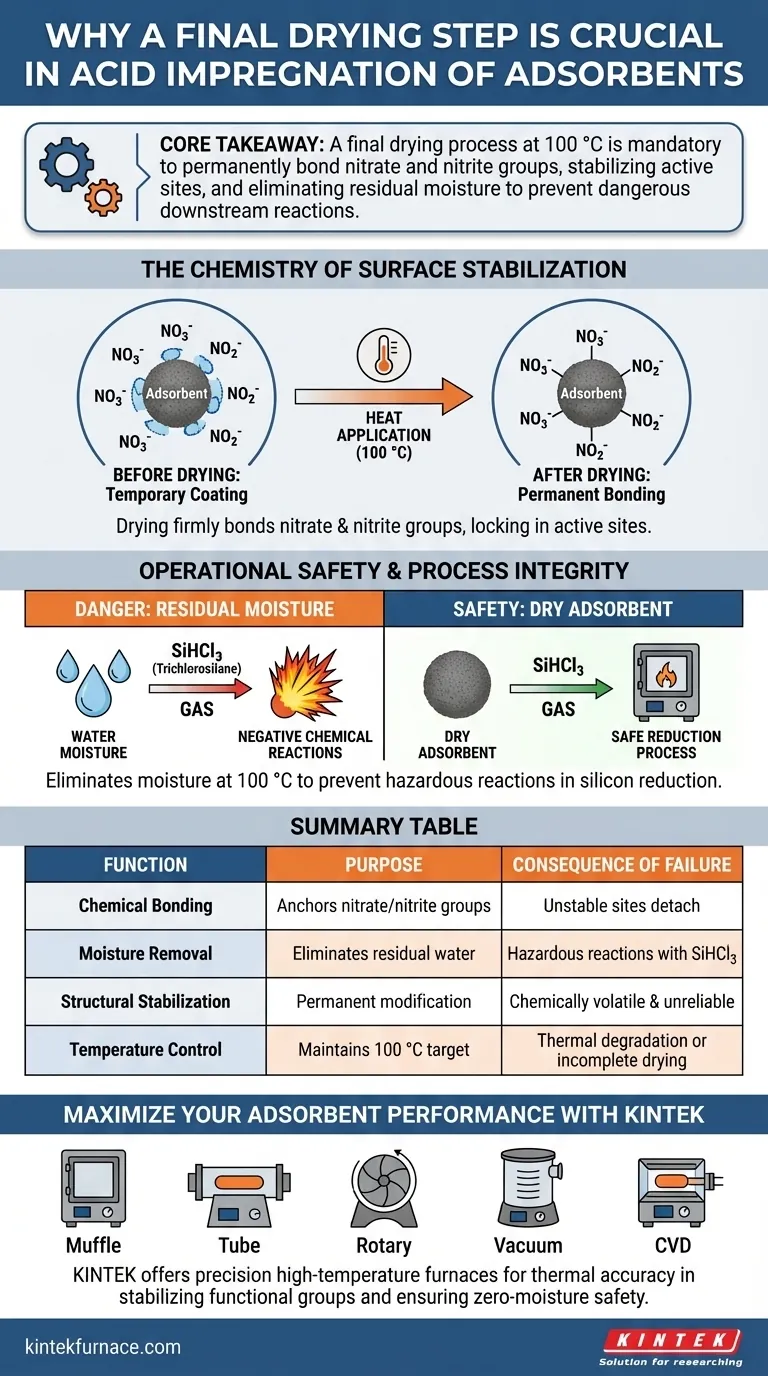
Core Takeaway A final drying process at 100 °C is mandatory to permanently bond nitrate and nitrite groups to the adsorbent, stabilizing its active sites. Crucially, this step eliminates residual moisture that would otherwise trigger detrimental chemical reactions with sensitive industrial gases like trichlorosilane (SiHCl3).
The Chemistry of Surface Stabilization
Bonding Functional Groups
Acid impregnation introduces specific chemical markers, specifically nitrate (NO3−) and nitrite (NO2−) functional groups.
However, simply soaking the material is not enough to attach these groups permanently.
Locking in Active Sites
The application of heat drives the chemical bonding process.
Drying ensures these functional groups are firmly bonded to the adsorbent surface, effectively stabilizing the active sites created during the modification.
Operational Safety and Process Integrity
Eliminating Residual Moisture
The most immediate operational goal of this step is the removal of excess water content.
This drying process is typically executed at 100 °C to ensure thorough evaporation.
Preventing Dangerous Side Reactions
This step is vital for safety in specific industrial contexts, such as silicon reduction furnaces.
These environments often utilize gases like SiHCl3 (trichlorosilane).
If residual moisture remains in the adsorbent, it will trigger negative chemical reactions with the SiHCl3 gas, potentially compromising the entire reduction process.
Understanding the Trade-offs
Precision in Temperature Control
While drying is essential, the temperature parameters must be strictly adhered to.
The process relies on a target of 100 °C to remove water without degrading the newly introduced functional groups.
Deviating significantly from this temperature could result in incomplete bonding or the thermal degradation of the adsorbent's porous structure.
Optimizing Your Restructuring Process
To ensure the success of your acid impregnation technique, align your quality control checks with your specific performance goals.
- If your primary focus is material stability: Verify that the drying duration is sufficient to fully bond the nitrate and nitrite groups, preventing them from detaching during operation.
- If your primary focus is process safety: Implement strict moisture content verification to ensure zero reactivity with SiHCl3 gas before the adsorbent enters the furnace.
Proper drying transforms a volatile chemical mixture into a robust, high-performance tool ready for demanding industrial environments.
Summary Table:
| Function | Purpose | Consequence of Failure |
|---|---|---|
| Chemical Bonding | Anchors nitrate/nitrite groups to the surface | Active sites remain unstable and detach during use |
| Moisture Removal | Eliminates residual water content | Triggers hazardous reactions with gases like SiHCl3 |
| Structural Stabilization | Transforms temporary coating into permanent modification | Material remains chemically volatile and unreliable |
| Temperature Control | Maintains target 100 °C threshold | Thermal degradation of porous structure or incomplete drying |
Maximize Your Adsorbent Performance with KINTEK
Precision heat treatment is the difference between a volatile mixture and a high-performance industrial tool. Backed by expert R&D and manufacturing, KINTEK offers a comprehensive range of Muffle, Tube, Rotary, Vacuum, and CVD systems, all fully customizable to meet your unique chemical restructuring needs. Whether you are stabilizing functional groups or ensuring zero-moisture safety for silicon reduction processes, our laboratory high-temperature furnaces provide the thermal accuracy your research demands.
Ready to optimize your drying and impregnation protocols? Contact us today to find your custom furnace solution!
Visual Guide
References
- Zhiyuan Liu, Guoqiang Huang. Acid-modified Cu–Ce/HZSM-5 adsorbent removes trace phosphorus impurities from recycled hydrogen during polysilicon production. DOI: 10.1039/d5ra01322d
This article is also based on technical information from Kintek Furnace Knowledge Base .
Related Products
- Controlled Inert Nitrogen Hydrogen Atmosphere Furnace
- 1700℃ Controlled Inert Nitrogen Atmosphere Furnace
- Spark Plasma Sintering SPS Furnace
- 1200℃ Controlled Inert Nitrogen Atmosphere Furnace
- High Temperature Muffle Oven Furnace for Laboratory Debinding and Pre Sintering
People Also Ask
- How does hydrogen furnace annealing assist in preparing mechanically alloyed powders for compaction?
- How does atmospheric annealing in a controlled hydrogen furnace affect the cold compaction behavior of metal powders?
- What are the characteristics and uses of hydrogen atmosphere in furnaces? Achieve Superior Surface Purity and Bonding
- What are the characteristics and uses of hydrogen atmospheres in furnaces? Unlock Clean Metal Processing
- What controlled-atmosphere furnace conditions are required for sintering powder metallurgy copper alloy compacts? Ideal Setup







