
A constant temperature blast drying oven functions as a precise pre-treatment environment that ensures the uniform dispersion of chemical activators. Specifically, it is used to deeply dry mixed suspensions of hydrochar and activators (such as potassium hydroxide, KOH) by maintaining a steady temperature, typically around 80 °C. The "blast" feature—forced air circulation—evaporates solvents evenly, preventing the chemical agents from clustering and ensuring they coat the carbon precursor at a molecular level.
Core Takeaway The oven is not just removing water; it is engineering the precursor's architecture. By utilizing forced convection to prevent solute segregation, it ensures the chemical activator is distributed evenly, which is the absolute prerequisite for developing extensive, uniform micropores during the subsequent high-temperature pyrolysis.
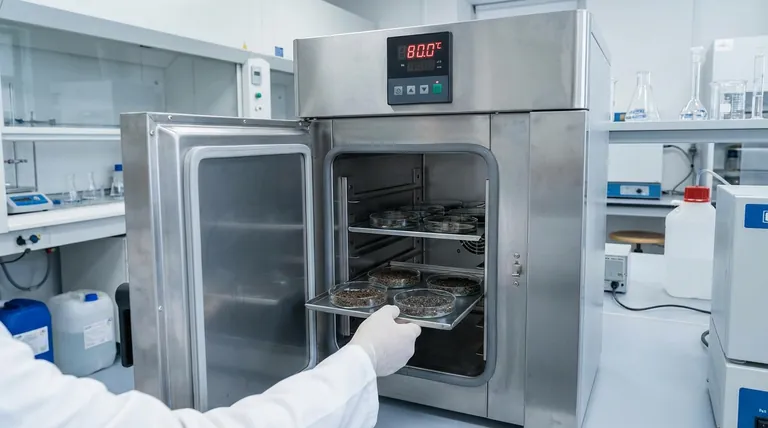
The Critical Role of Uniform Drying
The chemical activation process relies heavily on how the activator interacts with the carbon source. The blast drying oven manages this interaction through two specific mechanisms.
Forced Convection Ensures Homogeneity
The "blast" in the oven's name refers to forced air convection. Unlike static ovens where heat can stratify, this system circulates hot air continuously.
This circulation guarantees that the evaporation rate is consistent across the entire sample batch. Uniform evaporation prevents the formation of "hot spots" that could lead to uneven drying rates.
Preventing Solute Segregation
When a suspension containing dissolved salts (like KOH) dries, the salts naturally want to precipitate and clump together.
By precisely controlling the temperature and airflow, the oven facilitates slow, guided removal of moisture. This locks the activator ions in place within the hydrochar's pores rather than allowing them to migrate and segregate on the surface.
Molecular-Level Distribution
The ultimate goal of this drying phase is molecular-level distribution.
The primary reference notes that this specific distribution is required to form extensive microporous structures. If the activator is not evenly dispersed during drying, the final material will likely suffer from low surface area and irregular pore sizes.
Preparing for Pyrolysis
The work done in the drying oven directly dictates the success of the carbonization (pyrolysis) stage that follows.
Avoiding Structural Collapse
If moisture is left in the hydrochar, it will turn to steam explosively when introduced to high-temperature pyrolysis furnaces.
The drying oven removes this excess moisture gently at lower temperatures (e.g., 60–80 °C). This prevents the rapid expansion of water vapor that could rupture the material's internal structure or block existing micropores.
Creating Active Centers
For processes involving metal precursors (like iron), the oven ensures high dispersion of active centers.
By guiding the in-situ precipitation of these ions, the oven ensures that when the material is eventually carbonized, the catalytic or active sites are maximized throughout the porous structure.
Understanding the Trade-offs
While the constant temperature blast drying oven is essential for chemical activation, it is important to recognize its limitations compared to other drying methods.
Blast Drying vs. Vacuum Drying
A blast drying oven operates at atmospheric pressure using circulating air.
The downside: Because it uses air, there is a potential risk of oxidizing surface functional groups if the material is highly sensitive to oxygen, even at 80 °C.
The alternative: As noted in the supplementary references, a vacuum drying oven is preferred when the material requires a low-pressure, oxygen-free environment to prevent performance degradation or oxidation of specific ligands.
Making the Right Choice for Your Goal
How you utilize the drying phase depends on the specific requirements of your hierarchical porous carbon.
- If your primary focus is Maximizing Surface Area: Ensure the oven is set to a moderate temperature (approx. 80 °C) with high air circulation to guarantee the KOH is dispersed at a molecular level without clumping.
- If your primary focus is Structural Integrity: Use a lower temperature setting initially (e.g., 60 °C) to remove moisture slowly, preventing capillary forces from collapsing the pores before carbonization.
- If your primary focus is Preventing Oxidation: Consider if the blast oven's air circulation acts as a contaminant; if so, switching to a vacuum oven may be necessary to protect sensitive surface groups.
The blast drying oven transforms a simple mixture into a chemically programmed precursor, setting the stage for high-performance porosity.
Summary Table:
| Feature | Function in Chemical Activation | Impact on Material Quality |
|---|---|---|
| Forced Convection | Maintains uniform evaporation across samples | Prevents activator clustering & "hot spots" |
| Precise Temperature | Maintains steady low heat (e.g., 60–80 °C) | Prevents pore rupture from rapid steam expansion |
| Moisture Removal | Dehydration of mixed suspensions | Locks activator ions within the carbon structure |
| Atmospheric Control | Continuous hot air circulation | Ensures high dispersion of catalytic active centers |
Optimize Your Pre-Treatment with KINTEK
Don't let uneven drying ruin your material's surface area. Backed by expert R&D and manufacturing, KINTEK offers high-precision Muffle, Tube, Rotary, Vacuum, and CVD systems, along with specialized lab drying ovens. Whether you need molecular-level distribution for chemical activation or oxygen-free vacuum environments, our customizable high-temperature solutions are engineered for your unique research needs.
Ready to enhance your lab's efficiency and material performance? Contact KINTEK Today
References
- Marija Ercegović, Jugoslav Krstić. Efficient Adsorption of Pollutants from Aqueous Solutions by Hydrochar-Based Hierarchical Porous Carbons. DOI: 10.3390/w16152177
This article is also based on technical information from Kintek Furnace Knowledge Base .
Related Products
- 1700℃ High Temperature Muffle Oven Furnace for Laboratory
- 1800℃ High Temperature Muffle Oven Furnace for Laboratory
- 1400℃ Muffle Oven Furnace for Laboratory
- High Temperature Muffle Oven Furnace for Laboratory Debinding and Pre Sintering
- 1200℃ Muffle Oven Furnace for Laboratory
People Also Ask
- What is the primary function of a high-temperature laboratory muffle furnace in chemical synthesis? Achieve Precision.
- How does a high-temperature laboratory muffle furnace affect material properties? Transform Anodic Oxide Films Fast
- What role does a muffle furnace play in BCZY712 electrolyte powder production? Achieve Perfect Phase Purity
- What is the role of a high-temperature muffle furnace in guava leaf carbonization? Master Precise Pyrolysis Control
- How does a muffle furnace impact Ni/MgAl2O4 catalysts? Optimize Stability and Catalytic Performance





