
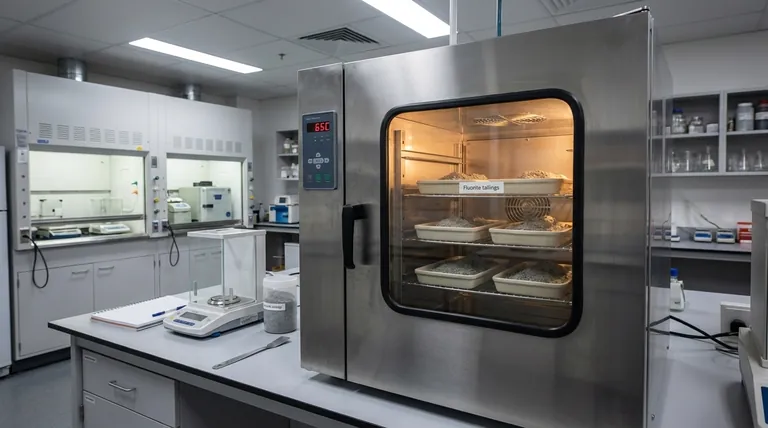
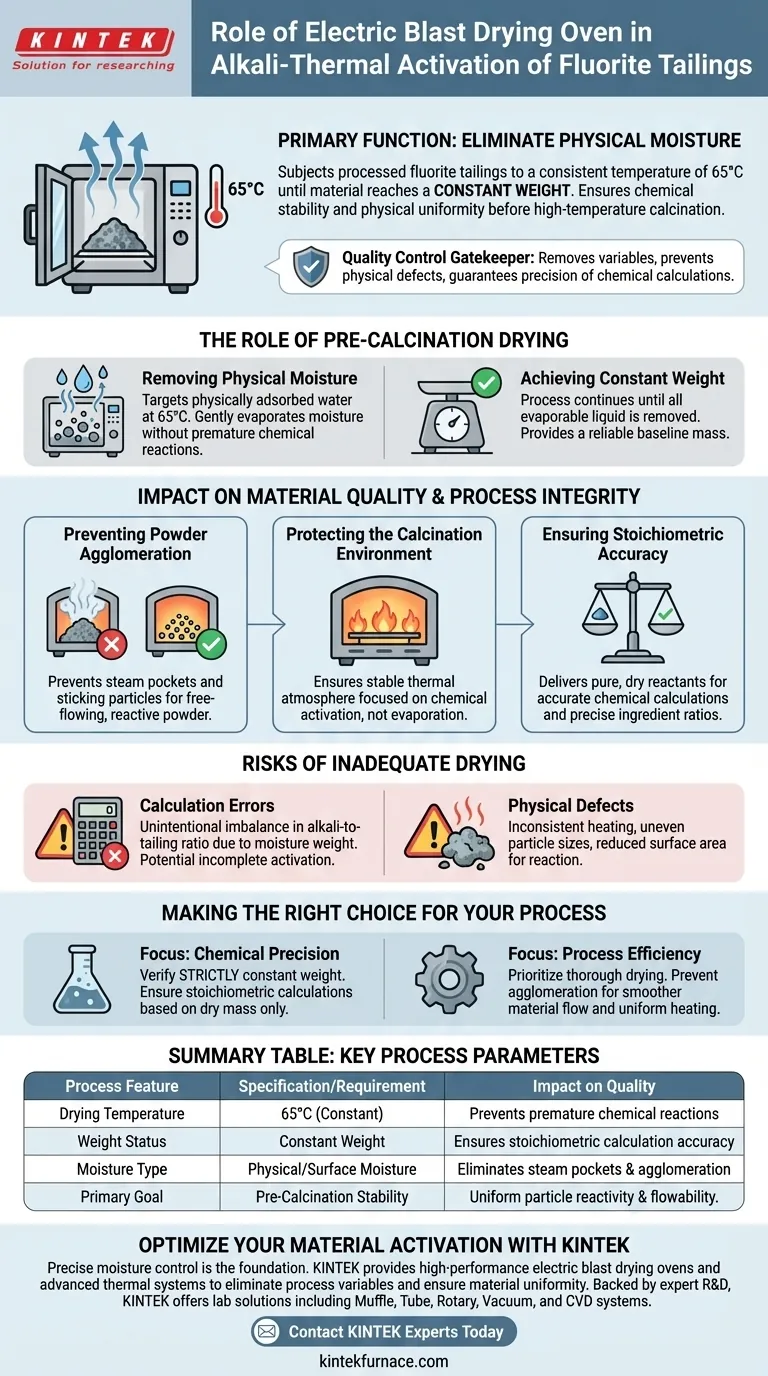
The primary function of an electric blast drying oven is to eliminate physical moisture. Specifically, it subjects processed fluorite tailings to a consistent temperature of 65°C until the material reaches a constant weight. This critical preparatory step ensures the raw material is chemically stable and physically uniform before it enters the high-temperature calcination phase.
The drying oven serves as a quality control gatekeeper, removing variables that could compromise the activation process. By ensuring tailings are dried to a constant weight, it prevents physical defects like clumping and guarantees the precision of chemical calculations required for successful alkali-thermal activation.
The Role of Pre-Calcination Drying
The drying process is not merely about removing water; it is about standardizing the material state. The electric blast drying oven prepares the tailings to behave predictably under intense heat.
Removing Physical Moisture
The oven targets water physically adsorbed onto the surface of the fluorite tailings. By maintaining a temperature of 65°C, the device gently evaporates this moisture without inducing premature chemical reactions.
Achieving Constant Weight
The process continues until the material reaches a constant weight. This indicates that all evaporable liquid has been removed, providing a reliable baseline mass for subsequent processing steps.
Impact on Material Quality and Process Integrity
The effectiveness of the subsequent calcination relies heavily on how well the drying oven performs its function.
Preventing Powder Agglomeration
If wet material enters a high-temperature calcination environment, rapid water evaporation can create steam pockets. This leads to powder agglomeration, where particles stick together. The drying oven prevents this, ensuring the powder remains free-flowing and reactive.
Protecting the Calcination Environment
Excess moisture can interfere with the thermal atmosphere inside a calcining kiln. By pre-drying the material, the oven ensures the calcination environment remains stable and focused on chemical activation rather than evaporation.
Ensuring Stoichiometric Accuracy
Chemical reactions depend on precise ratios of ingredients. If the tailings contain moisture, the weight measurement will include water mass, leading to incorrect calculations. The drying oven ensures accurate chemical stoichiometry by delivering pure, dry reactants.
Risks of Inadequate Drying
Skipping or rushing this stage introduces significant variables that can degrade the final product.
Calculation Errors
If the material is not dried to a constant weight, operators will unintentionally add less fluorite tailing than required. This imbalance disrupts the alkali-to-tailing ratio, potentially leading to incomplete activation.
Physical Defects
Residual moisture causes inconsistent heating. This often results in uneven particle sizes or clumping, which reduces the surface area available for the alkali-thermal reaction.
Making the Right Choice for Your Process
To maximize the efficiency of alkali-thermal activation, consider these specific operational goals when utilizing the drying oven.
- If your primary focus is Chemical Precision: Verify that the material has reached a strictly constant weight to ensure your stoichiometric calculations are based on dry mass only.
- If your primary focus is Process Efficiency: Prioritize thorough drying to prevent agglomeration, which facilitates smoother material flow and more uniform heating during calcination.
A properly executed drying phase is the foundation for a predictable and high-yield activation process.
Summary Table:
| Process Feature | Specification/Requirement | Impact on Quality |
|---|---|---|
| Drying Temperature | 65°C (Constant) | Prevents premature chemical reactions |
| Weight Status | Constant Weight | Ensures stoichiometric calculation accuracy |
| Moisture Type | Physical/Surface Moisture | Eliminates steam pockets & agglomeration |
| Primary Goal | Pre-Calcination Stability | Uniform particle reactivity & flowability |
Optimize Your Material Activation with KINTEK
Precise moisture control is the foundation of successful alkali-thermal activation. KINTEK provides high-performance electric blast drying ovens and advanced thermal systems designed to eliminate process variables and ensure material uniformity.
Backed by expert R&D and manufacturing, KINTEK offers a comprehensive range of lab solutions including Muffle, Tube, Rotary, Vacuum, and CVD systems. Whether you are processing fluorite tailings or advanced ceramics, our equipment is fully customizable to meet your unique thermal processing needs.
Ready to enhance your lab's efficiency and chemical precision?
Visual Guide
References
- Hao Qiu, Xiao Wang. Preparation and mechanical performance of fluorite tailings geopolymer precursor under alkaline heat activation. DOI: 10.1038/s41598-024-82560-y
This article is also based on technical information from Kintek Furnace Knowledge Base .
Related Products
People Also Ask
- What thermal phenomena occur during polymer binder burnout in ceramic green bodies? Lab Furnace Guide
- Why is controlled heat treatment in a muffle furnace necessary for calcined clay? Achieve Optimal Pozzolanic Activity
- What role does a high-temperature muffle furnace play in STFO synthesis? Achieve Pure Perovskite Results
- How does a high-temperature muffle furnace facilitate the formation of LaNbxAl1−xO3+δ perovskite structures? Key Roles
- What role does a high-temperature muffle furnace play in the multi-stage synthesis of Li0.5MnFe1.5O4? Key to Pure Spinel
