
The primary technical consideration when using alumina crucibles for Cobalt-based high-entropy alloys is the inevitable chemical interaction between the containment vessel and the melt. While these crucibles provide critical thermal stability up to 1550°C, they actively introduce trace amounts of aluminum into the alloy during the remelting process. This introduction fundamentally alters the chemical balance, specifically targeting residual oxygen to modify the final microstructure.
Alumina crucibles are not inert vessels; they act as active participants in the chemical evolution of the melt. The introduction of trace aluminum modifies oxygen reactions, shifting the formation of inclusions toward stable alumina or hafnium-enriched structures.
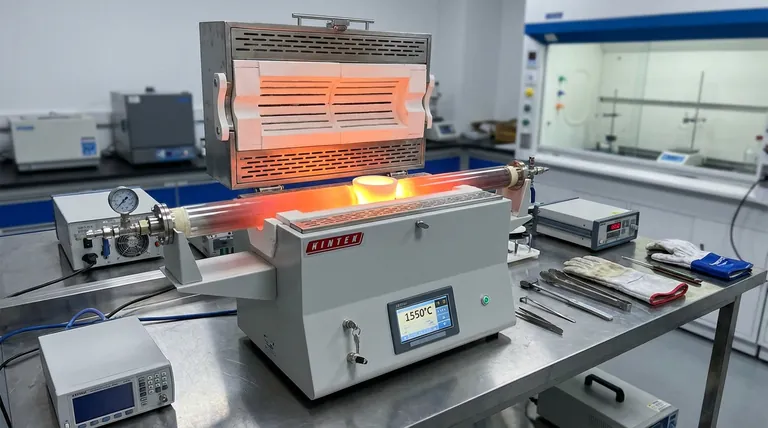
Thermal Capability and Limits
Operating Temperature Range
Alumina crucibles are chosen primarily for their robustness in high-heat environments. They are capable of supporting solidification and remelting processes at temperatures reaching 1550°C.
Suitability for Cobalt-Based Alloys
This temperature ceiling is generally sufficient for the melting points of most Cobalt-based high-entropy alloys. The material provides structural integrity during the phase transitions of the metal.
Chemical Interactions with the Melt
Aluminum Leaching
The most critical factor to consider is that the crucible degrades slightly during processing. This results in the release of trace amounts of aluminum into the molten alloy.
Reaction with Residual Oxygen
The introduced aluminum does not remain passive. It reacts chemically with any residual oxygen present within the melt.
Modification of Inclusion Evolution
This reaction pathway changes the type of impurities that form during solidification. The presence of aluminum facilitates the formation of stable alumina inclusions.
Impact on Hafnium
In addition to alumina structures, this chemical environment can promote the development of hafnium-enriched inclusions. This suggests a complex interaction where the crucible material influences the segregation of other reactive elements in the high-entropy mix.
Understanding the Trade-offs
Thermal Stability vs. Chemical Purity
You must balance the need for high-temperature containment against the requirement for chemical isolation. While alumina allows for processing at 1550°C, it compromises the absolute purity of the alloy composition.
Controlled vs. Unwanted Inclusions
The modification of inclusions is not necessarily a defect, but it is a variable that must be managed. The formation of stable alumina or hafnium-enriched phases prevents the melt from behaving as a closed system.
Making the Right Choice for Your Goal
To ensure your casting process meets your material specifications, consider how the crucible interacts with your specific alloy chemistry:
- If your primary focus is thermal endurance: Utilize alumina crucibles for their proven stability in melts requiring temperatures up to 1550°C.
- If your primary focus is inclusion control: Anticipate the reaction between trace aluminum and residual oxygen, and account for the formation of alumina or hafnium-enriched phases in your quality analysis.
By treating the crucible as a reactive agent rather than a passive container, you can better predict the microstructural outcome of your Cobalt-based alloy.
Summary Table:
| Technical Factor | Consideration | Impact on Process |
|---|---|---|
| Max Operating Temp | Up to 1550°C | High thermal stability for Co-based melts |
| Chemical Stability | Reactive interaction | Trace aluminum leaching into the melt |
| Inclusion Formation | Oxygen reaction | Shifts formation toward stable alumina/hafnium phases |
| Alloy Purity | Micro-alloying effect | Crucible acts as a participant in chemical evolution |
Elevate Your Material Research with KINTEK Precision
Don't let crucible interactions compromise your research. KINTEK provides industry-leading thermal solutions, including specialized Muffle, Tube, and Vacuum furnace systems designed to handle demanding high-entropy alloy processes. Backed by expert R&D and manufacturing, our lab high-temp furnaces are fully customizable to meet your unique chemical isolation and thermal stability requirements.
Ready to achieve superior microstructure control? Contact our engineering team today to find the perfect high-temperature furnace and containment solution for your lab.
References
- Yong Wang, Wangzhong Mu. Effect of hafnium and molybdenum addition on inclusion characteristics in Co-based dual-phase high-entropy alloys. DOI: 10.1007/s12613-024-2831-x
This article is also based on technical information from Kintek Furnace Knowledge Base .
Related Products
- 1400℃ High Temperature Laboratory Tube Furnace with Alumina Tube
- 1700℃ High Temperature Laboratory Tube Furnace with Alumina Tube
People Also Ask
- How does zone-melting in tube furnaces synthesize bismuth micro-wires? Master Single-Crystal Thermoelectric Growth
- How are high-temperature laboratory tube furnaces applied in long-term vacuum homogenization heat treatments for intermetallic samples?
- How do high-temperature laboratory tube furnaces ensure environmental stability? Precision Thermal Reduction Tips
- How are high-temp tube furnaces used to measure diffusion coefficients per Fick's law? Master Precision Annealing
- How are high-temperature tube furnaces applied in testing ceramic-supported alloy membranes? Insights

