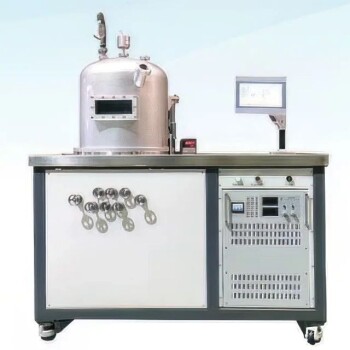
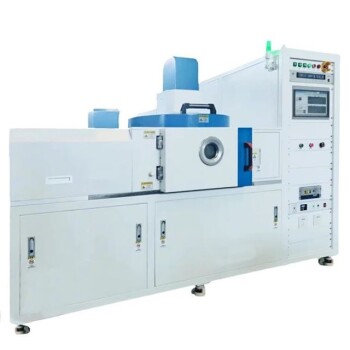
The fundamental distinction between a Rapid Thermal Annealing (RTA) system and a standard hotplate lies in the mechanism and velocity of heat transfer. While a hotplate relies on slower conductive heating through a substrate, an RTA system utilizes high-efficiency infrared lamps to ramp temperatures up and down within seconds. This difference fundamentally alters the crystallization kinetics of the perovskite film.
Core Takeaway By delivering precise, instantaneous thermal energy, RTA forces rapid nucleation and growth before volatile components can escape. This prevents the material decomposition common with prolonged hotplate exposure, resulting in higher crystallinity and superior device efficiency.
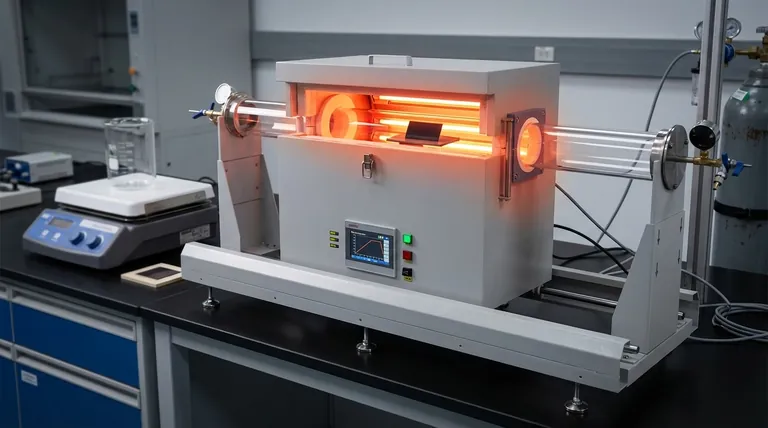
The Physics of Heating Velocity
Radiative vs. Conductive Energy
A standard hotplate transfers heat through conduction. This requires physical contact and results in a gradual thermal gradient as heat moves through the substrate to the film.
In contrast, an RTA system uses infrared lamps or similar high-efficiency sources. This radiative method heats the thin film directly and almost instantaneously, bypassing the thermal lag associated with conductive heating.
Time Scales and Ramp Rates
The defining characteristic of RTA is the speed of temperature change. It operates on a timescale of seconds to minutes.
Hotplates, conversely, involve prolonged exposure times. They require a "ramp-up" period that exposes the material to intermediate temperatures for longer durations, which can be detrimental to complex chemical structures.
Impact on Crystal Nucleation and Growth
Inducing Instantaneous Nucleation
The rapid heating rate of RTA induces a specific reaction in the material known as rapid nucleation.
Because the thermal energy is applied so quickly, the material is forced to nucleate immediately across the film. This contrasts with the slower, more heterogeneous nucleation often seen with the gradual heating of a hotplate.
Enhancing Crystallinity
This controlled thermal shock promotes the growth of larger, denser crystal grains.
Primary references indicate that this process significantly enhances overall crystallinity. A higher degree of crystallinity directly correlates to better charge transport and ultimately, higher device efficiency.
Preserving Chemical Composition
Controlling Volatility
Perovskite precursors often contain volatile components, such as methylamine.
When processed on a standard hotplate, the slow heating ramp provides a window of time for these components to volatilize and escape the film before the crystal structure forms.
Preventing Material Decomposition
RTA solves the volatility issue through speed. By crystallizing the film almost instantly, RTA locks the chemical components into the lattice structure.
This prevents the decomposition associated with prolonged high-temperature exposure. The result is a film that maintains its intended stoichiometry without the compositional deviations often caused by slow thermal processing.
Understanding the Trade-offs
Process Window and Control
While RTA offers superior film quality, it requires precise calibration. The heating rates are so fast (e.g., 5°C/s or higher) that there is little room for error.
Equipment Complexity
A standard hotplate is a simple, equilibrium-based tool. RTA is a non-equilibrium process requiring sophisticated control systems to manage the rapid ramp-up and cool-down phases effectively.
Making the Right Choice for Your Goal
To select the correct thermal processing method, consider your specific constraints regarding film composition and available equipment.
- If your primary focus is maximizing efficiency: Choose RTA to ensure high crystallinity and prevent the loss of volatile organic components like methylamine.
- If your primary focus is simplicity and low cost: Choose a standard hotplate, accepting that you may face challenges with grain size and compositional control.
- If your primary focus is preventing phase separation: Choose RTA, as the rapid ramp rate bypasses the temperature zones where phases are likely to separate or decompose.
RTA transforms heat from a simple drying mechanism into a precision tool for controlling crystal kinetics.
Summary Table:
| Feature | Rapid Thermal Annealing (RTA) | Standard Hotplate |
|---|---|---|
| Heating Mechanism | Radiative (Infrared Lamps) | Conductive (Surface Contact) |
| Ramp Rate | High (e.g., >5°C/second) | Low / Gradual |
| Processing Time | Seconds to Minutes | Minutes to Hours |
| Nucleation | Rapid & Uniform | Slow & Heterogeneous |
| Material Integrity | Prevents Volatile Component Loss | Risk of Decomposition |
| Primary Benefit | Superior Crystallinity & Efficiency | Cost-Effective & Simple |
Elevate Your Material Research with KINTEK Precision
Maximize your perovskite device efficiency and ensure perfect stoichiometry with our advanced thermal solutions. Backed by expert R&D and manufacturing, KINTEK offers Muffle, Tube, Rotary, Vacuum, CVD systems, and other lab high-temp furnaces, all customizable for unique needs. Whether you require the rapid heating velocity of an RTA-capable system or a highly stable furnace for controlled synthesis, our team is ready to assist.
Contact us today to find your custom thermal solution!
References
- Shengcong Wu, Peng Gao. Temperature Matters: Enhancing Performance and Stability of Perovskite Solar Cells through Advanced Annealing Methods. DOI: 10.3390/chemistry6010010
This article is also based on technical information from Kintek Furnace Knowledge Base .
Related Products
- HFCVD Machine System Equipment for Drawing Die Nano Diamond Coating
- Laboratory Quartz Tube Furnace RTP Heating Tubular Furnace
- RF PECVD System Radio Frequency Plasma Enhanced Chemical Vapor Deposition
People Also Ask
- What is Hot-filament Chemical Vapor Deposition (HFCVD)? Achieve High-Quality Thin Films with Precision Control
- What are the equipment for chemical vapor deposition? A Guide to the 5 Essential Components
- What is the significance of the vacuum pressure control system in the CVD coating process for powders?
- What is the function of high-purity Argon (Ar) gas during CVD? Optimize Your Thin Film Uniformity and Purity
- What are the advantages of using Chemical Vapor Deposition (CVD) for coating turbine blades? Enhance Life & Performance