
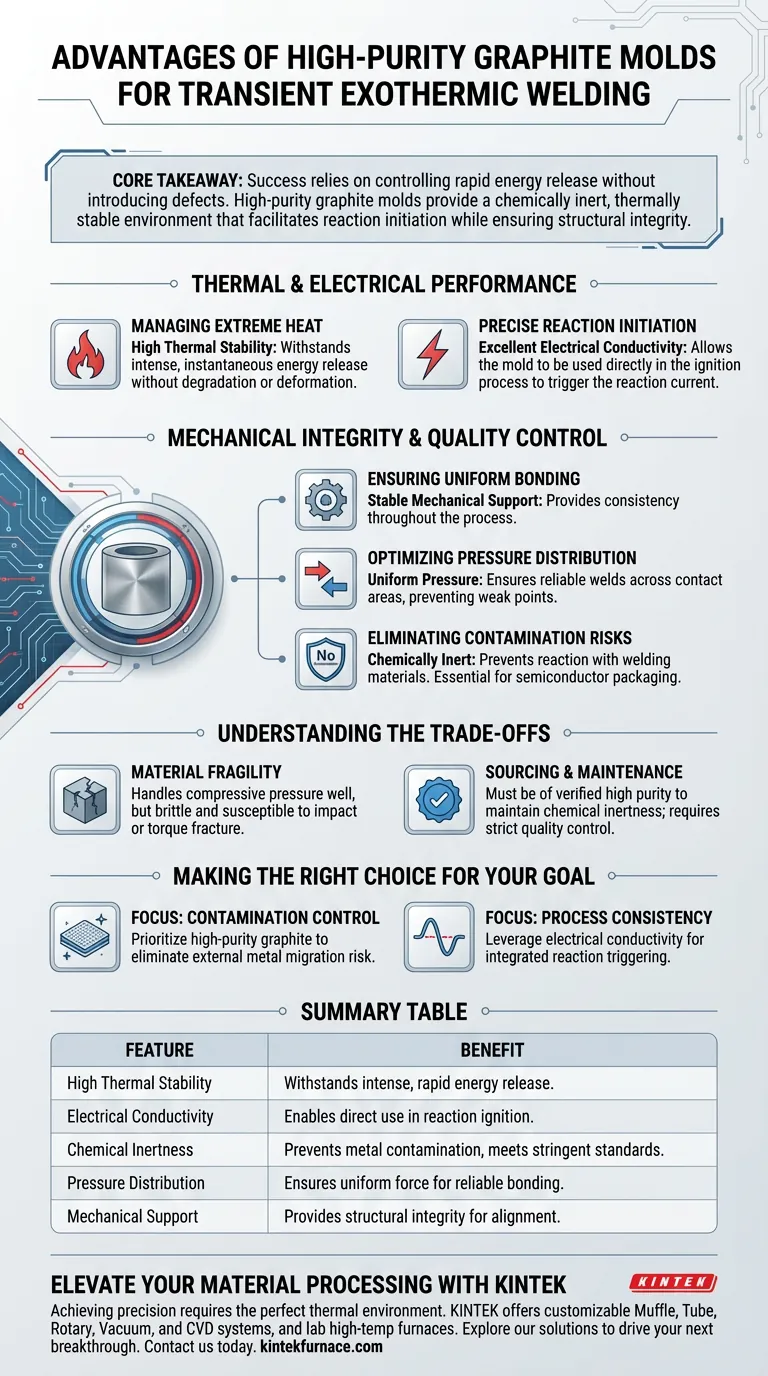
High-purity graphite molds offer a critical combination of thermal, electrical, and mechanical stability necessary for precise transient exothermic welding. They provide uniform pressure and mechanical support while conducting the current needed to trigger reactions. Crucially, their chemical inertness prevents contamination, making them indispensable for high-purity applications like semiconductor packaging.
Core Takeaway Success in transient exothermic welding relies on controlling rapid energy release without introducing defects. High-purity graphite molds solve this by offering a chemically inert, thermally stable environment that facilitates reaction initiation while ensuring structural integrity.

Thermal and Electrical Performance
Managing Extreme Heat
Exothermic reactions, such as those in Al/Ni multilayer films, release intense energy in a fraction of a second. Graphite molds possess high thermal stability, allowing them to withstand these instantaneous high temperatures without degrading or deforming.
Precise Reaction Initiation
Unlike insulating mold materials, graphite offers excellent electrical conductivity. This property allows the mold to be utilized directly in the ignition process, effectively helping to trigger the reaction current required to start the weld.
Mechanical Integrity and Quality Control
Ensuring Uniform Bonding
Consistency is paramount in welding micro-components. Graphite molds provide stable mechanical support throughout the process.
Optimizing Pressure Distribution
To achieve a reliable weld, the force applied to the materials must be consistent. Graphite ensures uniform pressure distribution across the contact area, preventing weak points or uneven bonding.
Eliminating Contamination Risks
In sensitive industries, foreign material can ruin a device. Graphite is chemically inert, meaning it does not react with the welding materials.
Suitability for Semiconductor Packaging
Because graphite ensures that no external metal contamination is introduced during the process, it meets the stringent cleanliness standards required for semiconductor packaging and other high-purity electronics.
Understanding the Trade-offs
Material Fragility
While graphite offers excellent thermal stability, it is mechanically different from steel or alloy molds. It acts more like a ceramic; while it handles compressive pressure well, it can be brittle and susceptible to fracture if subjected to impacts or torque outside of its design parameters.
Sourcing and Maintenance
To maintain the advantage of "no external metal contamination," the graphite itself must be of verified high purity. Using lower-grade graphite can negate the chemical inertness benefit, requiring strict quality control over the mold material itself.
Making the Right Choice for Your Goal
- If your primary focus is contamination control: Prioritize high-purity graphite to eliminate the risk of external metal migration into sensitive semiconductor components.
- If your primary focus is process consistency: Leverage graphite’s electrical conductivity to integrate reaction triggering directly into the mechanical support structure.
By utilizing high-purity graphite, you align the welding environment with the physics of the reaction, ensuring a defect-free, high-integrity bond.
Summary Table:
| Feature | Benefit for Exothermic Welding |
|---|---|
| High Thermal Stability | Withstands intense, rapid energy release without deformation or degradation. |
| Electrical Conductivity | Enables the mold to be utilized directly in the reaction ignition process. |
| Chemical Inertness | Prevents metal contamination, meeting stringent semiconductor packaging standards. |
| Pressure Distribution | Ensures uniform force across contact areas for reliable, defect-free bonding. |
| Mechanical Support | Provides the structural integrity needed to maintain alignment during reactions. |
Elevate Your Material Processing with KINTEK
Achieving precision in transient exothermic welding requires not only the right molds but also the perfect thermal environment. Backed by expert R&D and manufacturing, KINTEK offers a comprehensive range of Muffle, Tube, Rotary, Vacuum, and CVD systems, as well as other lab high-temp furnaces—all fully customizable to meet your unique experimental and production needs.
Whether you are working with sensitive semiconductor packaging or advanced multilayer films, our systems provide the stability and control necessary for high-integrity results. Contact us today to explore our solutions and see how our expertise can drive your next breakthrough.
Visual Guide
References
- Wafer Bonding Technologies for Microelectromechanical Systems and 3D ICs: Advances, Challenges, and Trends. DOI: 10.1002/adem.202500342
This article is also based on technical information from Kintek Furnace Knowledge Base .
Related Products
- 2200 ℃ Graphite Vacuum Heat Treat Furnace
- Magnesium Extraction and Purification Condensing Tube Furnace
People Also Ask
- Why are vacuum heat treating furnaces essential for aerospace? Ensure Superior Material Integrity for High-Stakes Applications
- What is the primary application of vacuum heat treating furnaces in aerospace? Enhance Component Performance with Precision
- How does a vacuum heat treating furnace improve the condition of metal alloys? Achieve Superior Metal Performance
- How does vacuum heat treating work in terms of temperature and time control? Master Precise Material Transformations
- What is the process of vacuum heat treating? Achieve Superior Metallurgical Properties

