
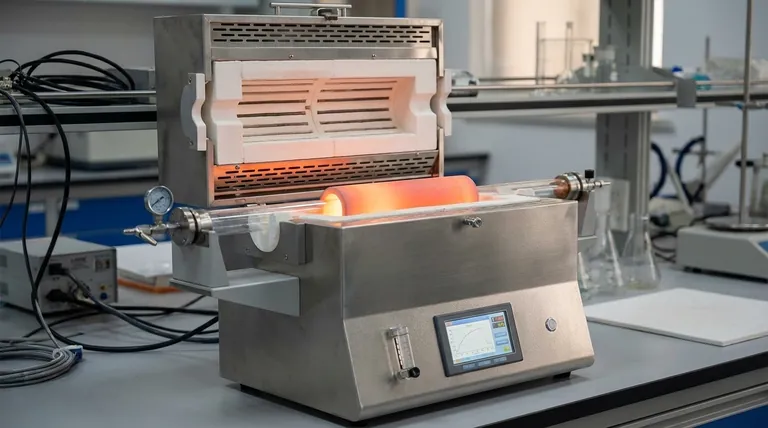
In short, high-purity alumina ceramic tubes can withstand extremely high operating temperatures, often up to 1800°C (3272°F). This exceptional thermal stability, combined with other key properties, makes them a default choice for some of the most demanding industrial furnace, laboratory, and processing applications.
The true value of alumina ceramic is not just its high melting point, but its ability to maintain structural integrity, chemical inertness, and electrical insulation simultaneously, even at extreme temperatures where most metals would fail.
What Determines High-Temperature Performance?
Understanding why alumina excels requires looking beyond a single temperature rating. Several interconnected thermal properties work together to ensure reliability in high-heat environments.
Maximum Service Temperature
The headline feature of a 99.7% or higher purity alumina tube is its maximum service temperature of 1800°C. This rating is crucial for applications like sintering, melting, and high-temperature material testing. It's essential to select a tube with a rating safely above your application's peak temperature.
Thermal Stability and Low Expansion
Alumina has a very low coefficient of linear thermal expansion, around 7.3 x10⁻⁶ mm/°C. This means it expands and contracts very little when heated or cooled, dramatically reducing internal stress and the risk of cracking during thermal cycles.
Thermal Conductivity
With a thermal conductivity of 16-23 W/(m·K), alumina is effective at distributing heat evenly across its surface. This property helps prevent "hot spots" that could otherwise lead to thermal stress and potential failure.
Resistance to Thermal Shock
Alumina is engineered to have good thermal shock resistance. This allows it to withstand relatively rapid changes in temperature without fracturing, a critical attribute in processes that involve quick heating or cooling phases.
Beyond Temperature: Critical Properties for Harsh Environments
In most high-temperature applications, heat is only part of the challenge. Alumina's performance is reinforced by its outstanding mechanical and chemical properties.
Mechanical Strength and Hardness
Even at elevated temperatures, alumina maintains high hardness and compressive strength. This ensures the tube does not sag, bend, or fail under mechanical loads, providing a stable structure for furnace elements or processing materials.
Chemical and Corrosion Resistance
Alumina is chemically inert and exhibits excellent corrosion resistance. It can withstand aggressive chemical environments, making it ideal for metallurgy, chemical processing, and semiconductor manufacturing where it may be exposed to corrosive gases or melts.
Electrical Insulation (Dielectric Strength)
Alumina is an exceptional electrical insulator, not a conductor. This dielectric property is vital for applications where the tube must isolate electrical heating elements or sensors from the surrounding environment, preventing short circuits at high temperatures.
Gas-Tight Integrity
High-purity alumina tubes are gas tight, meaning they are not permeable to gases. This is essential for creating a controlled vacuum or a protective atmosphere within a furnace, protecting sensitive materials from oxidation and contamination.
Understanding the Trade-offs and Considerations
While incredibly capable, alumina ceramic is not without its limitations. Understanding these trade-offs is key to successful implementation.
Purity Dictates Performance
The 1800°C temperature rating applies to high-purity (typically 99.7% or higher) alumina. Lower-purity grades are more common and less expensive, but their maximum service temperature will be significantly lower. Always verify the purity specification.
Brittleness is a Factor
Like all ceramics, alumina is brittle. While it has good thermal shock resistance for a ceramic, it can still fracture from severe mechanical impact or an extremely rapid, uncontrolled temperature change that exceeds its limits. Careful handling is required.
Difficult to Machine
Alumina is extremely hard, which contributes to its excellent wear resistance. However, this also makes it very difficult and costly to machine or modify after it has been sintered. Designs should be finalized before the tube is manufactured.
Making the Right Choice for Your Application
Selecting the right material requires matching its properties to your primary goal.
- If your primary focus is a maximum-temperature furnace: Prioritize a high-purity (99.7%+) alumina tube to achieve the 1800°C rating and ensure gas-tight integrity for atmosphere control.
- If your primary focus is aggressive chemical processing: Leverage alumina's superior corrosion resistance and thermal stability to ensure longevity and prevent contamination.
- If your primary focus is high-voltage electrical insulation at high heat: Rely on alumina's high dielectric strength and mechanical rigidity to provide safe and stable electrical isolation.
Ultimately, alumina's unique combination of properties makes it one of the most reliable and versatile materials available for high-performance thermal applications.
Summary Table:
| Property | Value / Description |
|---|---|
| Maximum Service Temperature | Up to 1800°C (3272°F) for high-purity alumina |
| Thermal Expansion Coefficient | ~7.3 x10⁻⁶ mm/°C (low expansion) |
| Thermal Conductivity | 16-23 W/(m·K) (even heat distribution) |
| Key Benefits | Thermal shock resistance, chemical inertness, electrical insulation, gas-tight integrity |
| Common Applications | Sintering, melting, material testing, semiconductor processing |
Upgrade your high-temperature processes with KINTEK's precision furnace solutions! Leveraging exceptional R&D and in-house manufacturing, we provide diverse laboratories with advanced high-temperature furnaces like Muffle, Tube, Rotary, Vacuum & Atmosphere Furnaces, and CVD/PECVD Systems. Our strong deep customization capability ensures we meet your unique experimental needs, enhancing efficiency and reliability. Contact us today to discuss how our tailored solutions can benefit your application!
Visual Guide

Related Products
- 1400℃ High Temperature Laboratory Tube Furnace with Alumina Tube
- 1700℃ High Temperature Laboratory Tube Furnace with Alumina Tube
- Dental Porcelain Zirconia Sintering Ceramic Vacuum Press Furnace
People Also Ask
- How do high-temperature laboratory tube furnaces ensure environmental stability? Precision Thermal Reduction Tips
- How are high-temperature laboratory tube furnaces applied in long-term vacuum homogenization heat treatments for intermetallic samples?
- How are high-temperature tube furnaces applied in testing ceramic-supported alloy membranes? Insights
- How does a laboratory high-temperature tube furnace contribute to the conversion of electrospun fibers? Expert Insights
- What is the function of a furnace in CuAlMn alloy treatment? Achieve Perfect Microstructural Homogenization


