
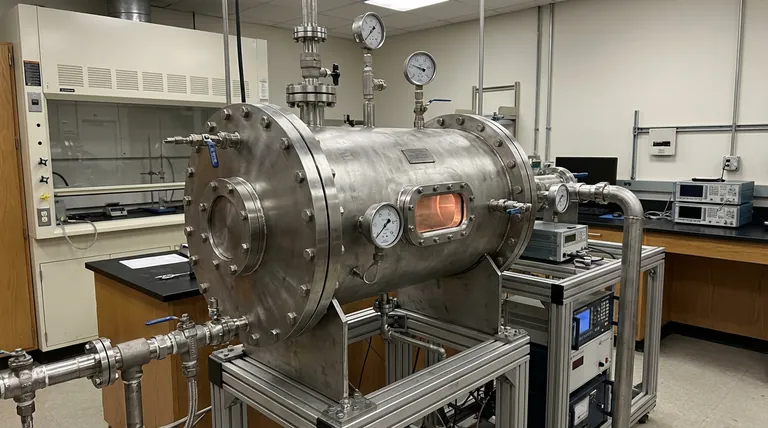
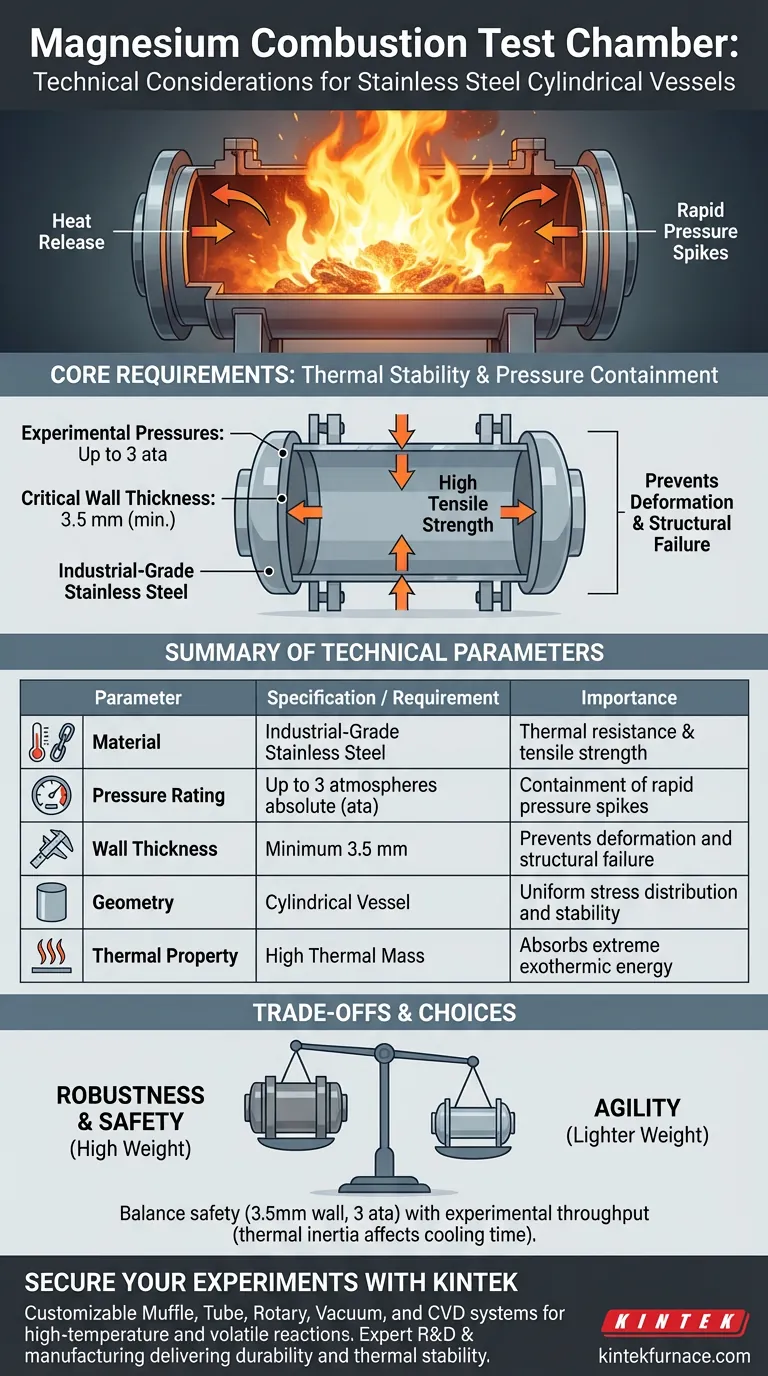
Selecting the right test chamber for magnesium combustion requires prioritizing thermal stability and pressure containment. For this application, an industrial-grade stainless steel cylindrical vessel is essential to withstand the intense exothermic reaction and experimental pressures up to 3 atmospheres absolute (ata), typically necessitating a wall thickness of approximately 3.5 mm to ensure safety.
Magnesium combustion generates violent heat and significant pressure spikes, rendering standard laboratory glassware or softer metals unsafe. The critical requirement is a stainless steel construction with specific geometric reinforcement—such as a 3.5 mm wall thickness—to maintain structural integrity and a stable internal environment under loads up to 3 ata.
Material Properties and Durability
High-Temperature Resistance
Magnesium combustion releases a tremendous amount of energy in the form of heat. The vessel must be constructed from industrial-grade stainless steel to absorb and dissipate this thermal load without warping or losing structural strength.
Pressure Containment Capabilities
The combustion process can rapidly increase internal pressure. The vessel must be rated to handle experimental pressures of at least 3 ata.
Stainless steel provides the high tensile strength necessary to contain these pressure spikes without the risk of rupture, protecting both the operator and the experiment.
Geometric and Structural Design
Critical Wall Thickness
The geometry of the cylinder is just as important as the material itself. To ensure the vessel does not deform under the combined stress of heat and 3 ata pressure, a wall thickness of 3.5 mm is recommended.
This specific thickness creates a safety factor that prevents catastrophic failure during the violent reaction phases.
Controlled Internal Volume
Beyond safety, the vessel design impacts data quality. A controlled internal volume helps maintain a stable environment around the sample.
This stability is crucial for ensuring that the combustion characteristics observed are a result of the fuel properties, not fluctuations in the test environment.
Understanding the Trade-offs
Weight and Portability
The requirement for industrial-grade steel and a 3.5 mm wall thickness significantly increases the weight of the apparatus. This makes the vessel robust but potentially difficult to move or reconfigure compared to lighter, less durable alternatives.
Thermal Inertia
While thick stainless steel protects against structural failure, it also has high thermal mass. The vessel may take longer to cool down after a test, potentially increasing the turnaround time between experimental runs.
Making the Right Choice for Your Project
When finalizing your vessel specifications, balance your safety requirements with your experimental throughput needs.
- If your primary focus is personnel safety: Prioritize the 3.5 mm wall thickness and pressure rating to ensure total containment of the reaction up to 3 ata.
- If your primary focus is experimental consistency: Ensure the internal volume is precisely machined and controlled to maintain a stable environment during combustion.
Select your vessel specs not just for the average operating conditions, but for the peak stress of the reaction.
Summary Table:
| Technical Parameter | Specification / Requirement | Importance in Combustion |
|---|---|---|
| Material | Industrial-Grade Stainless Steel | Thermal resistance & tensile strength |
| Pressure Rating | Up to 3 atmospheres absolute (ata) | Containment of rapid pressure spikes |
| Wall Thickness | Minimum 3.5 mm | Prevents deformation and structural failure |
| Geometry | Cylindrical Vessel | Uniform stress distribution and stability |
| Thermal Property | High Thermal Mass | Absorbs extreme exothermic energy |
Secure Your High-Temperature Experiments with KINTEK
Don't compromise on safety when dealing with volatile reactions like magnesium combustion. Backed by expert R&D and manufacturing, KINTEK offers a wide range of Muffle, Tube, Rotary, Vacuum, and CVD systems, all of which are fully customizable to meet your specific wall thickness and pressure containment needs.
Whether you require a custom stainless steel cylindrical vessel or a high-precision lab furnace, our team delivers the durability and thermal stability your research demands. Contact us today to discuss your unique project requirements and see how our advanced engineering can support your lab's success.
Visual Guide
References
- Ioan Barabulica, Ioan Mămăligă. Experimental Study on the Reaction of Magnesium in Carbon Dioxide and Nitrogen Atmosphere. DOI: 10.3390/chemengineering8020041
This article is also based on technical information from Kintek Furnace Knowledge Base .
Related Products
People Also Ask
- What are the advantages of using a condensing tube furnace for magnesium extraction? Achieve High Purity and Efficient Metal Recovery
- How do advanced control systems enhance the operation of a tube furnace? Boost Precision and Efficiency in Thermal Processing
- Why is temperature range important when choosing a tube furnace? It Dictates Cost, Materials, and Performance
- What are the differences between solid tube and split type tube furnaces? Choose the Right Furnace for Your Lab
- What function does a tube furnace serve in the PVT growth of J-aggregate molecular crystals? Mastery of Thermal Control
