
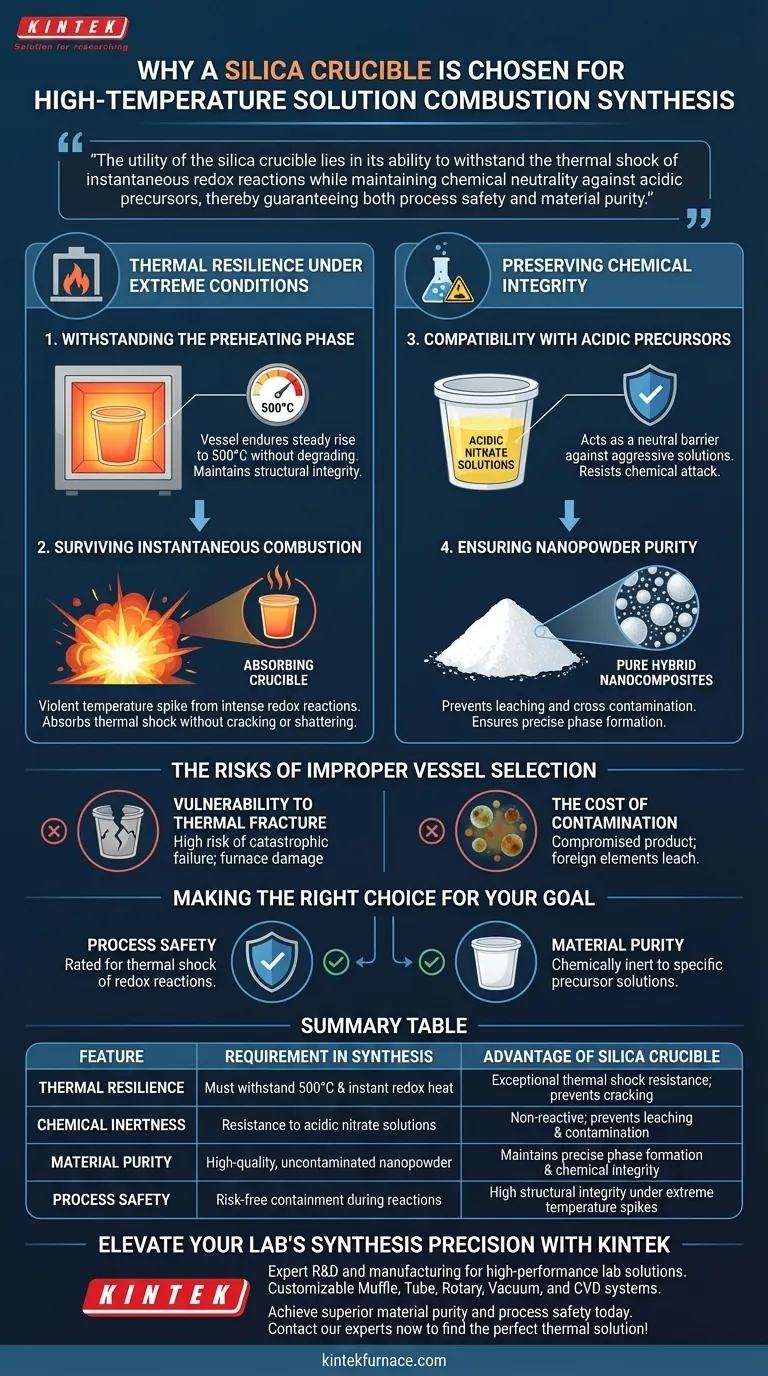
The selection of a silica crucible is a critical decision driven by the need for exceptional thermal shock resistance and strict chemical inertness during the synthesis process. High-temperature solution combustion involves a preheating phase of 500°C followed by immediate, intense heat generation, creating a thermal environment that would fracture standard laboratory vessels. Additionally, silica remains non-reactive in the presence of acidic nitrate solutions, ensuring the final hybrid nanocomposite remains free from container-leached contaminants.
The utility of the silica crucible lies in its ability to withstand the thermal shock of instantaneous redox reactions while maintaining chemical neutrality against acidic precursors, thereby guaranteeing both process safety and material purity.
Thermal Resilience Under Extreme Conditions
Withstanding the Preheating Phase
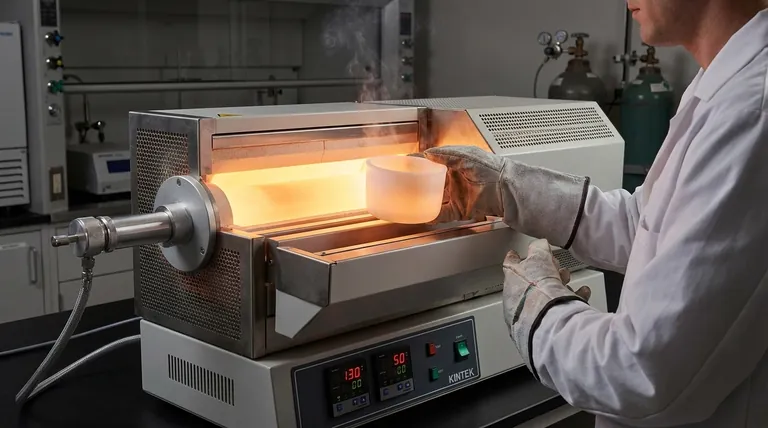
The synthesis process begins with a demanding preheating stage inside a muffle furnace. The vessel must endure a steady rise to 500°C without degrading. Silica is uniquely suited to maintain structural integrity during this initial high-temperature soak.
Surviving Instantaneous Combustion
Once the reaction triggers, the environment shifts from high heat to an instantaneous combustion event. This generates a violent spike in temperature caused by intense redox reactions. Silica possesses the specific physical properties required to absorb this thermal shock without cracking or shattering.
Preserving Chemical Integrity
Compatibility with Acidic Precursors
Solution combustion synthesis frequently relies on acidic nitrate solutions as precursors. Many containment materials react with acids, which can introduce foreign elements into the solution. Silica acts as a neutral barrier, resisting chemical attack from these aggressive solutions.
Ensuring Nanopowder Purity
The ultimate goal of this synthesis is the creation of high-quality hybrid nanocomposites. Because silica does not leach into the reaction mixture, it prevents cross-contamination. This ensures the resulting nanopowders retain the precise phase formation and purity intended by the experimental design.
The Risks of Improper Vessel Selection
While silica is the ideal choice, understanding why it is selected highlights the risks (or trade-offs) of using alternative materials.
Vulnerability to Thermal Fracture
Using vessels with lower thermal shock resistance than silica creates a high risk of catastrophic failure. The rapid transition from preheating to combustion can cause standard ceramics or glass to shatter, ruining the sample and potentially damaging the furnace.
The Cost of Contamination
If a reaction vessel is not chemically inert to nitrates, the "trade-off" is a compromised product. Reaction between the vessel wall and the solution introduces impurities that alter the properties of the final nanocomposite, rendering the synthesis ineffective for high-precision applications.
Making the Right Choice for Your Goal
To ensure the success of your high-temperature synthesis, evaluate your priorities against the capabilities of your equipment.
- If your primary focus is Process Safety: Ensure your crucible is rated specifically for the thermal shock of redox reactions, not just the static temperature of the furnace.
- If your primary focus is Material Purity: Verify that your reaction vessel is chemically inert to your specific precursor solution (specifically acidic nitrates) to prevent leaching.
By leveraging the thermal and chemical stability of silica, you ensure a safe synthesis process that yields a pure, high-performance nanocomposite.
Summary Table:
| Feature | Requirement in Synthesis | Advantage of Silica Crucible |
|---|---|---|
| Thermal Resilience | Must withstand 500°C preheating and instant redox heat | Exceptional thermal shock resistance; prevents cracking |
| Chemical Inertness | Resistance to acidic nitrate precursor solutions | Non-reactive; prevents leaching and contamination |
| Material Purity | High-quality, uncontaminated nanopowder production | Maintains precise phase formation and chemical integrity |
| Process Safety | Risk-free containment during violent reactions | High structural integrity under extreme temperature spikes |
Elevate Your Lab's Synthesis Precision with KINTEK
Don't let vessel failure or contamination compromise your research. KINTEK provides high-performance lab solutions backed by expert R&D and manufacturing. Whether you need specialized crucibles or advanced Muffle, Tube, Rotary, Vacuum, or CVD systems, our high-temperature furnaces are fully customizable to meet your unique experimental needs.
Achieve superior material purity and process safety today. Contact our experts now to find the perfect thermal solution for your lab!
Visual Guide
References
- A. Naveen Kumar, Nithesh Naik. Solution combustion synthesis of ZnO doped CuO nanocomposite for photocatalytic and sensor applications. DOI: 10.1038/s41598-024-82764-2
This article is also based on technical information from Kintek Furnace Knowledge Base .
Related Products
People Also Ask
- What is the primary function of a high-temperature laboratory muffle furnace in chemical synthesis? Achieve Precision.
- How does a high-temperature laboratory muffle furnace affect material properties? Transform Anodic Oxide Films Fast
- How is a laboratory high-temperature muffle furnace utilized to achieve the specific crystalline structure of LaFeO3 catalysts?
- How is a laboratory high-temperature muffle furnace utilized in g-C3N4 synthesis? Optimize Your Thermal Polycondensation
- What is the purpose of using a laboratory high-temperature muffle furnace for drying Fe-Ni-Co catalysts? Boost Purity
