
The Solid Oxygen-ion Membrane (SOM) method enhances purity through precise physical isolation. By utilizing a solid electrolyte tube—typically made of zirconia—to separate the anode from the molten salt electrolyte, the system creates a highly selective barrier. This barrier permits only oxygen ions to migrate to the anode while blocking other anions, effectively preventing cross-contamination and the formation of impurities in the final titanium alloy.
The SOM method replaces the open electrolytic environment with a closed, selective system. By isolating the anode behind an oxygen-permeable membrane, it eliminates the cross-contamination pathway common in other methods, ensuring a significantly higher purity titanium alloy.
The Mechanism of Anodic Isolation
To understand the purity advantage, one must look at how the SOM method restructures the electrolytic cell.
The Zirconia Barrier
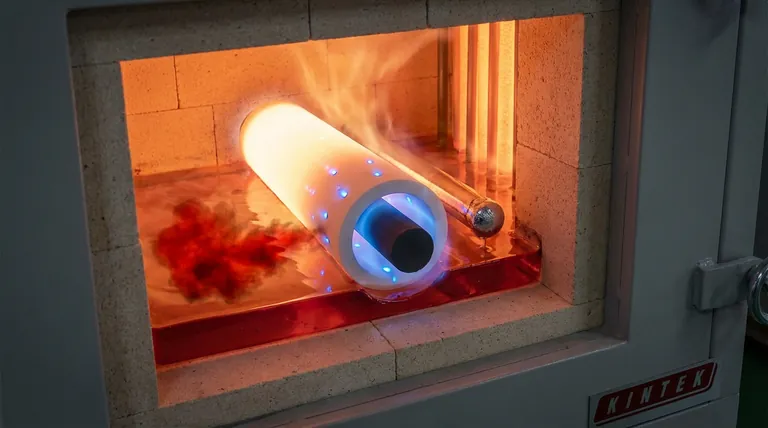
The core innovation is the introduction of a solid oxygen-ion conducting membrane tube. This component creates a physical wall between the anode (composed of metal or carbon) and the molten salt electrolyte.
Selective Ion Migration
This membrane is not merely a separator; it is an active filter. It is engineered to allow only oxygen ions to migrate through its structure to reach the anode. This selectivity is the primary driver of the method's efficiency.
Blocking Unwanted Anions
Because the membrane is selective, it physically blocks other anions present in the molten salt from reaching the anode. In standard processes without this tube, these anions would discharge freely, initiating unwanted chemical reactions.
Preventing Chemical Contamination
The isolation provided by the SOM tube directly addresses the chemical byproducts that degrade titanium purity.
Eliminating Harmful Gas Production
In non-isolated systems, the discharge of various anions often results in the production of harmful gases, such as chlorine. By blocking these anions from the anode, the SOM method effectively stops the generation of these hazardous byproducts.
Breaking the Contamination Cycle
A major issue in titanium electrolysis is the migration of anode impurities back toward the cathode. This "back-migration" re-contaminates the titanium being produced.
Ensuring Cathode Purity
The SOM tube acts as a one-way street for oxygen removal. It physically isolates the anode byproducts, making it impossible for them to drift back into the molten salt and contaminate the cathode product.
Understanding the Trade-offs
While the SOM method offers superior purity, the reliance on the solid electrolyte tube introduces specific operational considerations.
Reliance on Membrane Integrity
The entire purification process hinges on the structural integrity of the zirconia tube. If the membrane cracks or degrades, the isolation is lost, and the system reverts to a mixed electrolytic state, compromising purity.
Material Selectivity Limitations
The efficiency of the process is strictly limited by the membrane's conductivity. The tube must maintain high selectivity for oxygen ions over long durations; any material failure leads to immediate process contamination.
Making the Right Choice for Your Goal
The decision to utilize the SOM method largely depends on your tolerance for impurities and your environmental safety requirements.
- If your primary focus is Maximum Alloy Purity: The SOM method is superior because it physically prevents anode impurities from re-contaminating the titanium product.
- If your primary focus is Environmental Safety: The SOM method is ideal as it blocks the discharge of anions that create harmful gases like chlorine.
The SOM method fundamentally upgrades titanium extraction from a mixed chemical bath to a controlled, selective process, guaranteeing a cleaner and safer production cycle.
Summary Table:
| Feature | SOM Method (Solid Electrolyte Tube) | FFC / Standard Electrolysis |
|---|---|---|
| Anode Isolation | Physical barrier (Zirconia tube) | Open electrolytic environment |
| Ion Selectivity | Highly selective for oxygen ions | Non-selective anion migration |
| Contamination Risk | Low (prevents impurity back-migration) | High (anode byproducts reach cathode) |
| Byproduct Control | Blocks harmful gas formation (e.g., Chlorine) | Generates hazardous gas byproducts |
| Key Outcome | Superior purity titanium alloys | Potential for chemical cross-contamination |
Elevate your material processing with KINTEK’s advanced thermal technology. Backed by expert R&D and manufacturing, KINTEK offers high-precision Muffle, Tube, and Vacuum systems customizable for complex metallurgical processes like titanium extraction. Ensure the integrity of your research and production with our specialized high-temp furnaces—contact our experts today to find your perfect solution!
References
- Yuhang Miao, Jinming Hu. Research Progress of Preparing Titanium Alloy By Molten Salt Method. DOI: 10.62051/ijnres.v2n1.30
This article is also based on technical information from Kintek Furnace Knowledge Base .
Related Products
- Custom Made Versatile CVD Tube Furnace Chemical Vapor Deposition CVD Equipment Machine
- Multi Heating Zones CVD Tube Furnace Machine for Chemical Vapor Deposition Equipment
- Multi Zone Laboratory Quartz Tube Furnace Tubular Furnace
- Split Chamber CVD Tube Furnace with Vacuum Station CVD Machine
- Chairside Dental Porcelain Zirconia Sintering Furnace with Transformer for Ceramic Restorations
People Also Ask
- Why are CVD tube furnace sintering systems indispensable for 2D material research and production? Unlock Atomic-Scale Precision
- What is a CVD tube furnace and what is its primary function? Discover Precision Thin-Film Deposition
- Which industries and research fields benefit from CVD tube furnace sintering systems for 2D materials? Unlock Next-Gen Tech Innovations
- How does CVD tube furnace sintering enhance graphene growth? Achieve Superior Crystallinity and High Electron Mobility
- What are the practical applications of gate media prepared by CVD tube furnaces? Unlock Advanced Electronics and More
















