
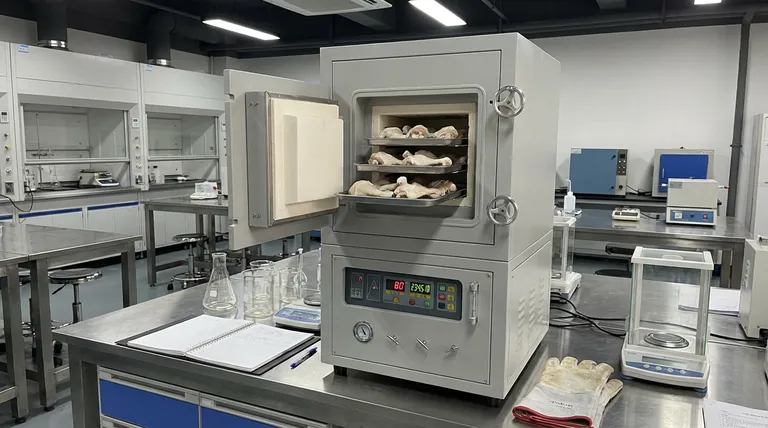
A laboratory oven functions as a critical dehydration unit during the pre-treatment of chicken bone waste for pyrolysis. Its primary purpose is to drastically reduce the high moisture content inherent in animal waste—which ranges from 74% to 90%—by subjecting cleaned bones to a consistent temperature, typically 80°C, for a duration of 24 hours.
Core Takeaway Direct pyrolysis of wet biomass is thermally inefficient and chemically unstable. Dehydrating chicken bones in a laboratory oven serves as a mandatory control step to prevent excessive steam generation, thereby maximizing thermal conversion efficiency and ensuring a consistent, high-quality final product.
The Necessity of Moisture Removal
The Challenge of Wet Feedstock
Chicken bone waste is not naturally ready for thermal decomposition.
According to the data, raw animal waste possesses a moisture content between 74% and 90%. Introducing material with this level of water saturation directly into a reactor creates significant thermal hurdles.
The Dehydration Protocol
To address this, the laboratory oven provides a controlled environment for drying.
The standard protocol involves heating cleaned bones at 80°C for approximately 24 hours. This specific duration and temperature are sufficient to evaporate water without initiating the chemical decomposition of the bone material itself.
Impact on Thermal Efficiency
Preventing Steam Interference
If moisture is not removed prior to pyrolysis, the water inside the bones will flash into steam inside the furnace.
Excessive steam generation disrupts the internal environment of the reactor. This steam acts as a diluent, potentially altering the pressure and interfering with the desired chemical reactions.
Maximizing Energy Utilization
Using the oven for pre-treatment optimizes the energy balance of the entire system.
By removing water beforehand, the energy supplied to the pyrolysis furnace is used strictly for thermal conversion (breaking chemical bonds) rather than wasted on the phase change of boiling water. This leads to significantly higher overall efficiency.
Ensuring Product Quality
Stabilizing the Final Output
Pre-treatment is not just about efficiency; it is about the integrity of the output.
Reducing moisture ensures the quality and stability of the final pyrolysis products (biochar, bio-oil, and syngas). Lower moisture levels prevent inconsistent reaction rates that lead to variable product compositions.
Establishing a Uniform Baseline
While the primary goal is dehydration, this step also standardizes the feedstock.
Much like drying plant biomass ensures accurate analysis, drying bones creates a uniform experimental baseline. This consistency allows operators to attribute variations in the final product to process parameters, rather than fluctuations in the water content of the raw waste.
Understanding the Trade-offs
Time and Throughput Constraints
While technically beneficial, oven drying is a time-intensive batch process.
Requiring a 24-hour drying period creates a bottleneck in the production line. In a high-throughput industrial setting, this waiting period must be accounted for in the operational schedule.
Energy Displacement
It is important to note that energy is not "saved" in absolute terms; it is displaced.
You are expending energy in the oven to save energy in the furnace. However, this is generally advantageous because laboratory ovens are more efficient at evaporating water at low temperatures (80°C) than high-temperature pyrolysis reactors are at managing phase changes.
Making the Right Choice for Your Project
The use of a laboratory oven is a calculated step to ensure process control.
- If your primary focus is Thermal Efficiency: Prioritize thorough pre-drying to ensure your main reactor energy is consumed solely by the pyrolysis reaction, not water evaporation.
- If your primary focus is Product Consistency: Adhere strictly to the 24-hour drying protocol to eliminate moisture as a variable, ensuring reproducible results across different batches.
Effective pyrolysis begins with a stable, dry feedstock.
Summary Table:
| Parameter | Typical Value | Impact on Pyrolysis |
|---|---|---|
| Initial Moisture Content | 74% - 90% | Reduces thermal efficiency & creates unstable reactions |
| Drying Temperature | 80°C | Evaporates water without premature chemical decomposition |
| Drying Duration | 24 Hours | Ensures uniform baseline & maximum dehydration |
| Core Benefit | Dehydration | Prevents excessive steam & maximizes energy for conversion |
| Final Output Impact | High Stability | Results in consistent quality biochar, bio-oil, and syngas |
Optimize Your Pyrolysis Research with KINTEK
Don't let moisture compromise your thermal efficiency or product quality. KINTEK provides high-precision laboratory ovens and advanced heating systems designed for the rigorous pre-treatment demands of biomass research.
Backed by expert R&D and manufacturing, we offer a comprehensive range of Muffle, Tube, Rotary, Vacuum, and CVD systems, all fully customizable to your specific laboratory requirements. Whether you are processing animal waste or advanced materials, our equipment ensures the stable, dry feedstock necessary for reproducible results.
Ready to elevate your thermal conversion process? Contact us today to discuss your custom furnace needs!
References
- Mircea Gabriel Macavei, Aneta Magdziarz. Thermochemical Conversion of Animal-Derived Waste: A Mini-Review with a Focus on Chicken Bone Waste. DOI: 10.3390/pr12020358
This article is also based on technical information from Kintek Furnace Knowledge Base .
Related Products
- Laboratory Muffle Oven Furnace with Bottom Lifting
- 1200℃ Muffle Oven Furnace for Laboratory
- 1400℃ Muffle Oven Furnace for Laboratory
- 1800℃ High Temperature Muffle Oven Furnace for Laboratory
- 1700℃ High Temperature Muffle Oven Furnace for Laboratory
People Also Ask
- What is the importance of the calcination process? Master High-Purity Calcium Phosphate Nanopowder Production
- Why is a high-temperature muffle furnace required for FeOx-MOx/TiO2? Engineering High-Performance Nanocomposites
- Why is a high-temperature laboratory muffle furnace essential for the alkali fusion process in zeolite synthesis?
- What function does a muffle furnace perform in Ba0.75Ca0.25TiO3 calcination? Ensure Phase Purity & Synthesis
- What are the primary functions of a high-temperature laboratory muffle furnace in the preparation of biosorbent materials?

















