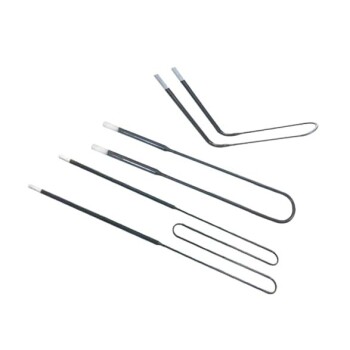
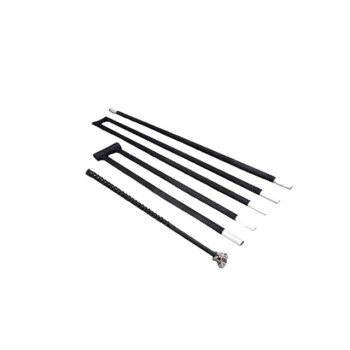
Molybdenum-disilicide heating elements offer a critical advantage in aluminum alloy processing by providing a high-power heat source capable of achieving rapid heating rates, such as 32 degrees Celsius per minute. This efficiency drastically reduces the time required to bring samples to target temperatures between 610 and 760 degrees Celsius. By minimizing the duration of the uncontrolled heating phase, these elements prevent unintended volatile loss and enable the precise analysis of evaporation reaction orders.
By condensing the heating timeline, molybdenum-disilicide elements eliminate the variables associated with slow thermal ramp-ups, ensuring that chemical reactions are measured only when the system has reached stability.
The Mechanics of Rapid Heating Efficiency
Achieving High-Velocity Thermal Ramps
The primary mechanical advantage of molybdenum-disilicide elements is their ability to generate intense thermal energy quickly.
In industrial refining simulations, this capability allows for heating rates as high as 32 degrees Celsius per minute.
Reducing Time to Target Temperature
This rapid ramp rate is essential for quickly reaching the specific processing window for aluminum alloys.
The elements efficiently drive the furnace to target temperatures ranging from 610 to 760 degrees Celsius, significantly cutting the overall process time compared to conventional heating methods.
Impact on Process Control and Analysis
Minimizing the Uncontrolled Phase
Every heating process involves an "uncontrolled heating phase" before the target temperature is stabilized.
Molybdenum-disilicide elements shorten this phase, reducing the window of time where the sample is exposed to rising temperatures without precise regulation.
Preventing Material Loss
Extended exposure to heat during a slow ramp-up can lead to the unintended loss of volatiles from the aluminum alloy.
By accelerating the heating phase, these elements preserve sample integrity, ensuring that the material composition remains consistent until the experiment begins in earnest.
Enhancing Analytical Precision
The stability provided by rapid heating is crucial for determining accurate chemical data.
Specifically, it allows for a more reliable analysis of evaporation reaction orders, as the data is not corrupted by pre-target temperature fluctuations.
The Cost of Slow Heating (Trade-offs)
The Risk of Data Corruption
While standard heating elements may be sufficient for general applications, they introduce a distinct disadvantage in high-precision analysis.
Slower heating extends the duration of the uncontrolled phase, which increases the probability of chemical variance before the simulation officially starts.
Compromising Reaction Order Accuracy
If the heating phase is too slow, the evaporation reactions typically measured at the target temperature may begin prematurely or inconsistently.
This makes it difficult to isolate the specific reaction orders required for accurate industrial refining simulations.
Optimizing Your Heating Strategy
To determine if molybdenum-disilicide elements are the right choice for your specific application, consider your primary operational goals.
- If your primary focus is process efficiency: Utilizing these elements will significantly reduce cycle times by achieving heating rates of 32 degrees Celsius per minute.
- If your primary focus is analytical accuracy: The rapid heating capability is essential to prevent volatile loss and ensure the validity of your evaporation reaction order data.
Ultimately, using high-performance heating elements transforms the heating phase from a variable liability into a controlled constant.
Summary Table:
| Feature | Benefit in Aluminum Processing |
|---|---|
| Rapid Heating Rate | Reaches up to 32°C per minute, cutting cycle times significantly. |
| Temperature Window | Efficiently targets the critical 610°C to 760°C processing range. |
| Phase Control | Minimizes the 'uncontrolled heating phase' to preserve sample integrity. |
| Material Preservation | Prevents unintended volatile loss during thermal ramp-ups. |
| Data Accuracy | Enables precise measurement of evaporation reaction orders. |
Elevate Your Thermal Processing Precision with KINTEK
Maximize your laboratory efficiency and analytical accuracy with our advanced heating solutions. Backed by expert R&D and world-class manufacturing, KINTEK provides high-performance Muffle, Tube, Rotary, Vacuum, and CVD systems, all featuring customizable configurations—including high-power molybdenum-disilicide elements—tailored to your unique aluminum alloy processing needs.
Don't let slow heating rates compromise your data integrity. Contact KINTEK today to discuss your custom furnace requirements and transform your heating phase into a controlled constant.
Visual Guide

References
- Aleksandar M. Mitrašinović, Milinko Radosavljević. Modeling of Impurities Evaporation Reaction Order in Aluminum Alloys by the Parametric Fitting of the Logistic Function. DOI: 10.3390/ma17030728
This article is also based on technical information from Kintek Furnace Knowledge Base .
Related Products
- Molybdenum Disilicide MoSi2 Thermal Heating Elements for Electric Furnace
- Molybdenum Vacuum Heat Treat Furnace
- Vacuum Heat Treat Sintering Furnace Molybdenum Wire Vacuum Sintering Furnace
- Silicon Carbide SiC Thermal Heating Elements for Electric Furnace
- 1400℃ Muffle Oven Furnace for Laboratory
People Also Ask
- What are the typical application temperatures for molybdenum disilicide (MoSi2) heating elements? Master High-Temp Performance
- What is the primary use of molybdenum disilicide? Ideal for High-Temp Heating Elements
- What are the characteristics of molybdenum disilicide heating elements? Unlock High-Temp Performance
- What are the properties of molybdenum disilicide (MoSi2) that make it suitable for high-temperature applications? Discover Its High-Temp Resilience
- What are the applications of molybdenum disilicide heating elements? Achieve Extreme Heat Stability for Industrial Processes