
The selection of high-purity ceramic crucibles is a critical variable in manufacturing optical glass phantoms. These vessels provide the necessary thermal stability and chemical inertness required during the secondary sintering process. By ensuring a stable heat conduction environment, the crucible allows glass powder to be processed precisely near its softening point, facilitating the creation of the internal microstructures needed to simulate human tissue.
The crucible is not merely a container; it is an active component of the thermal control system. Its primary function is to maintain a stable environment that fosters the growth of specific scattering centers—air cavities and crystals—without introducing chemical contaminants that would skew the phantom's optical properties.
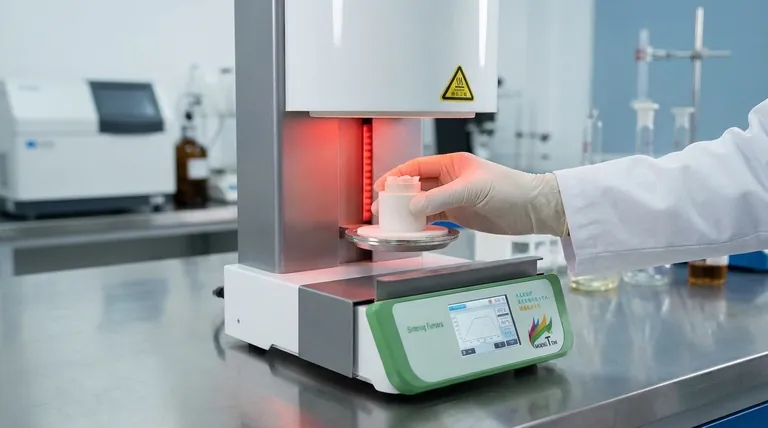
The Physics of Tissue Simulation
To understand the value of the crucible, you must understand the goal of the process: creating a material that mimics the light-scattering behavior of biological tissue.
Controlled Sintering Near the Softening Point
The manufacturing process often involves a secondary sintering phase at temperatures around 650°C.
At this specific thermal range, the glass powder is brought close to its softening point. High-purity ceramic crucibles provide the thermal stability requisite to hold this temperature precisely, preventing the glass from fully melting into a homogeneous block or failing to bond.
Formation of Scattering Centers
The ultimate goal of this controlled heating is the formation of scattering centers.
Because the crucible facilitates a stable heat conduction environment, the glass powder generates small air-filled cavities and in-situ crystals. These microstructures act as the physical mechanism that scatters light, simulating the optical complexity of human tissue.
The Role of Material Purity
Beyond thermal control, the chemical composition of the crucible dictates the integrity of the final product.
Chemical Inertness
High-purity crucibles, particularly those made of alumina, are prized for their chemical stability.
During sintering, molten or semi-molten glass is highly reactive. A high-purity crucible ensures that the container does not react with the mineral samples, preventing foreign elements from leaching into the glass and altering its refractive index or density.
Preventing Data Contamination
In analytical contexts like Thermogravimetric-Differential Scanning Calorimetry (TG-DSC), this inertness is vital.
It ensures that any thermal data collected reflects only the heat changes of the sintering material itself. This guarantees that the resulting phantom properties are purely a result of the glass formulation and the sintering schedule, free from interference or contamination from the container.
Understanding the Trade-offs
While high-purity ceramic crucibles are superior for precision applications, they require specific handling protocols.
Thermal Shock Sensitivity
Ceramics are generally susceptible to rapid temperature changes.
While they possess excellent heat resistance—often withstanding temperatures exceeding 1450°C—rapid heating or cooling can cause fracturing. The sintering ramp rates must be carefully calculated not just for the glass, but to preserve the integrity of the crucible.
Cost vs. Criticality
High-purity materials represent a higher consumable cost.
If the application does not require precise optical scattering—for example, a simple structural glass component—standard crucibles may suffice. However, for medical phantoms where scattering coefficient accuracy is paramount, the investment in high-purity ceramics is non-negotiable.
Making the Right Choice for Your Goal
The type of crucible you select should align with the specific fidelity requirements of your simulation.
- If your primary focus is Optical Scattering Fidelity: Prioritize crucibles with proven thermal stability to ensure the precise formation of air cavities and crystal structures.
- If your primary focus is Material Purity Analysis: Prioritize high-purity alumina crucibles to ensure absolute chemical inertness and prevent data interference.
By matching the crucible's thermal and chemical properties to your sintering goals, you turn a passive container into a tool for precision engineering.
Summary Table:
| Feature | Impact on Glass Phantoms | Benefit to Sintering Process |
|---|---|---|
| Thermal Stability | Enables precise control near the softening point (~650°C) | Facilitates consistent formation of scattering centers |
| Chemical Inertness | Prevents leaching and material contamination | Maintains accurate refractive index and optical fidelity |
| Microstructure Control | Promotes stable air cavity and crystal growth | Simulates the light-scattering behavior of human tissue |
| Purity (Alumina) | Ensures clean data in TG-DSC analysis | Eliminates interference from the container during heating |
Elevate Your Materials Research with KINTEK
Precision in sintering begins with the right environment. Backed by expert R&D and world-class manufacturing, KINTEK provides high-purity ceramic crucibles and advanced laboratory high-temperature systems—including Muffle, Tube, Rotary, Vacuum, and CVD systems—tailored for your unique optical and thermal engineering needs. Whether you are developing medical phantoms or high-tech glass, our customizable solutions ensure absolute purity and thermal control.
Ready to optimize your sintering results? Contact KINTEK today and let our experts design the perfect thermal solution for your laboratory.
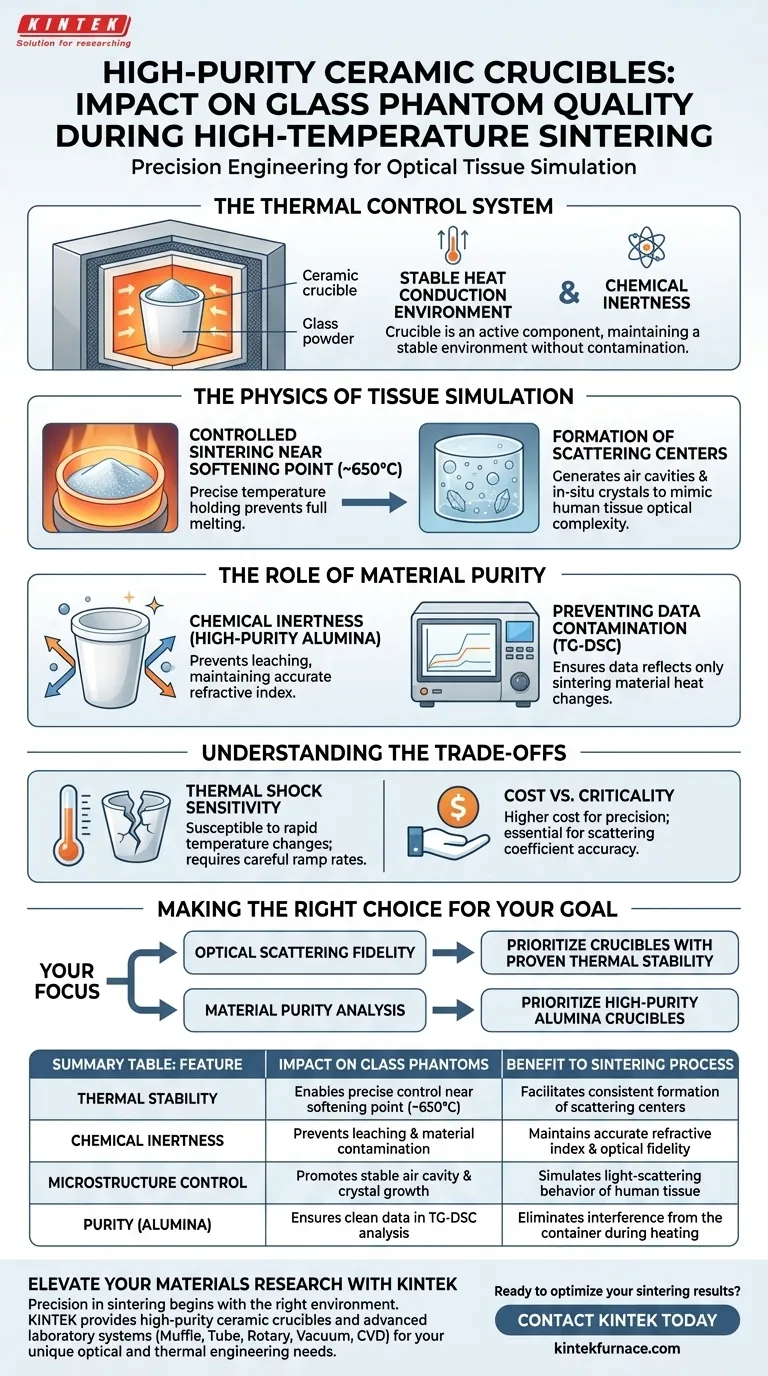
Visual Guide
References
- Mingze Yang, Robert A. McLaughlin. Single and Bi‐Layer Glass‐Based Phantoms: Robust Materials for a Calibration Standard for Fluorescence Imaging Systems. DOI: 10.1002/adpr.202400209
This article is also based on technical information from Kintek Furnace Knowledge Base .
Related Products
- Dental Porcelain Zirconia Sintering Ceramic Vacuum Press Furnace
- Vacuum Dental Porcelain Sintering Furnace for Dental Laboratories
People Also Ask
- What factors determine the quality of sintered zirconia restorations? Master Material, Equipment, and Technique
- How do conventional vs rapid sintering in dental furnaces affect zirconia? Optimize Efficiency Without Sacrificing Strength
- What is the purpose of dental sintering furnaces? Transform Zirconia into Durable, High-Quality Dental Restorations
- What precautions should be taken when sintering zirconia in the Fast Slow Dental Sintering Furnace? Master Key Steps for Perfect Results
- What temperature range is used for sintering zirconia ceramics? Achieve Optimal Strength and Translucency

