
To properly assess a supplier for alumina ceramic furnace tubes, you must evaluate their experience, reputation, quality assurance processes, the availability of technical support, and their track record for timely delivery. A truly reliable supplier not only provides a high-quality product but also offers partnership and support throughout the selection, installation, and operational lifecycle of the tube.
Choosing a supplier for a critical component like an alumina furnace tube is an exercise in risk management. The evaluation goes beyond a simple checklist; it is a deep assessment of the supplier's ability to consistently deliver a product that meets the precise and demanding technical specifications required for your high-temperature application.
Beyond Reputation: Tying Supplier Claims to Technical Reality
A supplier's reputation is a starting point, but it must be backed by verifiable data. Your goal is to confirm that their products possess the specific properties required to survive and perform within your unique operating environment.
Quality Assurance as a Proxy for Consistency
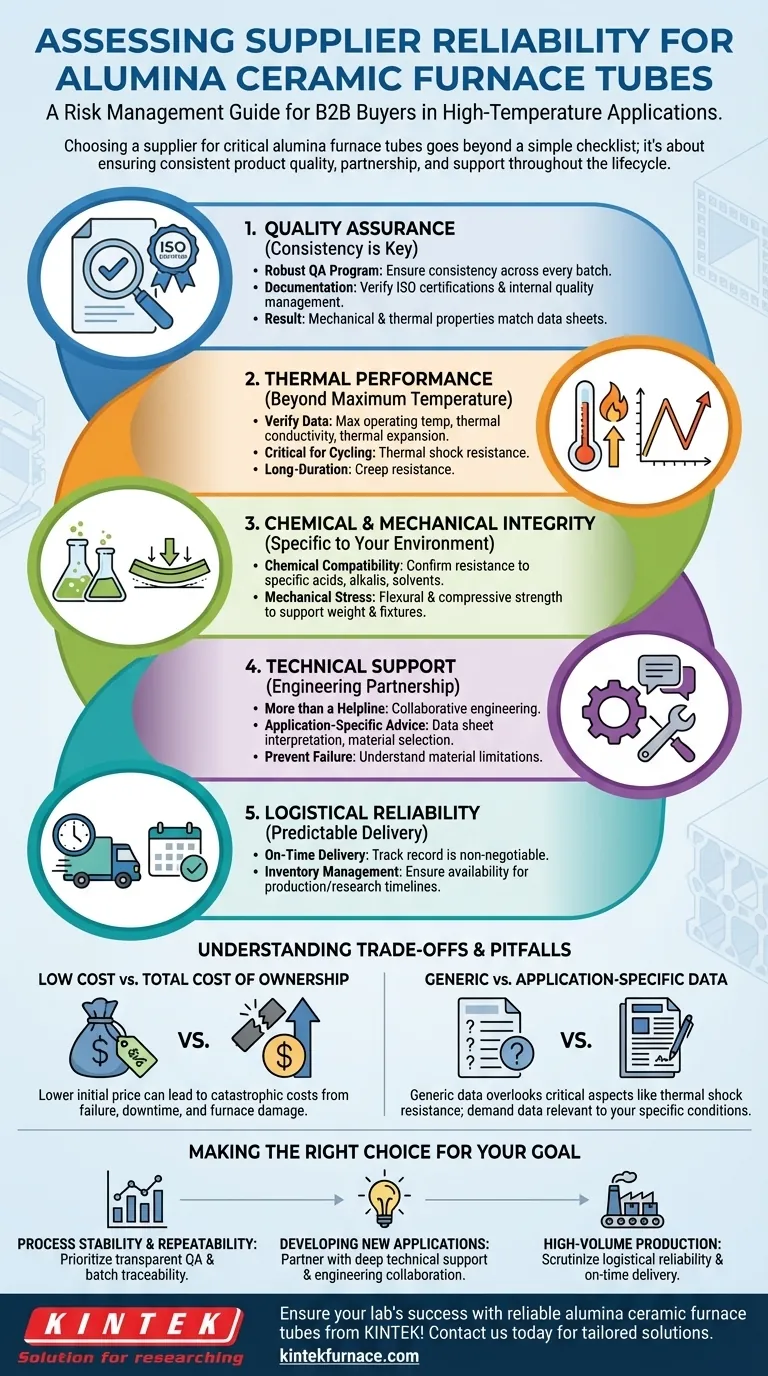
A robust quality assurance (QA) program is the single best indicator of product consistency. Ask for documentation of their QA processes, such as ISO certifications or internal quality management systems.
This ensures that the mechanical and thermal properties claimed in a data sheet are what you will actually receive, not just in one tube, but in every tube from every batch.
Verifying Thermal Performance Claims
The furnace tube must withstand your maximum operating temperature without structural failure. A reliable supplier provides clear data, not just vague assurances.
Look for specific values for maximum operating temperature, thermal conductivity, and thermal expansion coefficient. For applications with temperature cycling, data on thermal shock resistance is critical. For long-duration high-temperature processes, creep resistance is a key indicator of longevity.
Confirming Chemical and Mechanical Integrity
Alumina ceramic has excellent general chemical resistance, but "general" is not specific enough for a critical process. The supplier must be able to confirm compatibility with the specific acids, alkalis, or solvents in your environment.
Similarly, verify the tube's ability to handle mechanical stress. Request data on flexural strength (resistance to bending) and compressive strength to ensure it can support its own weight and any fixtures at high temperatures.
The True Role of Technical Support
Effective technical support is more than a helpline. It is an engineering partnership.
A knowledgeable supplier's technical team will help you interpret their data sheets, understand the material's limitations, and select the ideal tube for your specific application, preventing failure before the component is ever installed.
Understanding the Trade-offs and Common Pitfalls
Choosing a supplier involves balancing competing priorities. Being aware of common pitfalls is essential to avoid costly mistakes.
The Lure of Low Cost vs. Total Cost of Ownership
A lower-priced tube may seem like an easy win, but an unexpected failure can lead to catastrophic costs from process downtime, ruined product, and damage to the furnace itself.
The total cost of ownership includes the initial price plus the cost of potential failure. A slightly more expensive tube from a highly reliable supplier is often the most economical choice.
Generic Specifications vs. Application-Specific Data
Beware of suppliers who only provide generic data. A tube may have a high maximum temperature rating but poor thermal shock resistance, making it unsuitable for a rapid-cycling process.
A trustworthy supplier will work with you to understand your process—heating rates, chemical atmosphere, and mechanical loads—and provide data relevant to those specific conditions.
Overlooking Logistical Reliability
A technically perfect component that arrives late can be just as disruptive as one that fails. Production schedules and research timelines depend on predictable delivery.
Scrutinize a potential supplier's track record for on-time delivery and their inventory management practices. This logistical reliability is a non-negotiable aspect of their overall performance.
Making the Right Choice for Your Goal
Your final decision should be weighted based on your most critical operational priority.
- If your primary focus is process stability and repeatability: Prioritize suppliers with transparent quality assurance systems and detailed, batch-traceable material certifications.
- If your primary focus is developing a new, demanding application: Partner with a supplier offering deep technical support and engineering collaboration to match the right material properties to your unique challenge.
- If your primary focus is maintaining high-volume production: Scrutinize the supplier's track record for on-time delivery, inventory management, and logistical consistency.
Choosing the right supplier is not a procurement task; it is a critical engineering decision that safeguards your entire process.
Summary Table:
| Evaluation Criteria | Key Considerations |
|---|---|
| Quality Assurance | ISO certifications, batch traceability, consistency in mechanical and thermal properties |
| Thermal Performance | Maximum operating temperature, thermal shock resistance, creep resistance |
| Chemical & Mechanical Integrity | Compatibility with acids/alkalis, flexural and compressive strength |
| Technical Support | Engineering partnership, application-specific advice, data interpretation |
| Logistical Reliability | On-time delivery track record, inventory management |
Ensure your lab's success with reliable alumina ceramic furnace tubes from KINTEK! Leveraging exceptional R&D and in-house manufacturing, we provide advanced high-temperature furnace solutions tailored to your needs. Our product line includes Muffle, Tube, Rotary Furnaces, Vacuum & Atmosphere Furnaces, and CVD/PECVD Systems, backed by deep customization capabilities to meet your unique experimental requirements. Don't compromise on quality and support—contact us today to discuss how we can enhance your process stability and efficiency!
Visual Guide
Related Products
- 1400℃ High Temperature Laboratory Tube Furnace with Alumina Tube
- 1700℃ High Temperature Laboratory Tube Furnace with Alumina Tube
- Vacuum Heat Treat Furnace with Ceramic Fiber Liner
- Vertical Laboratory Quartz Tube Furnace Tubular Furnace
- Magnesium Extraction and Purification Condensing Tube Furnace
People Also Ask
- How do high-temperature laboratory tube furnaces ensure environmental stability? Precision Thermal Reduction Tips
- How are high-temperature laboratory tube furnaces applied in long-term vacuum homogenization heat treatments for intermetallic samples?
- How are high-temperature tube furnaces applied in testing ceramic-supported alloy membranes? Insights
- What is the mechanism of a high-temperature furnace in Bi-2223 sintering? Achieve Precision Phase Transformation
- What is the function of a furnace in CuAlMn alloy treatment? Achieve Perfect Microstructural Homogenization


















